
This guide covers what a sanitary sight glass is, how it differs from industrial sight glasses, its key design features, available types, and how to select the right one for your regulated process.
TLDR:
- Sanitary sight glasses provide real-time visual monitoring of flow, clarity, and CIP rinse without breaking sterility or stopping production
- True sanitary design requires crevice-free construction, 0.8 µm surface finish, and FDA/3-A/USDA compliance—not just polished stainless
- Borosilicate glass handles CIP/SIP cycles to 500°C; acrylic is limited to 150°F for ambient applications
- Gasket material determines operating limits: EPDM for dairy, PTFE for universal chemical resistance, FKM/Viton for solvents
- Tri-clamp connections dominate in food/pharma due to tool-free assembly and validated cleanability
What Is a Sanitary Sight Glass?
A sanitary sight glass is a sealed, transparent viewing component installed inline on pipelines or vessels. It lets operators monitor process flow, product clarity, color, phase separation, or CIP rinse effectiveness without opening the system or interrupting production. Unlike a simple window, it's precision-engineered to maintain sterility while giving continuous visual access to process conditions.
What Makes a Sight Glass "Sanitary"?
The difference between a sanitary sight glass and a standard industrial one goes well beyond appearance. Industrial sight glasses used in oil, gas, and chemical plants are engineered for containment and pressure handling — full stop.
Sanitary sight glasses are built for verifiable sterility and cleanability, meeting regulatory requirements for biofilm prevention and bacterial control. Every surface, seal, and connection point is designed to be fully cleanable in place.
3-A Sanitary Standard 65-01: "Sight and/or Light Windows and Sight Indicators in Contact with Product" sets the baseline requirements for hygienic design. You'll also see this component listed under alternative names — "sight flow indicator," "inspection window," and "viewing glass" — depending on the supplier or industry context.
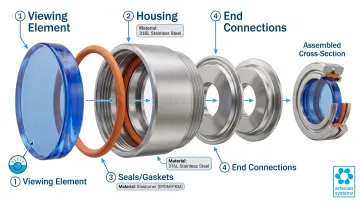
Basic Anatomy of a Sanitary Sight Glass:
A complete assembly consists of four integrated components:
- Viewing element: Borosilicate glass for high-temp/chemical resistance, or polycarbonate for impact tolerance
- Housing: 316L stainless steel with electropolished or mechanically polished internal surfaces
- Seals: FDA-compliant elastomers — EPDM, silicone, PTFE, or FKM/Viton — selected by media compatibility
- End connections: Tri-clamp ferrules, weld-ends, or flanges with crevice-free geometry
The assembly creates a flush, full-bore flow path with no gaps where product can pool or bacteria can colonize.
Key Design Features That Make It "Sanitary"
Superior Materials for Hygienic Processing
316L Stainless Steel Body
The housing is machined from 316L stainless steel, chosen for superior corrosion resistance against both process media (acids, caustics, solvents) and the aggressive chemicals used in CIP cleaning cycles. Unlike 304 stainless, 316L contains molybdenum for enhanced resistance to chloride pitting and crevice corrosion, which matters when equipment faces daily exposure to hypochlorite sanitizers and acidic rinses.
Borosilicate Glass vs. Acrylic Viewing Elements
Borosilicate glass is the pharmaceutical-grade standard, meeting USP Type 1 neutral glass classification. It withstands temperatures up to 500°C (932°F) with a coefficient of thermal expansion of just 43 × 10⁻⁷/°C, providing exceptional thermal shock resistance. Chemically inert and non-porous, it resists attack from aqueous solutions, acids, and most solvents.
Acrylic (PMMA or polycarbonate) is a lower-cost option for ambient-temperature applications, limited to approximately 145°C (293°F). Its higher thermal expansion coefficient (650 × 10⁻⁷/°C) makes it unsuitable for CIP/SIP cycles, though it offers superior impact resistance in high-traffic installations.
FDA-Compliant Gasket Materials
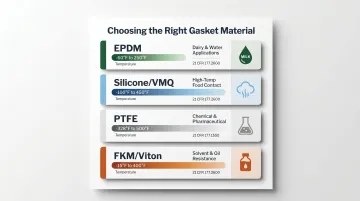
Every seal must comply with FDA 21 CFR 177.2600 (rubber articles for repeated food contact) or 21 CFR 177.1550 (perfluorocarbon resins/PTFE). Material selection depends on process chemistry:
| Gasket Material | Temperature Range | Best For | FDA Compliance |
|---|---|---|---|
| EPDM | -50°C to 150°C | Water, dairy, mild acids/alkalis | 21 CFR 177.2600 |
| Silicone (VMQ) | -60°C to 200°C | Wide temperature range, fats/oils | 21 CFR 177.2600 |
| PTFE | -100°C to 250°C | Universal chemical resistance | 21 CFR 177.1550 |
| FKM/Viton | -30°C to 200°C | Solvents, acids, hydrocarbons | 21 CFR 177.2600 |
Crevice-Free, No-Dead-Leg Design
This is the most critical hygiene feature. The glass element seals against the stainless steel body to create a perfectly smooth, continuous internal bore with zero gaps, threads, or recesses where product can stagnate and bacteria can form biofilm.
Contrast this with threaded NPT industrial fittings, which trap product in spiral crevices and are impossible to validate as clean. A true sanitary sight glass eliminates dead legs, meaning any holdup volume that doesn't fully drain during CIP cycles.
This design principle is a core requirement under 3-A Sanitary Standards and directly addresses the primary contamination vector in food and pharmaceutical processing: bacterial colonization in uncleanable geometries.
High-Polish Internal Surface Finish
Internal surfaces are mechanically or electropolished to a roughness average (Ra) of 0.8 micrometers (32 microinches) or smoother. Research shows that surfaces exceeding 0.95 µm Ra promote increased biofilm formation in S. aureus and E. coli, while the 0.8 µm standard provides effective microbial control.
A smoother finish reduces microscopic footholds for bacterial attachment and ensures CIP detergents can reach and remove residues. Electropolishing also passivates the stainless steel, creating a chromium oxide layer that further enhances corrosion resistance.
CIP/SIP Compatibility
A true sanitary sight glass must survive Clean-In-Place and Sterilize-In-Place protocols without degradation. Standard CIP cycles in dairy and beverage processing include:
- Caustic wash: 140–185°F with 0.5–2.0% sodium hydroxide
- Acid rinse: 130–150°F with 0.5% nitric acid
- Sanitizing rinse: hypochlorite or peracetic acid solutions
The sight glass assembly (glass, metal, and gasket) must tolerate these temperatures, chemicals, and rapid thermal cycling repeatedly without cracking, delaminating, or leaching contaminants. This is why borosilicate glass dominates pharmaceutical and dairy applications, while acrylic is restricted to lower-temperature food processing.
Compliance Standards and Certifications
Buyers in regulated industries should verify:
- 3-A Sanitary Standards: Standard 65-01 governs sight glasses specifically
- FDA 21 CFR compliance: Materials must meet 21 CFR 177.2600 (rubber) and 177.1550 (PTFE)
- USDA acceptance: Required for meat and poultry processing, validated every four years
Artesian Systems sources and manufactures components to these exact standards — 3-A approved, USDA compliant, and FDA 21CFR177.2600/1550 certified materials — simplifying audits and procurement for facilities operating under GMP, HACCP, or FSMA regulations.
Types of Sanitary Sight Glasses
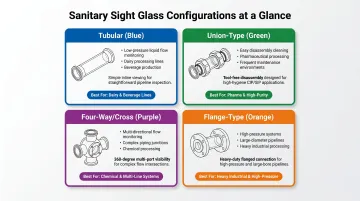
Sanitary sight glasses come in four main configurations, each suited to different process conditions and installation requirements. Understanding the differences helps you select the right unit for your line.
Tubular (Inline) Sight Glass
A cylindrical glass tube housed within a stainless steel spool, integrated directly into the pipeline. Provides 360-degree visibility of the process stream, ideal for monitoring:
- Flow rate and turbulence
- Liquid clarity and color
- Foam formation or air entrainment
- Product consistency in real time
Suited for both horizontal and vertical installations. Optional protective wire cages add impact resistance in high-traffic areas or high-pressure applications.
Best for: General flow monitoring in dairy, beverage, brewing, and food processing lines.
Artesian Systems' tubular sight glasses are available in sizes from 1.5" to 6", rated to 150 PSI and -40°C to 500°C using borosilicate glass.
Union-Type Sight Glass
Designed for tool-free disassembly and reassembly, making it ideal for processes requiring frequent inspection, cleaning verification, or glass replacement. Often equipped with optional accessories:
- Integrated LED lighting for visibility in low-light or enclosed process skids
- Wiper or scraper blades to keep the viewing surface clear when processing viscous, sticky, or opaque media
Best for: Systems requiring regular maintenance access, or where product buildup on the glass is a concern (sauces, syrups, emulsions).
Four-Way (Cross) Sight Glass
A cross-shaped assembly that allows simultaneous visibility from two perpendicular directions. This is useful in complex piping layouts where lines converge, diverge, or intersect — giving you multi-angle flow observation without installing multiple inline units.
Best for: Mixing systems, blending manifolds, or Y-branch configurations where flow needs to be monitored from multiple perspectives.
Flange-Type Sight Glass
The most robust configuration, with flanged end connections that provide a high-integrity seal for demanding conditions. Designed for:
- Higher operating pressures and temperatures
- Applications requiring ASME B16.5 flanged connections
- Integration into existing flanged piping systems
Available with the same lighting and wiper accessories as union-type models. While more common in chemical processing, sanitary flange-type variants meet 3-A and FDA standards for food and pharmaceutical use.
Best for: High-pressure systems, chemical processing, or installations requiring flanged connections for structural or regulatory reasons.
Once you've identified the right configuration, the next decision involves materials — specifically the glass type and body construction that can handle your process conditions.
Industries and Applications
Food, Beverage, Dairy, and Brewing
Sanitary sight glasses serve as visual control points throughout hygienic processing:
- Brewing: Monitor wort clarity, boil intensity, and fermentation activity in craft beer production
- Dairy: Confirm CIP rinse water runs clear before resuming production, verify homogenization in milk processing
- Sauces and juices: Observe pigment distribution, viscosity, and clarity during mixing and pasteurization
- Transfer lines: Detect air entrainment, phase separation, or contamination in food-grade ingredient handling
Visual checkpoints reduce batch failures and contamination events—critical when label errors and contamination cost the industry $1.92 billion in 2024 recall costs.
Pharmaceutical, Biotech, and Medical Device Manufacturing
In sterile and aseptic processing, visual confirmation of process states is required without breaking sterility:
- WFI (Water for Injection) systems: Detect rouge, biofilm, solids, and gas bubbles in real time, ensuring compliance with USP 788/1788 particulate standards
- Bioreactor lines: Observe culture growth, gas sparging, and mixing without opening the vessel
- Buffer prep and transfer: Verify clarity, color, and flow in purified water and buffer systems
3-A and FDA compliance is a baseline requirement in these applications—built into validation protocols and regulatory acceptance criteria. As biologics manufacturing expands, process observation equipment has become a core part of quality documentation and batch release workflows.
Specialty and Emerging Industries
Cannabis and Hemp Extraction
Sanitary sight glasses allow operators to observe extraction solvent flow, evaluate product color and clarity, and confirm separation in environments involving ethanol, butane, or CO₂. Material compatibility is critical here: borosilicate glass with FKM/Viton or PTFE gaskets resists solvent attack and maintains seal integrity under pressure cycling.
Artesian Systems has developed process systems specifically for hemp oil extraction, including documented methods for removing THC molecules without compromising product integrity—experience that directly informs material and configuration recommendations for solvent-based lines.
Nutraceutical and Cosmetic Production
Visual monitoring of pigments, emulsions, and suspensions ensures batch-to-batch consistency in products where appearance directly affects market acceptance. Sight glasses installed at mixing and transfer points give operators an immediate read on homogeneity and color development without sampling.
How to Choose the Right Sanitary Sight Glass
Selecting the right sight glass comes down to four variables: line size, pressure/temperature limits, material compatibility, and regulatory compliance. Get these right and you'll have a component that performs cleanly for years.
Match Line Size and Connection Type
The sight glass bore must match your pipeline's outer diameter to maintain a flush, full-port flow path. Common sizes run from 1.5" to 6" (DN40 to DN150). Artesian Systems manufactures sight glasses across this full range with tri-clamp connections, covering the majority of sanitary process lines.
Connection type determines both cleanability and maintenance burden:
- Tri-clamp: Tool-free, crevice-free assembly — the standard choice in food and pharma for validated cleanability
- Weld-end: Permanent installation for high-integrity, fixed-piping systems
- Flanged: Use when integrating into existing ASME B16.5 flanged infrastructure
- Threaded: Avoid — crevice formation makes it incompatible with sanitary standards
Verify Pressure and Temperature Ratings
Confirm that the sight glass, clamp, and gasket combination meets your peak operating conditions, including CIP temperatures and line pressures.
| Property | Borosilicate | Polycarbonate |
|---|---|---|
| Max Pressure | 150 PSI | 150 PSI |
| Temperature Range | -40°C to 500°C | Up to 65°C (150°F) |
| CIP/SIP Compatible | Yes | CIP only (no SIP) |
| Caustic Resistance | High | Low |

The gasket is typically the limiting factor. EPDM handles CIP cycles to 150°C, while PTFE extends to 250°C for steam-sterilization applications.
Choose the Right Glass and Gasket Materials
Borosilicate is the default choice for most applications — it handles thermal shock, resists CIP chemicals, and is fully SIP-compatible. Polycarbonate works for low-temperature, ambient-pressure observation but degrades with caustic cleaners and cannot withstand steam sterilization.
Gasket selection depends on your process fluid and cleaning regime:
- EPDM: Water, dairy, mild acids/alkalis — suitable for CIP cycles below 150°C
- Silicone (VMQ): Fats, oils, and wide temperature swings (-60°C to 200°C)
- PTFE: Universal chemical resistance; use for steam, aggressive solvents, or highly acidic media
- FKM/Viton: Solvents, acids, and hydrocarbons — not compatible with steam or ketones
All materials should comply with FDA 21 CFR 177.2600 or 177.1550.
Confirm Regulatory Compliance and Certification
If operating in a regulated environment, verify:
- 3-A Sanitary Standards symbol (Standard 65-01 for sight glasses)
- FDA 21 CFR 177.2600/1550 compliance for gasket materials
- USDA acceptance (if applicable to meat/poultry processing)
- Surface finish documentation (Ra ≤ 0.8 µm average surface roughness)
Artesian Systems stocks sight glasses with documented 3-A, USDA, and FDA 21 CFR compliance — so material certifications are available at the time of order, not sourced after the fact during an audit.
Frequently Asked Questions
What is the purpose of a sight glass?
A sight glass provides operators with a real-time visual window into a pipeline or vessel to monitor flow, product clarity, color, phase changes, or CIP rinse effectiveness—all without opening the system or interrupting production.
What is another name for a sight glass?
Depending on the application and industry, a sight glass may be called a sight flow indicator, inspection window, or viewing glass.
Is borosilicate glass toxic free?
Borosilicate glass is chemically inert, non-toxic, and safe for food, pharmaceutical, and other hygienic processing applications. That chemical stability makes it the default viewing material in sanitary sight glasses.
What is the difference between a sanitary sight glass and an industrial sight glass?
Sanitary sight glasses are designed with crevice-free interiors, polished surfaces (Ra ≤ 0.8 µm), FDA-compliant seals, and CIP/SIP compatibility for cleanability. Industrial sight glasses prioritize pressure and temperature containment without hygienic design requirements, making them unsuitable for food or pharma lines.
What gasket materials are compatible with sanitary sight glasses?
The most common FDA-compliant choices are EPDM, silicone, PTFE, and FKM/Viton — each suited to different fluids, temperatures, and cleaning chemicals. Match the gasket to your specific process media and CIP regime for best results.
How do you clean a sanitary sight glass?
Most sanitary sight glasses are fully CIP-compatible and handle standard caustic and acid cleaning cycles without disassembly. Union-type models can also be taken apart quickly for manual inspection when needed.