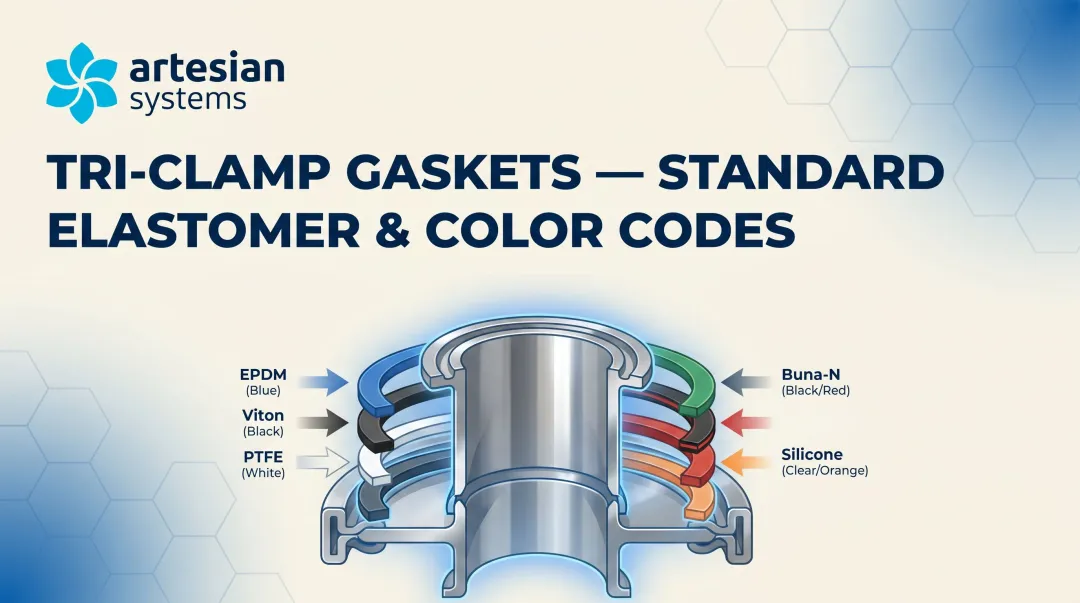

The confusion stems from a quirk in sanitary fitting conventions. The stated size refers to the tube outer diameter, not the flange. A 1.5" system uses tubing with a 1.5" OD, but the ferrule flange measures 1.984". Add to this the fact that two pairs of tube sizes share identical ferrules (½" and ¾" share one; 1" and 1.5" share another), and the potential for ordering errors multiplies.
This guide eliminates that confusion. We'll decode every dimension, explain how to measure what you see in the field, and walk through gasket and clamp selection so your next order arrives correct the first time.
Key Takeaways
- Tri-clamp size = tube OD, not ferrule flange OD—the flange is always ~½" larger
- Compatible sizes share a flange OD: ½" and ¾" tube both use a 0.984" flange, while 1" and 1.5" tube both use a 1.984" flange
- Always use the larger gasket when joining compatible different-size tubes
- Clamp style (single hinge vs. high-pressure bolted) is separate from size and dramatically affects pressure rating
- Measure the flange OD and cross-reference the sizing chart to confirm any unknown size
What Tri Clamp Dimensions Actually Mean
The "size" designation—1.5", 2", 3"—refers to the outer diameter of the tubing the fitting connects to, not the ferrule flange diameter. This causes the single most common ordering error in the industry.
The Three Critical Dimensions
Every tri-clamp connection involves three measurements:
| Dimension | What It Is | How You Use It |
|---|---|---|
| Tube OD (A) | Nominal size designation (e.g., 1.5") | What you specify when ordering |
| Flange OD (B) | Physical diameter of the ferrule face (~½" larger than tube OD) | What you measure on an existing fitting |
| Tube ID (C) | Inner diameter of the tube | Used for flow/hydraulic calculations, not fitting selection |
The Shared-Flange Phenomenon
Two size pairs create compatibility—and confusion:
- ½" and ¾" tube OD both produce a 0.984" flange (use a ¾" clamp)
- 1" and 1.5" tube OD both produce a 1.984" flange (use a 1.5" clamp)
This means a 1" sanitary spool uses 1.5" ferrules and gaskets. When connecting a 1" tube to a 1.5" tube, they clamp together directly—but you must use the 1.5" gasket to avoid an unsanitary gap on the larger ferrule face.
Why This Convention Exists
Sanitary fittings follow ASME BPE and 3-A standards that standardize ferrule flange dimensions per clamp size, so fittings from different manufacturers mate correctly. The tube OD convention emerged because sanitary systems are designed around pipe schedules—engineers specify tube size during design, and fittings follow.
Mismatching sizes doesn't just risk leaks. It creates sanitary dead zones where product stagnates and cleaning solutions can't reach: a direct violation that can shut down 3-A and FDA-compliant operations.
Tri Clamp Size Chart and Dimension Reference
This table cross-references tube OD, flange OD, and tube ID for all standard sizes. Use it to translate measurements into correct orders.
| Clamp Size | Tube OD (A) | Flange OD (B) | Tube ID (C) |
|---|---|---|---|
| ¾" | 0.500" (½") | 0.984" | 0.370" |
| ¾" | 0.750" (¾") | 0.984" | 0.620" |
| 1.5" | 1.000" (1") | 1.984" | 0.870" |
| 1.5" | 1.500" (1.5") | 1.984" | 1.370" |
| 2" | 2.000" | 2.516" | 1.870" |
| 2.5" | 2.500" | 3.047" | 2.370" |
| 3" | 3.000" | 3.579" | 2.870" |
| 4" | 4.000" | 4.682" | 3.834" |
| 6" | 6.000" | 6.562" | 5.782" |
| 8" | 8.000" | 8.602" | 7.782" |
| 10" | 10.000" | 10.570" | 9.782" |
| 12" | 12.000" | 12.570" | 11.760" |
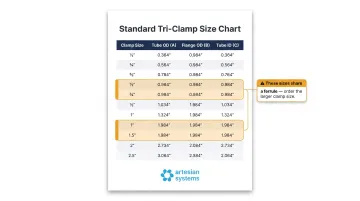
Source: SanitaryFittings.us dimensional data
Mini Tri-Clamp Sizes (½" and ¾")
These share the same 0.984" flange and use a ¾" clamp. You'll find them in:
- Sample ports and instrumentation taps
- Low-flow process lines
- Laboratory-scale systems
- Drain valves and sight glasses
Artesian Systems manufactures specialty gaskets for these fractional sizes, including screen gaskets with fully recessed designs that maintain sanitary compliance in compact installations.
The 1"/1.5" Shared Ferrule
Both sizes use a 1.984" flange and require a 1.5" clamp. The distinction: tube ID. A 1" tube has a 0.870" ID; a 1.5" tube has a 1.370" ID.
When you order a 1" sanitary spool, it arrives with 1.5" ferrules. If you ordered 1" gaskets thinking "1" fitting = 1" gasket," they'll leave a gap on the ferrule face—a compliance violation and contamination risk.
Workhorse Sizes (2"–4")
These dominate food, beverage, pharmaceutical, and extraction systems. Unlike the shared-ferrule sizes above, each tube OD here has its own unique flange OD—so the clamp size you order maps directly to the tube size:
- 2" tube → 2.516" flange
- 2.5" tube → 3.047" flange
- 3" tube → 3.579" flange
- 4" tube → 4.682" flange
No ambiguity, no shared ferrules. What you order is what connects.
Large-Format Sizes (6"–12")
Used for high-volume transfer lines and production-scale systems. Two cautions:
- Pressure ratings drop significantly—a 1.5" single-hinge clamp rates to 500 PSI at 70°F; a 12" clamp rates to just 30 PSI
- Clamp style becomes critical—at larger sizes, you'll typically need to switch to bolted or multi-bolt clamps to hold rated pressure
How to Identify Your Tri Clamp Size in the Field
Method 1: Measure Tube OD Directly (Most Accurate)
If the tube is accessible:
- Place calipers across the tube outer diameter
- Record the measurement
- This is your clamp size designation
Method 2: Measure Flange OD and Cross-Reference
When no tube is present (end caps, valves, standalone adapters):
- Measure the ferrule flange outer diameter with calipers
- Use this quick-reference table:
| Measured Flange OD | Clamp Size to Order | Compatible Tube OD |
|---|---|---|
| ~0.984" | ¾" | ½" or ¾" |
| ~1.984" | 1.5" | 1" or 1.5" |
| ~2.516" | 2" | 2" |
| ~3.047" | 2.5" | 2.5" |
| ~3.579" | 3" | 3" |
| ~4.682" | 4" | 4" |
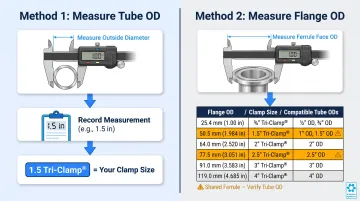
Two clamp sizes — ¾" and 1.5" — each accept two different tube ODs. When you land on either of those flange measurements, measure the tube ID to confirm which size you need. A 0.984" flange with a 0.370" ID = ½" tube; a 0.620" ID = ¾" tube.
Once you've confirmed your clamp and tube size, the same logic applies to gaskets — the OD you measure won't match the nominal size printed on the label.
Measuring a Gasket for Sizing
Measure the gasket's outer diameter. This should match the flange OD of your connection. A correctly sized gasket for a 2" connection measures 2.516" OD—not 2".
Warning signs of wrong gasket size:
- Too small: Gap visible between gasket edge and ferrule outer rim—creates dead space
- Too large: Gasket extends beyond ferrule, won't seat properly, may extrude into flow path
Gasket Sizing and Material Selection
The Fundamental Rule: Match Connection Size, Not Tube Size
Select gasket size to match the tri-clamp connection size (which equals tube OD). When joining identical-size tubes, this is straightforward: 2" tube to 2" tube = 2" gasket.
Joining Compatible Different-Size Tubes
When connecting tubes that share a ferrule (½" to ¾", or 1" to 1.5"), always use the larger gasket size.
Example: Connecting 1" tubing to 1.5" tubing:
- Correct: Use a 1.5" gasket
- Wrong: Using a 1" gasket leaves an exposed ring on the 1.5" ferrule face—an unsanitary gap that violates 3-A standards
Gasket Material Selection by Application
| Material | Temperature Range | Best For | Avoid With |
|---|---|---|---|
| Silicone | -40°F to 450°F | Food, beverage, general sanitary service | Harsh CIP chemicals |
| EPDM | -30°F to 300°F | Steam, water, dairies, breweries | Fats, oils, petroleum products |
| PTFE (Teflon) | -100°F to 500°F | Aggressive solvents, pharmaceutical, chemical processing | High-pressure applications (prone to cold flow) |
| FKM/Viton | -30°F to 400°F | Extraction, oils, fuels, solvents, high-temp chemical service | (Excellent chemical resistance—no common exclusions) |
| Buna-N (Nitrile) | -30°F to 200°F | Oils, fuels, hydrocarbons | Ozone, sunlight, ketones, acids |
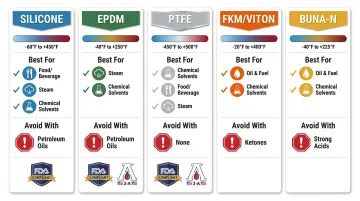
Sources: Dixon Valve specifications, Rubber Fab temperature data
Regulatory Compliance for Gasket Materials
For FDA-regulated and 3-A sanitary applications, gasket materials must meet:
- FDA 21 CFR 177.2600 (rubber articles for repeated food contact)
- FDA 21 CFR 177.1550 (PTFE resins for food contact)
- 3-A Sanitary Standard 18-03 (rubber materials in food equipment)
Artesian Systems manufactures sanitary gaskets in PTFE, EPDM, FKM/Viton, and Buna-N to these specifications, with compliance documentation available per SKU. Sizes cover 1.5" through 12", including specialty screen gasket configurations in 5-, 20-, and 100-micron ratings for inline filtration applications.
Clamp Style Selection and Pressure Ratings
Pressure ratings depend on both size and clamp style. Understanding the three main types helps you match the right hardware to your application.
Three Main Clamp Types
Single Hinge (2-Segment, Wing Nut):
- Most common for general sanitary service
- One hinge pin, one wing nut closure
- Cost-effective and quick-release
- Lower pressure rating than bolted clamps
Double Hinge (2- or 3-Segment):
- Two hinge points for easier installation in tight spaces
- Heavier duty than single hinge
- Maintains quick-release convenience
High-Pressure Bolted (2-Segment, Hex Bolt):
- No hinge; secured with bolt, lock washer, and nut
- Rated 3-5× higher pressure than single hinge
- Designed for permanent or semi-permanent installations
- Recommended for temperatures above 250°F
Pressure Ratings: Size and Temperature Matter
Pressure ratings drop as clamp size increases and temperature rises.
Single Hinge Clamp Ratings:
| Size | Max PSI at 70°F | Max PSI at 250°F |
|---|---|---|
| ½"–¾" | 1,500 | 1,200 |
| 1"–1.5" | 500 | 300 |
| 2" | 450 | 300 |
| 3" | 350 | 195 |
| 4" | 300 | 150 |
| 6" | 150 | 75 |
| 12" | 30 | 25 |
High-Pressure Bolted Clamp Ratings:
| Size | Max PSI at 70°F | Max PSI at 250°F |
|---|---|---|
| ½"–¾" | 1,500 | 1,200 |
| 1"–1.5" | 1,000 | 800 |
| 2" | 1,000 | 800 |
| 3" | 1,000 | 800 |
| 4" | 800 | 600 |
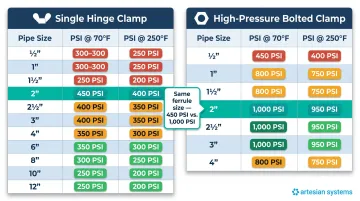
In practice: A 2" single hinge clamp rates to 450 PSI at 70°F; a 2" bolted clamp rates to 1,000 PSI. Same ferrule size, more than double the pressure capacity.
Installation note: These ratings assume proper torque (wing nuts to 25 in-lb; bolted hex nuts to 20 ft-lb), elastomer gaskets, and aligned ferrules. PTFE gaskets reduce pressure ratings due to cold flow.
Common Tri Clamp Sizing Mistakes and How to Avoid Them
Mistake 1: Ordering by Flange Measurement
The most common buyer error: measuring a 1.5" fitting's ~2" flange and ordering a 2" clamp.
Fix: Always identify tube OD first. If only the flange is measurable, use the cross-reference table—a 1.984" flange = 1.5" clamp, not 2".
Mistake 2: Wrong Gasket for Mixed-Size Connections
Connecting 1" to 1.5" tubing (which share a ferrule) using a 1" gasket creates an unsanitary "dam" on the 1.5" side that restricts flow and traps product.
Fix: Always use the larger gasket size in mixed connections. Same rule applies to ½" and ¾" combinations.
Mistake 3: Assuming All Manufacturers Are Identical
While ASME BPE and 3-A standards govern nominal dimensions, manufacturing tolerances vary. This matters in high-pressure or sterile pharmaceutical systems where a failed seal can contaminate an entire batch.
Fix: Source from consistent, standards-compliant suppliers—especially for regulated applications. Artesian Systems' tri-clamp gaskets, screen filters, and sight glasses are manufactured to 3-A, USDA, and FDA 21CFR177.2600/1550 specifications—useful when procurement or QA teams need to trace material compliance back to a specific component.
Quick reference — the three rules to remember:
- Use tube OD, not flange diameter, to identify clamp size
- Always select the larger gasket when connecting two different tube sizes
- Buy from suppliers with verifiable standards compliance, particularly for food and pharma applications
Frequently Asked Questions
How are tri clamps sized?
Tri-clamp size refers to the outer diameter of the tubing the fitting connects to—not the flange diameter. The flange is approximately ½" larger, so a 1.5" tri-clamp fitting has a flange measuring ~1.984" across.
How to measure a tri clamp gasket?
Measure the gasket's outer diameter with calipers. This should match the ferrule flange OD of your connection. A gasket sized for a 2" connection measures 2.516" OD—matching the 2" tube's flange, not the tube itself.
Are tri clover and tri clamp the same?
Yes. Tri-Clover was the original brand name (trademarked in 1955 by Ladish Co., now owned by Alfa Laval). "Tri-clamp" became the generic industry term. The fittings are dimensionally interchangeable regardless of manufacturer.
Can I connect different tri clamp sizes together?
Certain size pairs share ferrules (½" & ¾"; 1" & 1.5") and clamp together directly. Other combinations (2" to 3", etc.) require a reducer fitting. When connecting compatible sizes, always use the larger gasket to avoid an unsanitary gap.
What gasket material should I use for my tri clamp application?
Silicone suits food, beverage, and general sanitary use; PTFE or FKM/Viton handles aggressive solvents, high temperatures, and pharmaceutical applications; EPDM works well for steam and aqueous systems. For regulated industries, all materials must meet FDA 21 CFR 177.2600/1550 and 3-A standards.
What is the difference between a single hinge and a high-pressure tri clamp?
Single hinge clamps are quick-release designs for frequent disassembly. High-pressure bolted clamps (hex bolt and nut) deliver higher pressure ratings: 1,000 PSI vs. 450 PSI for a 2" connection at 70°F. They're the better choice for permanent installations or high-pressure service.