Introduction
Most engineers searching "tri-clamp vs. sanitary fittings" are working from a false premise—tri-clamp is a type of sanitary fitting, not a separate category competing against it. The confusion is understandable, but it leads to the wrong question. The real comparison is tri-clamp versus other sanitary connection types: welded, DIN, I-Line, and bevel seat designs.
That distinction matters operationally. Choosing the wrong connection type affects cleaning cycles, downtime, contamination risk, and regulatory compliance across food, pharmaceutical, hemp extraction, and chemical processing environments. A dairy line requiring daily CIP cycles demands different fittings than a pharmaceutical reactor running continuous SIP sterilization.
This guide breaks down each sanitary connection type, compares their strengths and limitations, and gives you a clear framework for selecting the right fitting for your process requirements.
Key Takeaways
- Tri-clamp fittings represent the majority of sanitary fittings sold in the U.S., making them the dominant connection type across food, beverage, and pharma processing
- Sanitary fittings include tri-clamp, welded/butt-weld, DIN, I-Line, and bevel seat, each suited to different process and regulatory requirements
- Tri-clamp excels where frequent disassembly, CIP cleaning, or reconfiguration is required; welded fittings suit permanent high-pressure systems
- Your choice depends on cleaning frequency, pressure/temperature demands, regulatory requirements, and long-term system flexibility
What Are Sanitary Fittings?
Sanitary fittings are specialized connectors engineered to prevent bacterial contamination in sensitive processing environments. Unlike standard industrial fittings, they eliminate threads, pockets, tight bends, and rough internal surfaces where bacteria can harbor and multiply.
Key design difference: Surface finish roughness average (Ra). Pharmaceutical applications require approximately 20 Ra (0.5 µm), while food and beverage typically specify 30-32 Ra (0.8 µm). These microscopic surface measurements matter—peaks and valleys in stainless steel create harborage points where microbes survive cleaning cycles.
Main sanitary fitting types:
- Tri-Clamp (Tri-Clover): Quick-connect ferrule design with external clamp
- Butt-Weld: Permanent fusion connection via orbital or TIG welding
- DIN 11851: European threaded nut connection with metric sizing
- DIN 32676: European clamp connection (metric alternative to tri-clamp)
- I-Line: Self-aligning male/female ferrule for high-pressure applications
- Bevel Seat: 45-degree metal-to-metal seal, common in legacy dairy systems
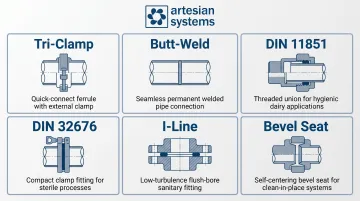
Tri-clamp dominates the U.S. market at roughly 67% of fittings sold (industry estimate), while DIN connections are standard across European food and beverage facilities.
Compliance Standards Governing Sanitary Fittings
3-A Sanitary Standards mandate a maximum Ra of 0.8 µm for all food-contact surfaces. ASME BPE (Bioprocessing Equipment) imposes tighter requirements for pharmaceutical use: SF1 at 20 Ra (mechanical polish) and SF4 at 15 Ra (electropolished finish).
Gasket and material standards break down by application:
- FDA 21 CFR 177.2600: Governs elastomeric gaskets (EPDM, FKM, Buna-N, Silicone) for repeated food contact
- FDA 21 CFR 177.1550: Covers PTFE gasket materials for food-contact use
- USDA guidelines: Require CIP fittings to be self-centering with flush interior gasket surfaces; mating surface offsets cannot exceed ±1/32 inch
- USP Class VI: Ensures pharmaceutical-grade gaskets meet in vivo biological reactivity requirements—critical for biotech and sterile fluid processing
These standards translate directly into where and how sanitary fittings are deployed across process industries.
Use Cases of Sanitary Fittings
Sanitary fittings appear throughout process pipelines:
- Milk transfer lines and pasteurization in dairy processing
- Sterile fluid paths in biopharmaceutical manufacturing
- Inline filtration in hemp and cannabis extraction systems
- High-purity water treatment and distribution
CIP (Clean-in-Place) and SIP (Sterilize-in-Place) systems drive sanitary fitting adoption. Proper fitting design enables automated sanitation without dismantling equipment—reducing downtime from hours to minutes and eliminating manual cleaning's contamination risk. CIP systems are required under FDA Title 21 for food and pharmaceutical manufacturing, making sanitary connection design a regulatory imperative rather than an operational preference.
What Are Tri-Clamp Fittings?
Tri-clamp fittings—also called Tri-Clover fittings after the Tri-Clover Machine Co. that developed them in 1919—are quick-connect sanitary fittings consisting of three components:
- Two ferrules (flanged pipe ends with polished faces)
- One gasket (food or pharma-grade seal material)
- One clamp (hinged band with closure mechanism)
The ferrules mate face-to-face with the gasket seated between them. The clamp wraps around both ferrule flanges and hand-tightens to create a leak-free, sanitary seal.
Alfa Laval Corporate AB holds the current trademark, having absorbed the brand through acquisition in 1991. Their Tri-Clover product line continues under the same fitting standard today.
How Tri-Clamp Fittings Are Measured
Tri-clamp fittings are measured by the outer diameter (OD) of the tubing they connect, not the clamp or flange size. A critical sizing nuance: 1" and 1.5" tube sizes share the same ferrule flange OD (1.984"), so they use the same clamp—only the inner diameter differs, affecting flow rate.
Simplified Sizing Reference:
| Tube Size | Tube OD | Ferrule Flange OD | Clamp Size |
|---|---|---|---|
| 1/2" | 0.500" | 0.984" | 3/4" |
| 3/4" | 0.750" | 0.984" | 3/4" |
| 1" | 1.000" | 1.984" | 1.5" |
| 1.5" | 1.500" | 1.984" | 1.5" |
| 2" | 2.000" | 2.516" | 2" |
| 3" | 3.000" | 3.579" | 3" |
| 4" | 4.000" | 4.682" | 4" |
Gasket Materials and Operational Impact
Choosing the wrong gasket material is one of the most common—and costly—mistakes in sanitary system design. Each elastomer has hard limits:
| Material | Temperature Range | Best For | Key Limitation |
|---|---|---|---|
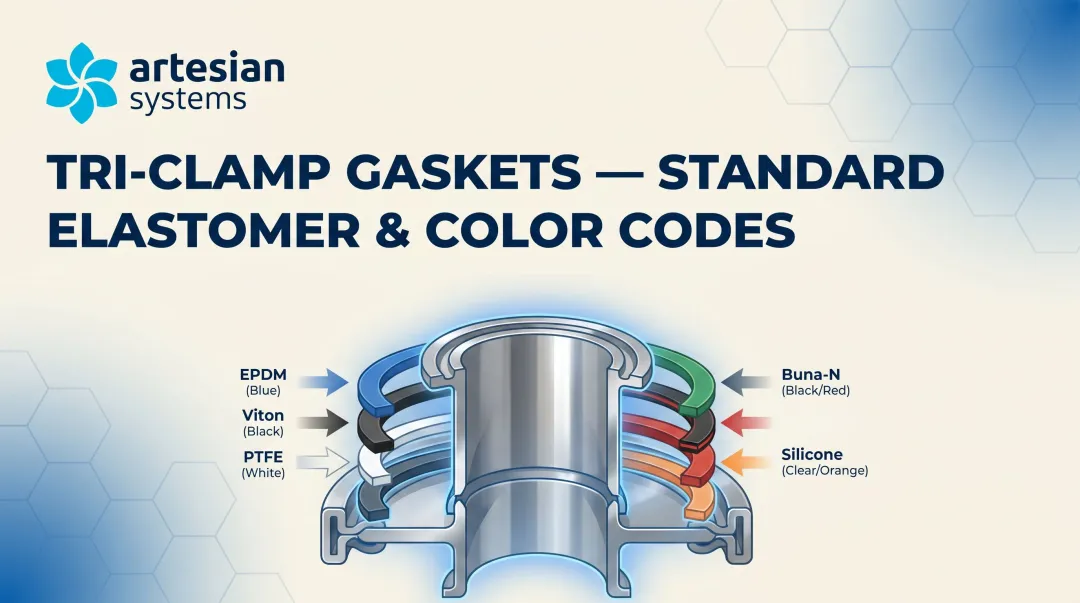
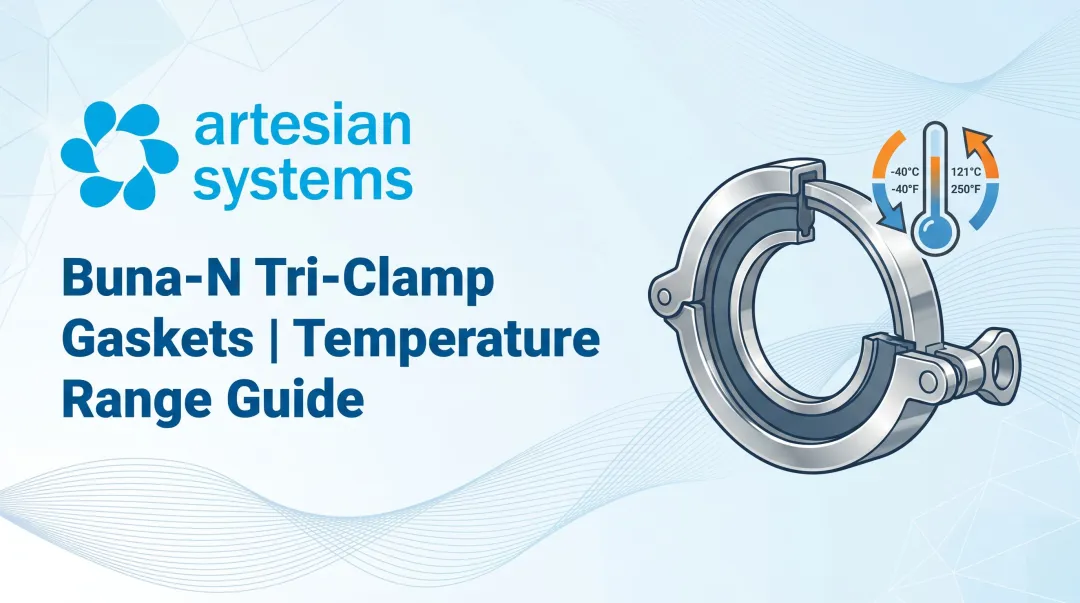
| Buna-N | -35°F to 250°F | Petroleum derivatives, oils, fuels | Not for steam sterilization |
| EPDM | -65°F to 300°F | Steam CIP cycles, outdoor exposure | Poor petroleum resistance |
| Silicone | -65°F to 450°F | Low extractables in pharma | Tears easily during removal |
| PTFE | -100°F to 500°F | Broadest chemical resistance | Cold flow under pressure (>1") |
| FKM (Viton) | -15°F to 437°F | SIP cycles, aggressive chemicals | Higher cost |
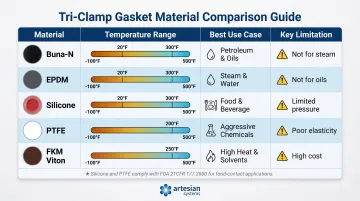
All materials from reputable suppliers comply with FDA 21 CFR 177.2600, 3-A Sanitary Standards, and USDA approval. Silicone and PTFE additionally carry USP Class VI certification for pharmaceutical contact applications. Artesian Systems offers tri-clamp gaskets in sizes 1.5" through 12" in PTFE, EPDM, FKM, and Buna-N materials.
Installation Best Practices and Failure Modes
Proper installation sequence:
- Inspect ferrule faces for scratches or debris
- Center gasket between ferrules before engaging clamp
- Hand-tighten wingnut only—standard torque guideline is 25 in-lbs
- Verify gasket alignment after partial tightening
Both failure modes create contamination risk, just from opposite directions:
- Over-tightening extrudes the gasket into the pipeline, creating bacteria harborage points outside CIP reach
- Under-tightening leaves gaps between ferrule faces where cleaning chemicals cannot penetrate, allowing microbial growth
Replace gaskets after every disassembly or when visual inspection reveals compression set, cracking, or hardening.
Use Cases of Tri-Clamp Fittings
That maintenance discipline pays off most in processes that demand frequent disassembly. Tri-clamp fittings dominate wherever changeovers are routine:
- Pharmaceutical cleanrooms with daily product switches between batches
- Food and beverage processing (beer, dairy, wine) requiring CIP between runs
- Hemp and cannabis extraction systems needing inspection-friendly modular connections
- Biotech fermentation setups with sterile transfer requirements
Tool-free assembly enables rapid disassembly between production batches—a brewery can reconfigure a transfer line in 15 minutes versus 2-3 hours for threaded connections requiring pipe wrenches and thread sealant cleanup.
Tri-Clamp vs. Other Sanitary Connection Types: Quick Comparison
Ease of Installation and Maintenance
Tri-Clamp: Tool-free hand assembly—tighten wingnut to 25 in-lbs torque. Disassembly takes seconds for inspection, gasket replacement, or cleaning validation. Ideal for CIP/SIP systems requiring frequent visual verification.
Other Sanitary Types: Welded fittings require certified TIG or orbital welders and are permanent installations. DIN/I-Line fittings use threaded nuts requiring wrenches and higher mechanical effort. Bevel seat connections demand significant tightening force to achieve metal-to-metal seal integrity.
Hygienic Performance
Tri-Clamp: Crevice-free ferrule faces with gasket seal when properly installed. Surface finish typically 30 Ra (0.8 µm) for food-grade applications, 20 Ra (0.5 µm) for pharma. Complies with 3-A, FDA 21 CFR, USDA, and ASME BPE standards.
Other Sanitary Types: Welded fittings offer fully smooth, uninterrupted internal bore with zero dead legs—the highest available protection against contamination in permanent installations, since no gasket surface or crevice exists for biofilm to accumulate. DIN and I-Line fittings meet European/alternative sanitary standards (ISO 2852, DIN 11851) but may have different cleaning access characteristics depending on gasket compression design.
Cost (Upfront vs. Total Cost of Ownership)
Tri-Clamp: Moderate hardware cost ($15-$200 per connection depending on size). Lower labor cost due to hand assembly. Ongoing gasket replacement adds $5-$30 per change, depending on material and size.
Other Sanitary Types: Welded fittings have minimal hardware cost but high skilled-labor installation expense ($75-$150/hour for certified orbital welding). Permanent installation eliminates recurring maintenance but increases shutdown cost for repairs. Cutting out and re-welding a failed section can run thousands of dollars in labor and downtime alone.
Flexibility and System Adaptability
Tri-Clamp: Modular by design: systems reconfigure, expand, or undergo inspection without process shutdowns. Compatible with adapters for NPT, butt-weld, end caps, and reducers, enabling hybrid system designs.
Other Sanitary Types: Welded systems are permanent and inflexible: design errors or process changes require cutting and re-welding. DIN fittings are widely used in European breweries but have limited interchangeability with tri-clamp components due to metric sizing and flange geometry differences.
Compliance and Industry Standards
Tri-Clamp: Broadly supported by 3-A Sanitary Standards, FDA 21 CFR, USDA, and ASME BPE. Dominant across U.S. food, pharma, biotech, and extraction industries including cannabis processing.
Other Sanitary Types: Key standards coverage by connection type:
- Welded fittings meet 3-A, FDA 21 CFR, and ASME BPE when executed with documented weld procedures
- DIN fittings comply with ISO 2852 and DIN 11850/32676, more common in European regulatory environments
- Both types carry global recognition, though tri-clamp dominates U.S. regulatory documentation and audits
Pressure Ratings Comparison
| Size | Tri-Clamp (Standard) | Tri-Clamp (High Pressure) | Welded Joints |
|---|---|---|---|
| 1.5" | 500 PSI @ 70°F | 1500 PSI @ 70°F | 1000+ PSI (process dependent) |
| 3" | 350 PSI @ 70°F | 1000 PSI @ 70°F | 1000+ PSI |
| 6" | 150 PSI @ 70°F | 300 PSI @ 70°F | 600+ PSI |
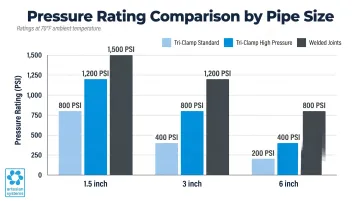
Pressure ratings decrease with size for clamp assemblies. Welded joints offer higher integrity under thermal cycling and high-pressure washdowns compared to clamp assemblies.
Tri-Clamp vs. Other Sanitary Connection Types: What's Better?
Decision Factors
Evaluate these criteria when selecting sanitary connection types:
- Cleaning frequency and method (daily CIP vs. weekly manual cleaning vs. continuous SIP)
- System permanency vs. modularity (fixed installation vs. frequent reconfiguration)
- Operating pressure and temperature (ambient vs. steam sterilization vs. high-pressure CIP)
- Budget constraints (upfront hardware cost vs. long-term labor and maintenance)
- Regulatory environment (U.S. FDA vs. European standards vs. international export requirements)
Situational Recommendations
Choose tri-clamp when:
- Frequent disassembly for inspection or validation is required (pharmaceutical batch production)
- CIP/SIP cycles demand visual gasket inspection between runs
- System layout changes seasonally or with product mix
- Installation team lacks certified welding capabilities
- Budget prioritizes lower upfront labor costs
This is the dominant choice for U.S. food, pharma, biotech, and extraction industries.
Choose welded/butt-weld when:
- System runs 24/7 with minimal shutdown windows (vaccine production lines)
- Maximum contamination prevention is non-negotiable (aseptic fill lines)
- High-pressure CIP loops (>500 PSI) exceed tri-clamp ratings
- Installation is permanent with no anticipated reconfiguration
- Long-term TCO favors eliminating gasket replacement labor
Choose DIN fittings when:
- Equipment integrates with European-standard machinery
- Metric-based process lines require dimensional compatibility
- Regional regulations reference DIN 11851 or DIN 32676 specifications
The Hybrid Approach
Real-world sanitary systems combine connection types strategically. Clamp weld fittings feature one tri-clamp end and one butt-weld end—placing permanent welds in product zones while maintaining tri-clamp access at inspection and maintenance points.
Hybrid design delivers several practical advantages:
- Reduces system-wide gasket count (fewer replacement points)
- Maintains inspection access where critical (pump inlets, filter housings)
- Balances contamination prevention with maintenance accessibility
- Lowers long-term gasket replacement labor
For example, a pharmaceutical water-for-injection (WFI) system might use welded piping throughout the distribution loop but install tri-clamp connections at sample ports, instrument taps, and equipment connection points.
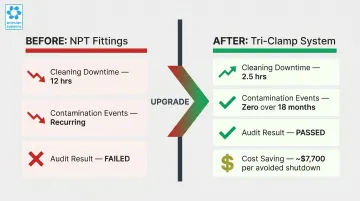
Real-World Scenario: Hemp Extraction System Upgrade
This scenario shows the decision framework in practice. A mid-sized hemp processor originally installed threaded NPT industrial fittings throughout their ethanol extraction system. Within six months, they faced recurring contamination events traced to thread sealant degradation and crevice corrosion in thread valleys—areas CIP spray balls couldn't reach.
The problems compounded quickly: CIP incompatibility required full manual disassembly for cleaning, pushing downtime to 8–12 hours per cycle. A failed third-party audit—citing non-compliant fittings and inadequate cleaning validation—forced the decision.
The processor converted entirely to tri-clamp sanitary connections with PTFE gaskets rated for ethanol compatibility. Permanent runs used hybrid clamp-weld fittings; inspection points received full tri-clamp access.
The outcome:
- Cleaning downtime reduced from 12 hours to 2.5 hours (CIP-compatible design)
- Zero contamination events in the subsequent 18 months
- Passed follow-up audit with full compliance verification
- Quarterly gasket cost of approximately $300 vs. $8,000 in lost production per contamination shutdown under the old system
For processors facing similar upgrades, Artesian Systems handles the full scope: process pipe engineering, CIP system design, P&ID development, and passivation services.
Conclusion
Tri-clamp is the right default for most U.S.-based sanitary processing environments due to its flexibility, broad compliance, and rapid maintenance access. Welded alternatives serve permanent high-pressure installations where zero dead-legs and maximum contamination prevention justify higher installation costs. DIN fittings address European-standard equipment integration and metric process lines.
The choice ultimately depends on your specific process:
- Cleaning method: Daily CIP cycles with frequent inspection favor tri-clamp modularity
- Pressure and temperature: High-pressure continuous service justifies the added cost of welded connections
- Regulatory environment: FDA, 3-A, or EHEDG requirements shape which fitting standards are acceptable for your line
Getting the connection type right from the start prevents the costly rework that comes from mismatched fittings, failed inspections, or unplanned downtime mid-production. Artesian Systems' engineering team works with food, pharma, chemical, and extraction operations to specify the right sanitary components and design process piping systems that hold up under real production conditions.
Frequently Asked Questions
What is the difference between sanitary and tri clamp?
Tri-clamp fittings are a specific type of sanitary fitting, and the most widely used connection type in the U.S. "Sanitary fittings" is the broader category that also includes welded, DIN, I-Line, and bevel seat connection types.
How do tri clamp fittings work?
Two ferrules mate face-to-face with a gasket seated between them. A hinged clamp wraps around both ferrule flanges and hand-tightens (typically to 25 in-lbs torque) to compress the gasket, creating a leak-free sanitary seal without tools.
Are 1 and 1.5 tri clamps the same?
Yes and no. Both 1" and 1.5" tube sizes share the same 1.984" ferrule flange OD, so they use the same 1.5" clamp. However, their inner diameters differ (1.000" vs. 1.500"), affecting flow rate. The gasket must match the tube's inner diameter.
What is the difference between DIN and tri clamp?
DIN fittings (DIN 11851 or DIN 32676) use metric sizing and a threaded nut connection, while tri-clamp uses inch-based sizing and a hinged clamp. The two systems are not interchangeable and serve different regional markets—DIN dominates Europe, tri-clamp dominates the U.S.
What is a tri clamp gasket?
A tri-clamp gasket is a food-grade or pharma-grade seal (commonly EPDM, silicone, PTFE, FKM, or Buna) seated between two ferrule faces to create a leak-proof, hygienic connection. Material selection depends on temperature exposure, chemical compatibility, and applicable standards such as FDA 21CFR, 3-A, or USP compliance.
What is the temperature rating of a tri clamp gasket?
Temperature ratings vary by material: Buna-N (-35°F to 250°F), EPDM (-65°F to 300°F), PTFE (-100°F to 500°F), and FKM (-15°F to 437°F). Gasket selection must account for both process temperature and sterilization cycle conditions like steam SIP at 250°F+.