
Introduction
Engineers and procurement teams specifying sealing materials for aggressive service environments face a persistent challenge: standard elastomers fail under simultaneous high temperatures and chemically demanding media.
The result is premature seal degradation, unexpected downtime, and contamination risk—consequences that food processing, pharmaceutical manufacturing, and chemical handling applications cannot afford.
Fluoroelastomer (FKM) addresses this specification gap. As a fluorocarbon-based synthetic rubber characterized by 66–70% fluorine content bonded directly to the polymer backbone, FKM delivers exceptional resistance to heat, fuels, oils, and most aggressive chemicals. Yet selecting FKM based solely on nominal datasheet values—without accounting for combined temperature and chemical exposure, compression set behavior, and application-specific boundary conditions—leads to costly failures.
Understanding FKM's composition, property envelope, operating limits, and grade selection criteria is essential for making specification decisions that balance performance, regulatory compliance, and cost in food, pharmaceutical, chemical, and industrial processing environments.
TLDR
- FKM resists heat, fuels, oils, and most aggressive chemicals—but not ketones, organic acids (acetic acid), or amines
- Continuous service temperature reaches 204°C with intermittent spikes to 260°C; standard grades become brittle below -20°C
- Grades A, B, F, and G each optimize different properties—food/pharma use requires FDA 21CFR177.2600 confirmation
- Combined heat and chemical exposure accelerates degradation; apply 15–20°C safety margins below rated limits
- Costs 8–35x baseline elastomers; specify FKM only where thermal and chemical conditions eliminate lower-cost alternatives
What Is Fluoroelastomer (FKM)?
Fluoroelastomer is a class of fluorocarbon-based synthetic rubber characterized by fluorine atoms bonded directly to the polymer backbone. This high fluorine content—typically 66–70% by weight—creates the structural basis for its performance in aggressive environments. The carbon-fluorine bond is one of the strongest in organic chemistry, giving FKM its resistance to chemical attack and thermal degradation.
Standard Designations and Nomenclature
FKM is the ASTM D1418 designation for fluoroelastomer materials. The ISO/DIN 1629 equivalent is FPM—both refer to the same base material class. Viton® is a widely recognized brand name (trademark of The Chemours Company), not a material specification. Other commercial FKM brands include Dyneon® (3M), Tecnoflon® (Solvay), and Dai-El® (Daikin). Procurement documents should specify "FKM per ASTM D1418" or "FPM per ISO 1629" rather than using brand names as generic specifications.
Distinguishing FKM from Related Fluoroelastomer Families
Three fluorinated elastomer families serve distinct performance niches:
| Property | FKM | FFKM | FEPM |
|---|---|---|---|
| Temperature Range | -20°C to 204°C | -20°C to 327°C | -10°C to 230°C |
| Chemical Resistance | Excellent (oils, fuels, most acids) | Near-universal | Excellent (bases, steam, hot water) |
| Relative Cost | $$ | $$$$$ (~10x FKM) | $$$ |
| Primary Applications | Automotive, general industry, oil/gas | Semiconductor, pharma clean rooms | Chemical processing, steam service |
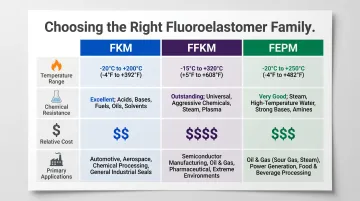
FFKM (perfluoroelastomer) achieves near-total fluorine saturation with no hydrogen atoms on the polymer chain, delivering near-universal chemical resistance up to 327°C. Specify FFKM when FKM's chemical resistance or temperature limits fall short—but expect costs approximately 10 times higher.
FEPM (tetrafluoroethylene/propylene rubber), such as Aflas®, resists steam, hot water, and alkaline environments where standard FKM fails. It is the preferred choice for high-pH applications and steam service in power generation and chemical processing.
Common FKM Grades and Formulations
FKM types differ in monomer composition, fluorine content, and resulting performance trade-offs:
| Type | Monomer Composition | Fluorine % | Glass Transition (Tg) | Key Advantage |
|---|---|---|---|---|
| Type A | VDF + HFP | 66% | -17°C | Best low-temperature flexibility among standard grades |
| Type B | VDF + HFP + TFE | 68% | -14°C | Enhanced resistance to strong acids and alkalis |
| Type F | VDF + TFE + PMVE | 70% | -8°C | Best chemical resistance, lowest gas permeability |
| Type G/APA | Various + APA technology | Varies | -24 to -30°C | Food-grade formulations, extended low-temperature performance |
Type A handles most hydrocarbon fuels, lubricants, and mineral oils—a reliable general-purpose choice when low-temperature performance matters. Type B adds TFE to the blend, trading a few degrees of cold flexibility for meaningful gains against concentrated acids and alkalis.
Type F suits applications demanding the broadest chemical resistance and lowest gas permeability, but its higher Tg (-8°C) rules it out for cold environments. Type G (APA) formulations meet FDA 21 CFR 177.2600 and are engineered for food and pharmaceutical contact: Chemours' APA grades eliminate traditional metal acid acceptors (magnesium or calcium hydroxide), reducing extractables to levels acceptable for clean-process applications.
The Critical Role of Compounding
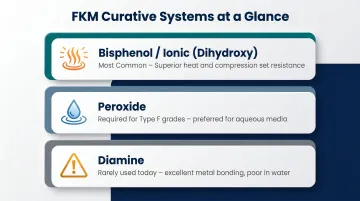
Compounding ingredients—curatives, fillers, and processing aids—significantly affect final part performance. Two FKM components from different manufacturers may perform differently even at the same nominal fluorine content. Three primary curative systems exist:
- Bisphenol/Ionic (dihydroxy): Most common system, offering superior heat resistance and compression set resistance
- Peroxide: Required for Type F (PMVE-based) grades and preferred for aqueous media exposure
- Diamine: Rarely used today; provides excellent rubber-to-metal bonding but vulnerable in water-based applications
Key Technical Properties of FKM
FKM's performance derives from its molecular architecture: high-energy C–F bonds resist chemical attack while polymer chain flexibility preserves elastic behavior at elevated temperatures.
Chemical Resistance
FKM is broadly compatible with:
- Aliphatic and aromatic hydrocarbons
- Fuels (gasoline, diesel, jet fuel)
- Mineral oils and synthetic hydraulic fluids
- Petroleum oils and greases
- Chlorinated solvents
- Concentrated mineral acids (sulfuric, hydrochloric)
- Silicone oils
- Animal and vegetable oils
This resistance stems from the shielding effect of fluorine atoms along the carbon backbone, which prevent reactive chemicals from attacking the polymer chain.
Critical Incompatibilities
FKM is incompatible with ketones (acetone, MEK), organic acids (acetic acid, formic acid), certain amines, and low-molecular-weight esters. The Calpac Lab Viton Chemical Compatibility Chart explicitly states: "Do not use Viton with acetone, esters, amines, organic acids, acetic acid, MEK, ethyl acetate, highly polar chemicals."
Acetic acid represents a commonly overlooked failure mode in food and pharmaceutical processing — it's a standard constituent in CIP (Clean-in-Place) acid-rinse formulations. Facilities running standard FKM seals through acetic acid-based cleaning cycles risk premature seal degradation, particularly when cleaning temperatures exceed ambient.
Viton Extreme ETP-600S was specifically developed to extend resistance to such aggressive chemicals. Standard Type A or B grades will fail under these conditions.
Thermal Stability and Temperature Performance
Continuous Service Temperature: FKM's maximum continuous service temperature is 204°C (400°F), per Chemours technical documentation. MatWeb data confirms: "Compounds of Viton remain elastic indefinitely at 204°C."
Intermittent/Peak Exposure: FKM can tolerate intermittent spikes to approximately 260°C under laboratory conditions, with some specialty grades rated to 300°C for brief exposures. However, prolonged exposure near the upper limit accelerates compression set and hardening.
Low-Temperature Boundary: Standard FKM grades (Type A) become stiff and brittle around -20°C to -23°C (0°F to -9°F). Specialized low-temperature formulations using APA technology (GLT/GFLT grades) extend this to approximately -40°C (Tg = -30°C), but with trade-offs in chemical resistance. Type F, with the best chemical resistance, has the poorest cold performance at Tg = -8°C.
Compression Set at Elevated Temperature
Compression set—the material's ability to recover after sustained deformation—is critical for maintaining seal face load. Chemours reports ASTM D395 compression set of 9–16% at 70 hours/23°C and 10–30% at 70 hours/200°C.
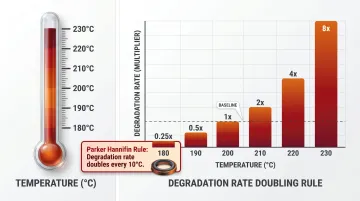
Parker Hannifin's engineering guideline describes a widely applied rule: the rate of chemical degradation (and thus compression set) approximately doubles for every 10°C increase in temperature.
A seal rated for acceptable compression set at 200°C will lose sealing force significantly faster at 210°C or 220°C. This exponential degradation curve makes temperature derating essential for long-term reliability.
Low Gas and Liquid Permeability
Beyond thermal performance, permeability is another area where FKM separates itself. It exhibits the lowest gas permeability among common industrial elastomers. Research by Jeon et al. (2022) measured hydrogen permeability coefficients at:
- FKM: 2.1 × 10⁻⁹ mol/m·s·MPa
- EPDM: 17.0 × 10⁻⁹ mol/m·s·MPa (approximately 8x higher than FKM)
This tightly packed molecular structure makes FKM critical for sealing applications in pressure-rated systems and where process contamination or fugitive emissions must be controlled—particularly in vacuum service, high-pressure gas containment, and systems requiring low fugitive emissions.
Mechanical and Environmental Durability
Good to excellent compression set resistance makes FKM well-suited for maintaining seal face load over a full service life. One critical caveat: published compression set values assume mandatory post-cure of 4–24 hours at 200–249°C. Skipping post-cure results in elevated compression set and premature seal failure — a common specification oversight.
On weathering and ozone exposure, the fully fluorinated backbone delivers inherent UV and ozone stability without protective additives. Chemours rates ozone/weather/oxidation resistance as "Outstanding," making FKM a reliable choice for outdoor installations and atmospherically exposed applications.
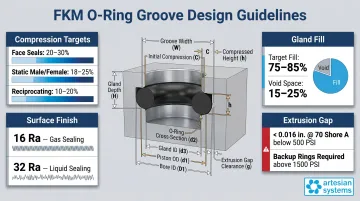
Tear resistance is moderate. Under high-pressure extrusion loading, FKM is susceptible to tear propagation when groove geometry includes sharp edges or excessive extrusion gaps. Proper O-ring groove design with controlled surface finish — and backup rings for pressures above 1,500 PSI with 70 Shore A compounds — is essential to prevent premature failure.
Operating Temperature and Chemical Resistance Range
FKM's allowable operating window is not defined by temperature or chemical exposure alone—it is the intersection of both simultaneously. Field performance depends on understanding this combined envelope rather than referencing single-variable datasheet limits.
Continuous vs. Intermittent vs. Peak Exposure
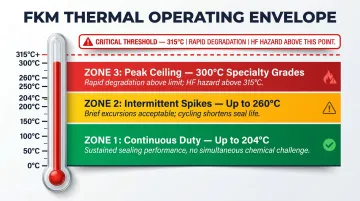
Three operating thresholds define FKM's thermal envelope:
- Continuous duty (204°C / 400°F in dry heat): The sustained rating at which FKM maintains acceptable compression set, seal integrity, and chemical resistance. This assumes no simultaneous chemical challenge.
- Intermittent spikes (up to ~260°C): Brief excursions that exceed the continuous rating but don't persist long enough to cause cumulative damage. Seal life shortens with cycling frequency and duration.
- Peak ceiling (300°C for specialty grades): The absolute thermal limit, beyond which rapid degradation or decomposition occurs. Above 315°C, hydrogen fluoride condensate may form on the surface, posing a severe chemical burn hazard.
Lower Temperature Boundary
Below the glass transition zone (Tg), FKM loses elasticity and sealing force. Standard Type A grades become brittle around -20°C; Type F grades stiffen at -8°C. This matters for outdoor installations, cold-room processing environments, and cryogenic transfer lines.
If your application requires sealing below -20°C, specify GLT/GFLT grades with extended low-temperature performance, but verify that chemical resistance hasn't been compromised for your process media.
Chemical Compatibility: What FKM Resists and What It Does Not
Media Categories FKM Handles Well:
- Aliphatic hydrocarbons (hexane, heptane, mineral spirits)
- Aromatic hydrocarbons (benzene, toluene, xylene)
- Fuels (gasoline, diesel, kerosene, jet fuel)
- Mineral oils and petroleum oils
- Concentrated mineral acids (sulfuric, hydrochloric, nitric)
- Silicone oils and greases
- Animal and vegetable oils
Media Categories That Cause Swelling, Degradation, or Loss of Mechanical Properties:
- Ketones: Acetone, methyl ethyl ketone (MEK), methyl isobutyl ketone (MIBK)
- Low-molecular-weight esters: Ethyl acetate, butyl acetate
- Organic acids: Acetic acid, formic acid
- Amines: Ammonia, ethylenediamine, monoethanolamine
- Polar solvents: Dimethyl sulfoxide (DMSO), dimethylformamide (DMF)
FKM performs well with hydrocarbons—making it relevant for petroleum refining, hemp/cannabis hydrocarbon extraction (butane, propane), and fuel system sealing. However, aromatic content level and temperature affect resistance. High-aromatic-content fuels at elevated temperatures cause greater swell than aliphatic hydrocarbons at room temperature.
Artesian Systems supplies FKM tri-clamp gaskets compliant with FDA 21CFR177.2600 and approved by 3A/USDA for sanitary applications in food, beverage, pharmaceutical, and biotech processing. These gaskets are suitable for applications involving petroleum derivatives, alcohols, ethers, glycols, fats, oils, and greases, with an operating temperature range of -40°F to +250°F (-40°C to 121°C).
Compounding Effect: Combined Stress Conditions
According to Parker Hannifin's O-Ring eHandbook, heat acts as a catalyst for chemical attack. A fluid that's compatible with FKM at room temperature can become highly aggressive at 100°C or above. When both thermal and chemical stresses are present, effective seal life is reduced to a fraction of what it would be in dry heat alone.
CIP Application Example
In food and pharmaceutical processing, CIP cycles subject seals to:
- Hot caustic washes (70–85°C)
- Acid rinses (often acetic acid-based)
- Steam sterilization
- Rapid thermal cycling
If acetic acid is used in CIP and standard (non-ETP) FKM seals are installed, the combined heat and chemical exposure creates a failure pathway that neither stress would produce alone at room temperature. Chemours engineered APA-grade FKM polymers (GF-600S and ETP-600S) specifically to withstand these combined thermal-chemical CIP stresses; standard grades will fail prematurely.
Safe Operating Margin and Boundary Conditions
The CIP scenario above illustrates a broader principle: operating at the rated limit without margin is a design risk. Parker Hannifin recommends operating 15–20°C (30–40°F) below the maximum rated temperature for continuous service. The system temperature limit should be defined by the lower of two values: the maximum operating temperature of the seal material or the maximum stable temperature of the process fluid.
Why This Matters:
- Compression set accumulates faster near temperature limits
- Chemical swell reduces contact pressure in seals
- Thermal cycling accelerates degradation
- The "10°C rule" (degradation doubles every 10°C) compounds quickly near rated limits
The 15–20°C derating recommendation should be treated as a minimum starting point, not an optional safety factor.
Industry Applications of FKM
FKM earns its place across more industries than nearly any other elastomer because no single-property material covers as many demanding environments at once.
High-Temperature and Chemical Process Industries
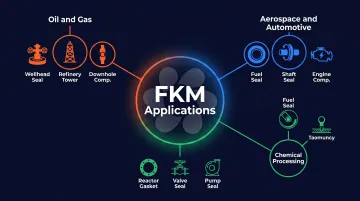
FKM covers a wide range of demanding industrial applications across these three primary sectors:
- Oil and gas: Wellhead seals, refinery gaskets, fuel system O-rings, and downhole components. Specialty grades like GLT, GBLT, and Viton Extreme handle environments requiring both chemical and thermal extremes. FKM's resistance to hydrocarbons, lubricants, and hydraulic fluids makes it a standard specification in petroleum refining and distribution.
- Aerospace and automotive: Type A dipolymers serve in fuel system seals, hoses, shaft seals, and aerospace lubricant applications. Resistance to jet fuels, transmission fluids, and engine bay heat cycling makes FKM essential in both sectors.
- Chemical processing: Reactor gaskets, valve seals, expansion joints, and pump seals in plants handling concentrated acids and hydrocarbon solvents. One important caveat: FKM's "universal chemical resistance" reputation leads to misspecification. Careful verification against ketones, amines, and organic acids is required before specifying.
Food, Pharmaceutical, and Regulated Process Industries
FDA 21 CFR 177.2600 governs "rubber articles intended for repeated use" in food contact, covering seals, O-rings, gaskets, and tubing. Compliance requires meeting extraction limits: for aqueous foods, total extractives must not exceed 20 mg per square inch during the first 7 hours and 1 mg per square inch during the subsequent 2 hours.
Not all FKM formulations meet FDA 21 CFR 177.2600. Compliance must be confirmed by the specific compound certification, not assumed from the base material type alone. Viton GF-600S (via FCN 510) and Viton Extreme ETP-600S (via FCN 53) are specific FDA-compliant grades with completed Food Contact Notifications.
In regulated process environments, FKM is specified across several applications:
- Pharmaceutical and biotech manufacturing: Low permeability, chemical resistance, and U.S.P. Class VI biocompatibility make FKM suitable for pharmaceutical fluid handling, bioreactor seals, and equipment requiring frequent CIP/SIP (Clean-in-Place/Sterilize-in-Place) cycles.
- Drinking water systems: FKM's low extractables and chemical resistance make it well suited to components where contamination prevention is critical.
- Hydrocarbon extraction: FKM is compatible with aliphatic hydrocarbons including butane and propane used in hemp/cannabis extraction. For ethanol-based extraction, compatibility is limited — engineers should verify against the specific solvent and concentration before specifying.
For sanitary process applications, Artesian Systems supplies tri-clamp FKM gaskets (1.5"–6") that meet FDA 21CFR177.2600 and 21CFR177.1550, carry 3A Sanitary Standards and USDA approval, and have passed U.S.P. Class VI Cytotoxicity testing. These gaskets are available in 5, 20, and 100 micron ratings with no minimum order quantity.
Limitations and Common Specification Mistakes
Most field failures with FKM components trace back to specification errors rather than inherent material deficiencies. Understanding the gap between how FKM is specified on paper and how it behaves under combined real-world conditions prevents costly downtime and contamination risk.
Cost-Performance Misalignment
FKM costs 8–35x baseline elastomers like EPDM or SBR. Raw material pricing data indicates EPDM costs approximately $2.50–$3.00/kg, NBR approximately $3–$12/kg, and FKM approximately $25–$200+/kg depending on grade and specialty.
Over-specifying FKM where a less expensive material would perform adequately adds unnecessary cost. Under-specifying (using NBR or silicone in an FKM-required environment) leads to premature failure, contamination risk, and system downtime. The specification decision should be driven by actual temperature and chemical exposure—not generic "best practice" or habit.
Assuming Universal Chemical Resistance
The most common field failure mode: engineers selecting FKM based on its broad chemical resistance reputation without checking specific compatibility against the actual process fluid. Ketone-based cleaning agents (e.g., acetone-based sanitizers) and organic acid-containing streams are frequently overlooked incompatibilities.
In food or pharmaceutical facilities using acetone-based sanitizers or MEK-containing cleaning solvents, standard FKM seals will swell and degrade. This failure mode is easy to miss: FKM is often specified precisely because of its perceived "universal" chemical resistance—a misconception that ignores the ketone/amine/organic acid blind spots.
Misreading Temperature Ratings
Confusion between continuous and intermittent ratings leads to two common errors:
- Applying the peak temperature tolerance to sustained-duty conditions: A 300°C peak rating does not mean the seal can operate continuously at 300°C. Continuous service is limited to 204°C.
- Ignoring the lower temperature brittleness limit: Cold storage, outdoor pipeline applications, and winter ambient conditions in unheated facilities expose seals to temperatures below -20°C, where standard FKM loses elasticity.
The ASTM D2000 HK designation indicates high heat resistance (Type H tested at 200°C for 70 hours) and oil resistance (Class K, maximum 10% volume swell in ASTM Oil IRM903). However, HK does not address compatibility with ketones, organic acids, amines, or steam—the very incompatibilities that cause the most damaging FKM failures in food and pharmaceutical environments.
Mechanical and Groove Design Errors
FKM's susceptibility to tear propagation under pressure makes groove design and surface finish critical to long-term seal life. Common design errors include:
- Under-compression causes leakage; target 20–30% for face seals, 18–25% for static male/female seals, and 10–20% for reciprocating seals
- Over-compression accelerates compression set and extrusion; keep gland fill at 75–85% with 15–25% void space
- Sharp-edged groove geometries concentrate stress and initiate tear propagation; target 16 Ra surface finish for gas sealing, 32 Ra for liquid
- For 70 Shore A material below 500 PSI, keep the extrusion gap under 0.016 inches; use backup rings above 1500 PSI
Frequently Asked Questions
Is fluoroelastomer the same as FKM (Viton)?
FKM is the ASTM D1418 material designation for fluoroelastomers; FPM is the ISO/DIN 1629 equivalent. Both refer to the same base material class. Viton® is a brand name (trademark of Chemours) for FKM products, not a generic specification. Always specify "FKM per ASTM D1418" or "FPM per ISO 1629" in procurement documents rather than using brand names.
What temperatures can fluoroelastomer withstand?
FKM's continuous service temperature is 204°C (400°F), with intermittent peak tolerance to approximately 260°C. Standard grades lose elasticity below -20°C; specialized low-temperature formulations extend this to approximately -40°C but with trade-offs in chemical resistance. Always apply a 15–20°C safety margin below rated limits for continuous-duty applications.
How does fluoroelastomer compare to PTFE (Teflon)?
PTFE is a rigid thermoplastic with near-universal chemical resistance (-200°C to +260°C) but no elastic recovery — making it unsuitable for dynamic sealing on its own. FKM provides sealing force through compression and recovery, making it the choice where load-bearing seal performance is required. The two are often paired in hybrid configurations: a PTFE contact face with an FKM energizer behind it.
Is fluoroelastomer food safe?
Food-grade FKM formulations (Type G/APA grades) comply with FDA 21CFR177.2600 and 3A Sanitary Standards, but not all FKM grades qualify — specific grades such as Viton GF-600S (FCN 510) and ETP-600S (FCN 53) carry completed Food Contact Notifications. Compliance must be confirmed by the specific compound certification, not assumed from the base material type alone.
Does fluoroelastomer contain latex?
No. Fluoroelastomers are fully synthetic and contain no natural rubber latex proteins. FKM is composed entirely of synthetic fluorinated monomers (VDF, HFP, TFE, PMVE) with no natural rubber content, making it appropriate for latex-sensitive or latex-free requirement environments.
Is fluoroelastomer safe to wear (skin contact)?
Cured FKM is safe for incidental skin contact in most applications, but uncured compound and high-temperature decomposition byproducts above 315°C are hazardous — hydrogen fluoride condensate can cause severe chemical burns, and fire-damaged components should be treated as such. For skin-contact applications, confirm safety against the material's SDS and applicable compliance certifications.