Introduction
Selecting the right elastomer for seals, gaskets, O-rings, and tubing is a critical decision in process system design. FKM (fluoroelastomer) has earned its reputation as one of the most chemically resistant elastomers available, serving industries from petroleum refining to pharmaceutical manufacturing.
Yet even with its strong chemical resistance profile, FKM isn't universally compatible. Choosing the wrong material can trigger a cascade of costly failures.
The consequences extend far beyond a failed seal:
- Food processing: Incompatible materials leach extractables into product streams, violating FDA compliance and forcing recalls
- Pharmaceutical manufacturing: Seal degradation compromises sterile environments and triggers regulatory inspections
- Chemical processing: The wrong gasket means unplanned shutdowns, equipment damage, and safety incidents
- Cannabis extraction: A single seal failure can halt production for days while contaminated product is discarded and systems are re-validated
Understanding where FKM excels—and where it fails—is what this guide covers. Use it to specify FKM with confidence, or recognize when a different elastomer is the right call for your process chemistry.
TL;DR
- FKM handles fuels, oils, concentrated acids, and aromatic hydrocarbons well, but fails with ketones, esters, amines, and concentrated ammonium compounds
- Compatibility ratings apply at room temperature only—elevated temperature, concentration, or contact time shift an "A" rating to "C" or worse
- Always test against the most aggressive chemical in mixed-fluid environments, not the average
- FKM outperforms EPDM with hydrocarbons; EPDM wins with steam, hot water, and polar solvents
- Physical testing under actual process conditions is mandatory before permanent installation
What Is FKM and Why Chemical Resistance Matters
FKM is the ASTM D1418 material designation for fluorocarbon-based elastomers, covering approximately 80% of all fluoroelastomers in commercial use. The equivalent designation under ISO/DIN 1629 is FPM. All FKM compounds contain vinylidene fluoride (VDF) as a primary monomer, with fluorine content typically ranging from 55% to 70% by weight.
Viton® is a registered trademark of The Chemours Company FC, LLC (spun off from DuPont in 2015), not a separate material category. DuPont introduced Viton to the market in 1957. Other FKM manufacturers include Daikin Chemical (Dai-El), 3M Dyneon, Solvay Specialty Polymers (Tecnoflon), and HaloPolymer (Elaftor). When you specify "Viton," you're specifying FKM—the terms are functionally interchangeable in technical specifications.
That material designation matters because chemical resistance drives elastomer selection in sanitary and industrial applications. An incompatible elastomer doesn't just degrade — it contaminates. When the wrong material contacts an aggressive fluid, multiple failure modes can occur at once:
- Volume swelling — compromises seal integrity and fit
- Hardening or embrittlement — leads to cracking under compression
- Surface degradation — releases particles directly into the process stream
- Extractables migration — transfers elastomer compounds into food, pharmaceutical, or chemical products
In regulated industries, these failures create compliance violations that can shut down production lines and trigger FDA warning letters.
FKM's chemical resistance comes packaged with physical properties that make it a premium material choice:
- Temperature tolerance: Continuous service from -15°F to 400°F (-26°C to 204°C) for standard grades, with specialty high-temperature compounds rated to 437°F (225°C)
- Low permeability: Excellent resistance to gas and fluid permeation, critical for vacuum systems and pressurized chemical handling
- Compression set resistance: Maintains sealing force over thousands of thermal cycles without permanent deformation
- UV and ozone stability: Resists atmospheric oxidation, sunlight, and ozone exposure that degrades many other elastomers
These properties position FKM as the default elastomer where chemical exposure, high temperature, and long service life converge.
How to Read FKM Chemical Compatibility Ratings
Understanding the A-B-C-D Rating System
Chemical compatibility charts use letter or numeric grades to communicate how an elastomer performs when exposed to a specific chemical. The most common system uses A-B-C-D ratings (or numeric equivalents 1-2-3-4):
- A (or 1) - Excellent: Recommended for continuous use; volume swell less than 10%
- B (or 2) - Good: Minor to moderate effect; volume swell 5–10%, may be suitable for static applications
- C (or 3) - Fair: Moderate to severe effect; volume swell 10–20%, not recommended for continuous use
- D (or 4) - Poor: Severe degradation; volume swell greater than 20%, not recommended for any use
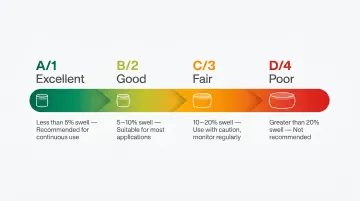
Volume swelling is the most direct indicator of material uptake and long-term seal failure risk. When an elastomer absorbs a chemical, it increases in volume, loses dimensional stability, and eventually fails to maintain sealing force. A 5% swell might be acceptable for a static gasket in low-pressure service; a 25% swell guarantees failure in any application.
Standard Test Conditions and Their Limits
Most published compatibility ratings reflect 48 to 168 hours of immersion at room temperature (approximately 64°F to 73°F, or 18°C to 23°C). This baseline matters because real-world process conditions rarely match laboratory test conditions.
Elevated temperature, higher chemical concentration, or extended contact time will shift compatibility ratings downward, often by two full grades. A chemical rated "B" at room temperature may become a "D" at 150°F. Temperature footnotes are therefore the most important modifier when reading any compatibility chart.
Temperature Footnotes Change Everything
The Foxx Life Sciences Viton Chemical Compatibility Chart uses temperature codes that alter the meaning of ratings:
- A₁: Satisfactory to 72°F (22°C) only
- A₂: Satisfactory to 120°F (48°C)
Concrete examples illustrate the impact:
- Sulfuric acid (75–100% concentration): Rated A₁ (Excellent, but only to 72°F)
- Sulfuric acid (10–75% concentration): Rated A₂ (Excellent to 120°F)
- Sodium hypochlorite (<20% and 100%): Rated A₁ (Excellent, only to 72°F)
These footnotes reveal a critical truth: an "A" rating without temperature context is incomplete information. If your process operates at 180°F and the rating only applies to 72°F, you're specifying without the data you actually need.
The Most Aggressive Fluid Rule
In mixed-chemical environments (common in CIP processes, extraction systems, and blended solvents), evaluate FKM compatibility against the most chemically aggressive component, not an average or the least aggressive. A single incompatible fluid will cause seal failure regardless of how compatible the others are.
If your CIP sequence includes a caustic wash (compatible with FKM) followed by an acetone rinse (incompatible with FKM), the acetone determines material selection. The caustic compatibility is irrelevant; the acetone will degrade the seal.
All Published Data Is a Starting Point, Not a Guarantee
Compatibility charts reflect controlled laboratory conditions: single chemicals, defined exposure periods, consistent temperatures. Your process operates in the real world with chemical blends, thermal cycling, pressure fluctuations, and contamination.
Published ratings provide initial screening guidance. Physical testing under actual process conditions is essential before permanent installation, particularly in food, pharmaceutical, or cannabis extraction applications where seal failure means product loss, contamination, or regulatory violations.
What FKM Resists Well—and What It Doesn't
Excellent Resistance (A-Rated Applications)
FKM holds up well against these chemical families:
Petroleum Hydrocarbons:
- Gasoline (leaded, unleaded, high-aromatic formulations)
- Diesel fuel and fuel oil
- Mineral oil and lubricating oils
- Naphtha and kerosene
Aromatic and Halogenated Hydrocarbons:
- Benzene
- Chloroform
- Carbon tetrachloride
Mineral and Oxidizing Acids:
- Hydrochloric acid (20%, 37%, and 100% concentrations)
- Sulfuric acid (up to 75% concentration)
- Phosphoric acid (25%)
- Nitric acid (20%)—note that FKM resists nitric acid while EPDM degrades
Salt Solutions and Aqueous Inorganics:
- Sodium hypochlorite (bleach solutions, concentration and temperature dependent)
- Calcium chloride
- Aluminum chloride
- Potassium hydroxide at moderate concentrations
Animal and Vegetable Oils:
- Natural fats and fatty acids
- Food-grade oils used in processing equipment
This resistance profile makes FKM the standard choice for petroleum refineries, chemical plants handling acids and aromatics, and food processing equipment where oils and fats are processed.
Poor Resistance (D-Rated—Do Not Use)
FKM is incompatible with these chemical families:
Ketones:
- Acetone
- Methyl ethyl ketone (MEK)
- Methyl isobutyl ketone (MIBK)
- Cyclohexanone
Esters and Acetates:
- Ethyl acetate
- Butyl acetate
- Amyl acetate
Amines and Ammonia Compounds:
- Anhydrous ammonia
- Ethylenediamine
- Monoethanolamine
Concentrated Organic Acids:
- Glacial acetic acid
- Chloroacetic acid
Polar Ethers:
- Tetrahydrofuran (THF)
- Dioxane
Steam: FKM is rated "Do Not Use" for steam at all temperatures, including below 300°F. EPDM is the correct elastomer for steam service.
If your process uses any of these chemicals, eliminate FKM from consideration immediately.
Gray-Area Chemicals Requiring Careful Evaluation
Several common industrial chemicals fall in the "B" or "C" range where conditional use requires engineering judgment:
- Methanol and lower alcohols: Fair to poor depending on concentration and temperature (rated C to D)
- Formic acid: Fair at all tested concentrations (rated C)
- Acetic acid: Concentration-dependent—5% rated A, 20–30% rated B, glacial (concentrated) rated D
- Toluene: Discrepancy in published data (Foxx/ISM rate C, Posiflate rates A); DuPont data shows 24%+ volume swell at 50°C, making the C rating more appropriate for elevated-temperature service
When chemicals fall in this gray area, compatibility data alone is insufficient—physical testing is required.
Single-chemical gray areas get more complicated when real processes chain multiple fluids together. Most industrial environments cycle through several chemicals in sequence, and every fluid in that sequence puts stress on the seal.
Chemical Combinations in Real-World Processing
Common multi-chemical scenarios include:
- CIP sequences in food processing: Caustic wash (sodium hydroxide, FKM-compatible) followed by acid rinse (phosphoric or nitric acid, FKM-compatible)—but if the rinse includes acetone or alcohol-based sanitizers, FKM fails
- Cannabis and hemp extraction: Hydrocarbon solvents (butane, propane, hexane—all FKM-compatible) versus polar solvents (ethanol or acetone—EPDM or FFKM required)
- Petroleum applications: Crude oil blends containing sulfur compounds, water, and dissolved gases create cumulative stress on elastomers
Each chemical in the sequence affects the seal. Material selection must account for the most aggressive fluid in the entire process cycle.
Quick Reference: FKM Compatibility Summary
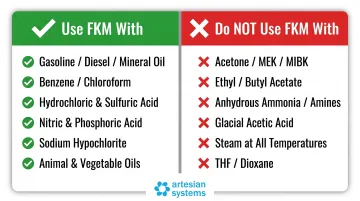
| Use FKM With | DO NOT Use FKM With |
|---|---|
| Gasoline, diesel, mineral oil | Acetone, MEK, MIBK |
| Benzene, chloroform | Ethyl acetate, butyl acetate |
| Hydrochloric acid, sulfuric acid (<75%) | Anhydrous ammonia, amines |
| Nitric acid (20%), phosphoric acid | Glacial acetic acid |
| Sodium hypochlorite (moderate conc.) | Steam (all temperatures) |
| Animal/vegetable oils, fatty acids | THF, dioxane |
FKM vs. Other Elastomers: When to Choose What
FKM's broad chemical resistance doesn't make it the universal solution. Knowing when a different elastomer outperforms FKM is as important as knowing when FKM excels. The key alternatives are EPDM, Nitrile (Buna-N), Silicone, and FFKM (perfluoroelastomer).
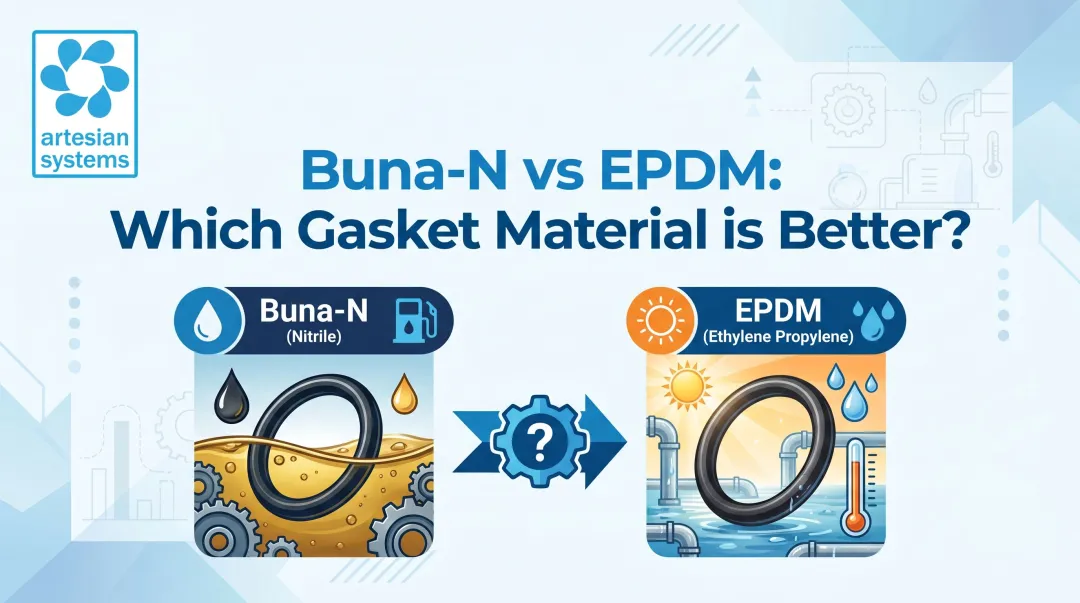
FKM vs. EPDM: Complementary Resistance Profiles
FKM and EPDM are chemical opposites in the best sense. Where FKM excels, EPDM often fails—and vice versa.
| Chemical | EPDM | FKM | Advantage |
|---|---|---|---|
| Gasoline (100%) | 3 (No Resistance) | 1 (High Resistance) | FKM |
| Diesel oil | 3 | 1 | FKM |
| Benzene | 3 | 1 | FKM |
| Mineral oil | 3 | 1 | FKM |
| Nitric acid (20%) | 3 | 1 | FKM |
| Acetone | 1 | 3 | EPDM |
| MEK | 1 | 3 | EPDM |
| MIBK | 1 | 3 | EPDM |
| Anhydrous ammonia | 1 | 3 | EPDM |
| Steam (248°F) | 1 | U (Do Not Use) | EPDM |
| Hot water (212°F) | 1 | 1 | Tie |
FKM dominates with: Petroleum products, fuels, aromatic hydrocarbons, halogenated solvents, and concentrated acids.
EPDM dominates with: Ketones, polar solvents, amines, steam, and hot water.
Facilities running both hydrocarbon and polar solvent processes need both elastomers in inventory. Use EPDM for steam-service and water-based cleaning systems; reserve FKM for fuel and oil handling.
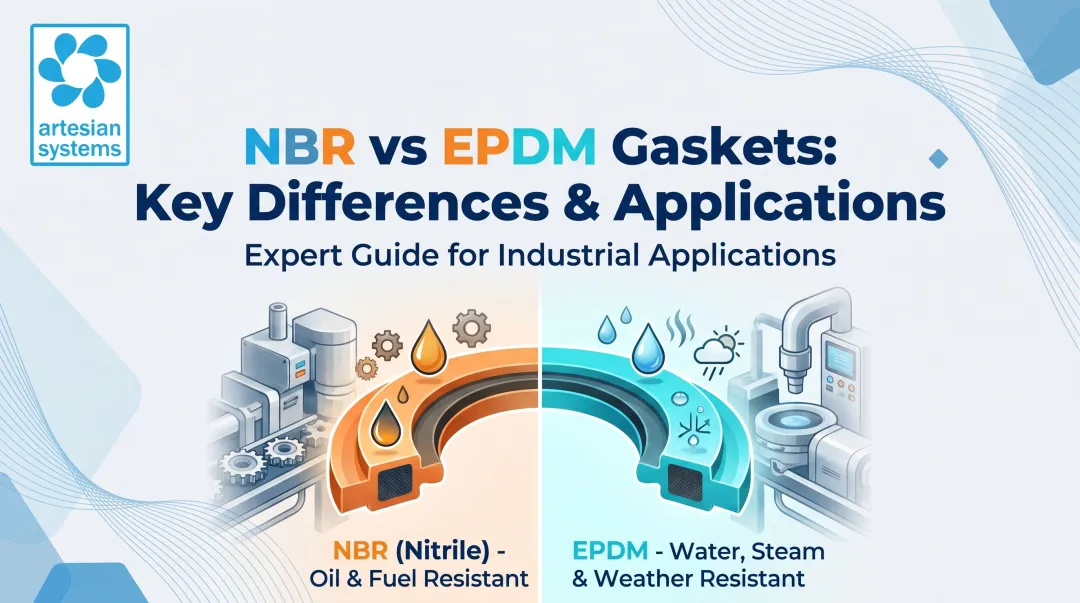
FKM vs. Nitrile (Buna-N): Temperature and Aromatic Resistance
Both FKM and Nitrile handle petroleum-based oils and fuels, but FKM maintains performance at significantly higher temperatures and with more aggressive chemicals.
- Temperature range: FKM operates from -15°F to 400°F standard (up to 437°F for specialty compounds); Nitrile operates from -30°F to 250°F standard (up to 275°F for specialty compounds). FKM provides approximately 150°F higher continuous temperature capability.
- Aromatic hydrocarbons: FKM resists benzene, toluene, and xylene; Nitrile degrades in aromatic service unless formulated with high acrylonitrile (ACN) content.
- Cost: Nitrile is lower-cost and appropriate for lower-temperature, less chemically aggressive environments.
Choose Nitrile when process temperatures stay below 200°F and aromatic hydrocarbon exposure is minimal. Choose FKM when temperature exceeds 250°F or aromatic hydrocarbons are present.
FKM vs. FFKM (Perfluoroelastomer): Chemical Breadth vs. Cost
FFKM (commercial brands include Kalrez® and Chemraz®) offers near-universal chemical resistance, including many chemicals that destroy standard FKM.
| Chemical | FKM Rating | FFKM (Kalrez) Rating |
|---|---|---|
| Acetone | U (Do Not Use) | A (Excellent) |
| MEK | U | A |
| Ethyl acetate | U | A |
| Aniline | U | A |
| Ethylenediamine | U | A |
| THF | U | A |
| Dioxane | U | A |
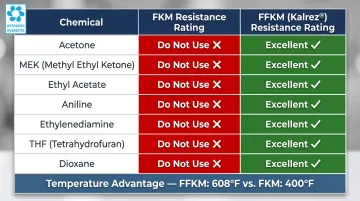
FFKM also runs hotter: up to 608°F (320°C) versus FKM's 400°F (204°C) standard rating.
The trade-off is cost. FFKM is significantly more expensive and reserved for applications where standard FKM is chemically insufficient. Industries that commonly specify FFKM include:
- Pharmaceutical and bio-pharma processing
- Semiconductor manufacturing
- Chemical processing with aggressive solvent blends
- Power generation
Choose FFKM when your process chemistry includes ketones, esters, or amines—or when a mixed-solvent environment defeats both FKM and EPDM.
Artesian Systems' Material Selection Expertise
Artesian Systems supplies FDA 21CFR177.2600-compliant, 3A-approved, and USDA-compliant FKM and EPDM gaskets for sanitary process applications. With almost two decades of field experience across petroleum, chemical, and food processing, the team can help you match the right elastomer to your specific process chemistry—whether you're designing a CIP system, specifying seals for hydrocarbon extraction, or rebuilding pharmaceutical equipment. Contact Artesian Systems to confirm material compatibility before your next build.
Industry Applications: Where FKM Performs Best
Petroleum and Chemical Processing
FKM seals and gaskets are standard in refinery, pipeline, and chemical plant applications handling:
- Crude oil, natural gas, and sour gas
- Gasoline, diesel, kerosene, and fuel oil
- Aromatic solvents and halogenated hydrocarbons
- Hydraulic fluids and lubricating oils
- Concentrated mineral acids
FKM's combination of high-temperature resistance (continuous service to 400°F) and broad hydrocarbon compatibility makes it one of few elastomers that can serve reliably in these environments without frequent replacement. Parker O-Ring Division recommends FKM for gasoline, gasoline/alcohol blends, naphtha, diesel fuel, and LP-gas service.
Food, Beverage, Pharmaceutical, and Nutraceutical Processing
FKM is compatible with many cleaning agents and process fluids used in sanitary applications:
- Dilute bleach solutions (sodium hypochlorite at moderate concentrations)
- Phosphoric and nitric acid rinses
- Process fluids including oils, fats, alcohols, and mild acids
Verify compatibility against your specific CIP chemistry before specifying FKM—particularly where caustic-only or ketone-containing cleaning agents are used. FKM compounds formulated per FDA 21CFR177.2600 are eligible for repeated-use food contact applications.
3A-approved FKM components are required in sanitary dairy and beverage systems. The 3A standard goes beyond FDA ingredient compliance, adding performance requirements that include milk fat absorption testing, air aging stability, and chemical cleaning compatibility across four temperature classes.
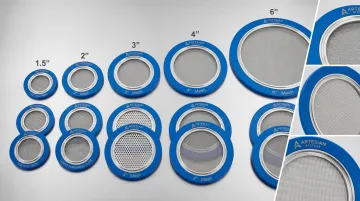
Artesian Systems manufactures FKM tri-clamp gaskets (sizes 1.5″ to 6″) with 316L stainless steel screens, available in 5-micron, 20-micron, and 100-micron filtration ratings. These gaskets are FDA 21CFR177.2600-compliant, 3A-approved, USDA-compliant, and have passed U.S.P. Class VI Cytotoxicity testing—making them suitable for food, beverage, pharmaceutical, and biotech applications.
Hemp and Cannabis Extraction; Petroleum/Hydrocarbon Extraction
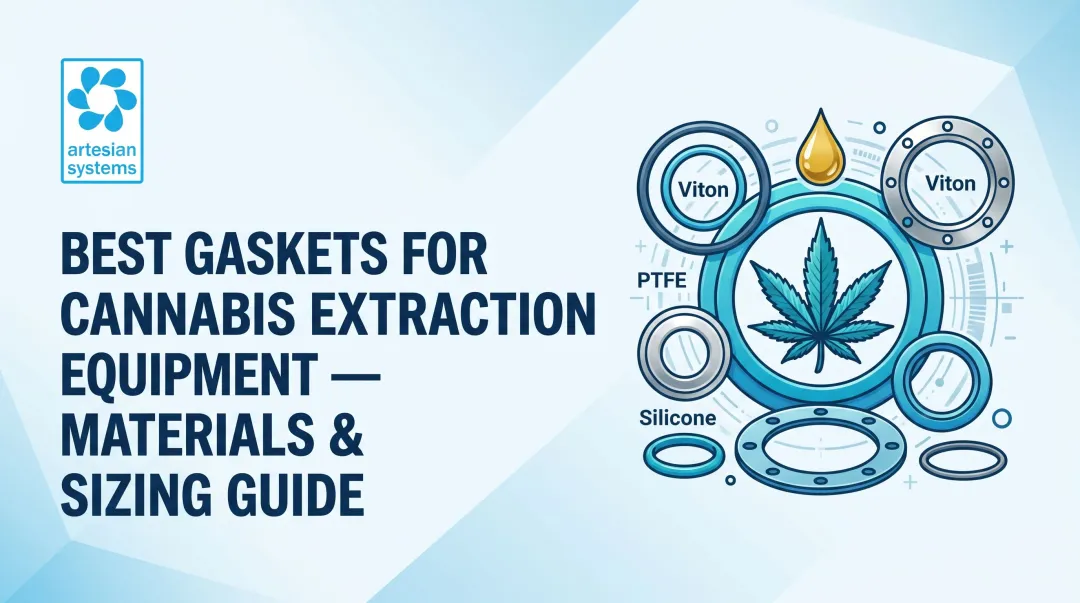
FKM is well-suited for hydrocarbon extraction environments where it demonstrates excellent resistance. The table below compares FKM and EPDM resistance ratings across common extraction solvents:
| Solvent | FKM Rating | EPDM Rating |
|---|---|---|
| n-Hexane | 1 — High Resistance | 3 — No Resistance |
| Butane | 1 — High Resistance | 3 — No Resistance |
| Propane | 1 — High Resistance | 3 — No Resistance |
| Ethanol (96%) | 1 — High Resistance | 1 — High Resistance |
| Methanol | 2 — Limited Resistance | 1 — High Resistance |
| Acetone | 3 — No Resistance | 1 — High Resistance |
For polar solvent extraction—acetone in particular—EPDM is the correct choice, not FKM.
Facilities that switch between hydrocarbon and polar solvent extraction processes must maintain dual elastomer inventories or specify FFKM for universal compatibility.
Conclusion
FKM is one of the most chemically robust elastomers available, well-suited for hydrocarbons, concentrated acids, and high-temperature environments. Even so, no single elastomer covers every application. The right choice depends on the specific combination of chemicals, temperatures, and process conditions involved.
A sound material selection process covers three steps:
- Start with published compatibility data for each chemical in the system
- Adjust for temperature and concentration effects on swell and degradation rates
- Validate the final selection through real-world testing under actual operating conditions
Artesian Systems has nearly two decades of hands-on experience designing sanitary process systems for petroleum, chemical, food, and pharmaceutical applications. Working with a partner who understands both material science and process requirements helps ensure components are specified correctly the first time—avoiding costly failures, contamination events, and unplanned downtime.
Frequently Asked Questions
Is fluoroelastomer the same as Viton?
Viton® is a brand name (originally DuPont, now Chemours) for a specific FKM product. FKM is the broader ASTM D1418 material designation for the class of fluoroelastomers. All Viton is FKM, but not all FKM is Viton—other manufacturers produce FKM under different brand names.
What is better, FKM or EPDM?
Neither is universally superior. FKM outperforms EPDM with petroleum products, fuels, aromatic hydrocarbons, and concentrated acids. EPDM is better for steam, hot water, ketones, and ozone exposure. The right choice depends on your specific chemical environment.
Is FFKM material better than Viton?
FFKM (perfluoroelastomer, brands include Kalrez®) resists chemicals that degrade standard FKM—ketones, esters, amines, and polar ethers—and handles temperatures up to 608°F versus FKM's 400°F. The trade-off is cost: FFKM carries a significant price premium and is typically chosen only when standard FKM falls short chemically.
Is Viton compatible with motor oil?
Yes. FKM/Viton is generally rated Excellent (A/1) for petroleum-based lubricating oils including motor oil, making it a common choice for automotive and industrial oil-handling seals and gaskets.
What are the different types of fluoroelastomers?
The main commercial types include FKM (standard fluoroelastomer with broad chemical resistance), FFKM (perfluoroelastomer with near-universal resistance but higher cost), and FVMQ (fluorosilicone, which blends low-temperature flexibility with moderate fuel resistance). Each offers different performance trade-offs for temperature, chemical resistance, and cost.
What gasket material has great chemical resistance?
FKM/Viton handles most industrial applications involving hydrocarbons, oils, fuels, and acids. For the most demanding environments—polar solvents, extreme temperatures—PTFE/Teflon and FFKM offer wider coverage. Final selection depends on your specific chemical exposure, temperature range, and compliance requirements.