Introduction
In process-critical industries — food and beverage, pharmaceutical, chemical, and petroleum — the choice between NBR and EPDM gaskets is not a minor procurement decision. Using the wrong material can cause seal failure, system contamination, or costly unplanned downtime. In chemical processing plants, downtime costs approximately $500,000 per day, while food processing facilities face losses around $30,000 per hour.
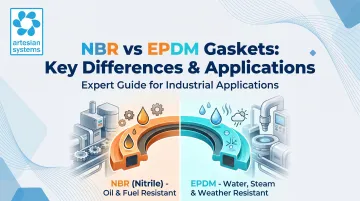
Those numbers make material selection a critical call. NBR and EPDM are two of the most widely used elastomers for gaskets and seals, but they're built for opposite environments: NBR excels in oil and hydrocarbon contact, while EPDM dominates in steam, sanitary processing, and weathering applications.
Choosing the wrong one doesn't just cause leaks. It triggers failed inspections, compliance violations, and contamination risks that compromise product integrity and system uptime.
Key Takeaways
- NBR excels in oil, fuel, and hydrocarbon resistance — making it the standard choice for petroleum, automotive, and chemical applications
- EPDM dominates weather, ozone, UV, steam, and water resistance and is preferred for food, pharma, HVAC, and outdoor use
- Cross-exposure is a hard failure point: NBR degrades under UV and ozone; EPDM swells and fails in petroleum-based oils
- EPDM covers the broadest sanitary compliance path: FDA, 3A Dairy, USDA, and USP Class VI
- Choose based on primary exposure: hydrocarbons favor NBR; steam, weather, and sanitary processing favor EPDM
NBR vs EPDM Gaskets: Quick Comparison
Chemical Composition
NBR (Nitrile Butadiene Rubber): Copolymer of acrylonitrile (ACN) and butadiene. ACN content ranges from 18% to 50%, with higher percentages delivering superior oil resistance but reduced low-temperature flexibility.
This tunable chemistry lets formulators target specific applications:
- High-ACN grades (40-50%): Maximum fuel resistance, but lose flexibility below -15°F (-26°C)
- Low-ACN grades (18-30%): Maintain pliability to -65°F (-54°C) with moderate oil resistance
EPDM (Ethylene Propylene Diene Monomer): Terpolymer of ethylene, propylene, and a diene monomer. Its fully saturated polymer backbone contains no exposed carbon-to-carbon double bonds, giving it inherent resistance to ozone, UV radiation, and oxygen — which is why EPDM outlasts most elastomers in outdoor and weathering applications.
Chemical Resistance
NBR: Excellent resistance to petroleum oils, mineral oils, fuels, hydraulic fluids, aliphatic hydrocarbons, and vegetable oils. Poor resistance to:
- Ozone and UV (causes surface crazing and cracking)
- Ketones and esters
- Aromatic hydrocarbons (causes significant swelling)
- Glycol-based brake fluids
EPDM: Excellent resistance to steam, hot water, weathering, UV, ozone, bases, phosphate ester hydraulic fluids, ketones, and cleaning agents. Critical limitation:
- No hydrocarbon oil resistance — petroleum oils, mineral oils, fuels, and aliphatic hydrocarbons cause significant swelling and structural failure
Temperature Range
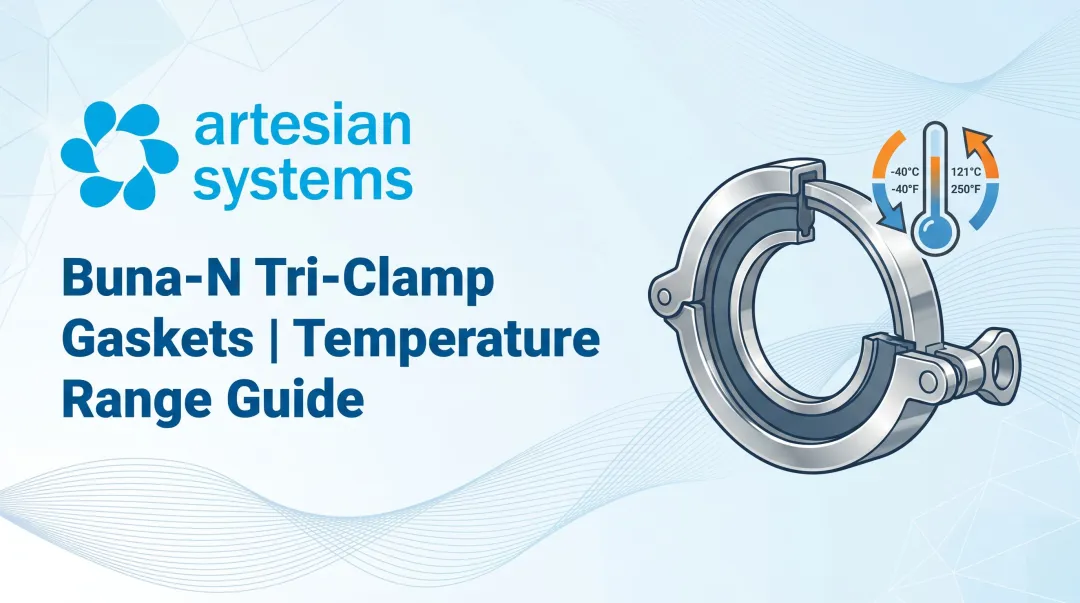
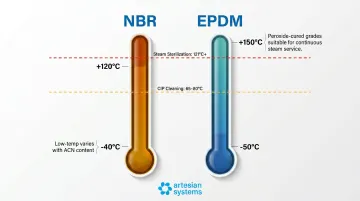
NBR: General operating range of -40°C to +120°C (-40°F to +250°F). Specialty compounds can extend the range, but standard formulations degrade at temperatures exceeding 100°C over time.
EPDM: General operating range of -50°C to +150°C (-60°F to +300°F). Peroxide-cured EPDM formulations reach the upper end of this range and handle continuous steam service, significantly outperforming NBR in high-temperature applications.
Flexibility and Mechanical Properties
NBR: More flexible than EPDM at standard temperatures. Good tensile strength and abrasion resistance. Hardness range Shore A 30–90. Low-temperature performance varies significantly with ACN content.
EPDM: Slightly less flexible than NBR but offers excellent resistance to cracking and tearing even at low temperatures. Hardness range Shore A 30–90. Minimum elongation typically exceeds 300%, providing strong recovery after compression.
Regulatory and Compliance Suitability
NBR: FDA 21CFR177.2600 compliant variants are available, with NSF 51 (food contact) and NSF 61 (drinking water) compounds also on the market. That said, NBR's limited steam resistance rules it out for high-temperature CIP or autoclave sterilization cycles.
EPDM: Widely available in FDA 21CFR177.2600, 3A Dairy, USDA, and USP Class VI compliant formulations. EPDM's superior resistance to alkalis, CIP/SIP detergents, and hot water makes it the preferred choice for food, beverage, and pharmaceutical sanitary systems.
What is NBR?
NBR (Nitrile Butadiene Rubber), also called Buna-N or Nitrile rubber, is a synthetic elastomer produced by copolymerizing acrylonitrile and butadiene. The acrylonitrile content — ranging from 18% to 50% — is the key variable that determines performance characteristics. Higher ACN content delivers stronger oil resistance but reduces low-temperature flexibility, allowing formulators to tune compounds for specific applications.
NBR's core advantage is its exceptional resistance to petroleum-based oils, fuels, and hydrocarbons. This makes it the default gasket material where sealing against oil exposure is the primary concern — reducing leakage risk, extending seal service life, and lowering maintenance costs in oil-heavy systems.
The global NBR market was valued at $3.12 billion in 2025 and is projected to reach $5.00 billion by 2033, with seals and gaskets representing the largest application segment.
Key Limitations
NBR's biggest weakness is its poor resistance to UV radiation, ozone, sunlight, ketones, aromatic fuels, and glycol brake fluids. In outdoor environments or systems exposed to ozone and weathering, NBR will crack and degrade, compromising seal integrity and system uptime. NBR is also unsuitable for high-temperature steam applications like power generation, industrial heating, or steam sterilization.
Regulatory Compliance
FDA 21CFR177.2600 compliant NBR compounds and NSF 51/NSF 61 certified formulations exist for food-contact and drinking water applications.
However, NBR's limited steam resistance makes it unsuitable for high-temperature CIP (clean-in-place) or autoclave sterilization cycles common in food and pharmaceutical processing. Typical CIP caustic cycles run at 65-80°C, and steam sterilization operates at 121°C+ — both conditions where NBR degrades over time.
Use Cases of NBR Gaskets
Primary NBR gasket applications include:
- Hydraulic systems and industrial machinery with mineral oil-based lubricants
- Fuel handling systems and pipelines in petroleum refining
- Oil and gas processing equipment
- Automotive fuel systems and engine seals
- Agricultural equipment seals exposed to petroleum products
- Chemical transfer systems handling aliphatic hydrocarbons
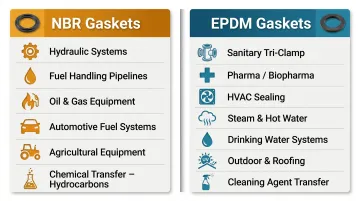
The pattern is consistent: wherever hydrocarbon exposure is constant and temperatures stay within NBR's operational range, it outperforms most alternative elastomers.
What is EPDM?
EPDM (Ethylene Propylene Diene Monomer) is a synthetic rubber produced by polymerizing ethylene, propylene, and a diene monomer through vulcanization. Its defining characteristic is the fully saturated polymer backbone — with no carbon-to-carbon double bonds exposed to the environment — which makes it resistant to breakdown from ozone, UV, and oxygen exposure.
These properties translate directly into longer maintenance intervals and leak-free performance across food, beverage, pharmaceutical, and HVAC systems. Key material characteristics include:
- Steam and hot water resistance rated to +150°C (peroxide-cured grades)
- High resistance to alkalis, CIP/SIP detergents, and hot water, making it well suited for cleaning-in-place processes
- Excellent UV and weathering stability for outdoor applications
- Resistance to alkaline chemicals and most cleaning agents
Why EPDM Fails in Oil and Fuel Service
EPDM absorbs petroleum-based oils, mineral oils, fuels, and aliphatic hydrocarbons, causing it to swell and lose structural integrity. Using EPDM in hydrocarbon service will result in significant swelling, destruction of the liner, and inability of the valve to function properly. It is entirely unsuitable for oil and fuel sealing applications.
Regulatory Compliance Excellence
EPDM is the most widely compliant elastomer for food, beverage, and pharmaceutical gasket applications. Formulations meeting FDA 21CFR177.2600, 3A Dairy, USDA, and USP Class VI standards are commercially available. Material traceability and compliance documentation are non-negotiable in these industries, where even minor deviations can trigger costly production shutdowns.
For companies operating in sanitary processing environments, working with a supplier who understands both regulatory requirements and process conditions is critical. Artesian Systems supplies FDA-compliant sanitary components — including tri-clamp gaskets in sizes from 1.5" to 12" — for food, pharmaceutical, and chemical processing systems, with direct engineering support for material selection and system design.
Use Cases of EPDM Gaskets
Primary EPDM gasket applications include:
- Sanitary tri-clamp gaskets in food and beverage processing
- Pharmaceutical and biopharma process lines requiring USP Class VI compliance
- HVAC sealing systems
- Steam and hot water systems (up to +150°C)
- Drinking water distribution (NSF 61 certified)
- Outdoor and roofing applications exposed to UV and weathering
- Chemical transfer systems handling bases, ketones, and cleaning agents
Newman Sanitary Gasket notes that their EPDM compound 2107 "has been the material of choice for FDA and USP applications for decades around the world" — a track record that reflects how consistently the material performs under regulated process conditions.
NBR vs EPDM: Which Gasket Material is Right for Your Application?
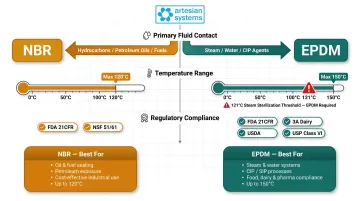
The right question isn't "which is better overall" but "which performs reliably under the specific chemical, thermal, and regulatory conditions of my system." Base your decision on three primary factors:
1. Primary Fluid Contact
Choose NBR when: The system handles petroleum oils, mineral oils, fuels, hydraulic fluids, or aliphatic hydrocarbons. EPDM will swell and fail under these conditions, while NBR maintains seal integrity and mechanical properties. NBR is the standard choice in petroleum refining, automotive systems, and industrial hydraulic applications.
Choose EPDM when: The system involves steam, hot water, CIP cycles (clean-in-place), caustic cleaning agents, or requires FDA, 3A, or USDA material compliance. NBR degrades in steam and breaks down under ozone exposure — both disqualifying factors in sanitary environments where seals must survive repeated high-temperature cleaning cycles.
2. Temperature and Sterilization Method
Typical CIP caustic cycles run at 65-80°C, while hot water sanitization operates at 82°C+. Steam sterilization in pharmaceutical applications reaches 121°C or higher. Peroxide-cured EPDM handles maximum temperatures of +150°C, while standard NBR degrades above 100°C over time. This temperature performance gap directly impacts gasket service life in sanitary systems.
3. Environmental Exposure
Choose EPDM for outdoor applications: UV, ozone, and weathering exposure cause NBR to crack and fail. EPDM's saturated backbone provides inherent resistance to these conditions without requiring antioxidants or antiozonants.
Consult a specialist for mixed exposures: Applications involving both cleaning agents and light hydrocarbons — where neither material is clearly optimal — may benefit from alternative elastomers (Viton, PTFE-based composite gaskets) or engineered solutions.
For engineers specifying components in food, pharma, chemical, or petroleum processing, working with a supplier who understands both regulatory requirements and process conditions reduces long-term maintenance risk. Artesian Systems offers FDA 21CFR177.2600-compliant gaskets alongside CIP system engineering, P&ID development, and custom machining — with nearly two decades of field experience across food, pharmaceutical, and chemical applications to back up material selection guidance.
Conclusion
NBR and EPDM are both high-performance gasket materials serving distinct operational environments. NBR leads in oil and hydrocarbon applications; EPDM leads in steam, weathering, and sanitary/regulated applications. Match your material to fluid contact type, temperature range, and compliance requirements — and you've solved most seal failure problems before they start.
Choosing the wrong gasket material doesn't just cause leaks — it causes unplanned downtime, failed inspections, compliance violations, and contamination risks.
The industrial gaskets market is projected to grow from $12.76 billion in 2025 to $16.84 billion by 2030. In refineries and process-critical facilities driving that growth, getting material selection right at the specification stage prevents seal failures and contamination events — and cuts long-term maintenance costs significantly.
Frequently Asked Questions
What is the difference between NBR and EPDM gaskets?
NBR gaskets resist petroleum oils and fuels but degrade rapidly in ozone and UV environments. EPDM gaskets resist steam, weathering, and cleaning agents but swell and fail when exposed to petroleum-based fluids. The primary difference is chemical compatibility.
What is the difference between NBR and EPDM o-rings?
NBR and EPDM o-rings use the same base elastomers as their gasket counterparts, but o-rings operate under dynamic compression and face more demanding dimensional tolerances. The chemical selection rule still applies — NBR for oil and hydrocarbon contact, EPDM for steam, sanitary, and weather-exposed systems — but o-ring groove design and pressure ratings also factor into the final material choice.
Is NBR (nitrile) or EPDM better for gaskets?
Neither is universally better. NBR is better for oil and hydrocarbon sealing applications. EPDM is better for steam, food and pharma sanitary systems, and outdoor or weather-exposed applications. The right answer depends on the specific fluid, temperature, and compliance requirements.
Can EPDM gaskets be used with petroleum-based oils?
No. EPDM should not be used with petroleum oils, mineral oils, fuels, or aliphatic hydrocarbons. EPDM will absorb these fluids, swell, and lose its sealing properties. NBR is the correct material choice for petroleum-contact applications.
Are NBR gaskets food-safe or FDA compliant?
FDA 21CFR177.2600 and NSF 51 compliant NBR compounds exist and are suitable for certain food-contact applications. However, NBR's limited steam resistance makes it unsuitable for systems requiring high-temperature CIP sterilization — a critical consideration in food and pharma processing.
What temperature range can NBR and EPDM gaskets handle?
Standard NBR operates from approximately -40°C to +120°C (-40°F to +250°F). Standard EPDM handles a wider range: -50°C to +150°C (-65°F to +300°F), with peroxide-cured EPDM formulations holding up under continuous steam service at the upper limit.