Introduction
Choosing the wrong gasket material in sanitary processing, pharmaceutical manufacturing, or chemical handling environments isn't just an inconvenience—it's a direct path to product contamination, system failure, or unplanned downtime that can cost your facility hundreds of thousands of dollars per incident.
For engineers and procurement managers, the decision between EPDM and Viton is one of the most consequential material selections in the entire system.
This choice extends far beyond initial cost. Temperature range, chemical compatibility, regulatory compliance (FDA, 3A, USDA), and service life all depend on selecting the right elastomer for your application. A wrong call means shutting down production lines, scrapping contaminated batches, and explaining how a $15 gasket created a $500,000 problem.
This guide breaks down both materials across the criteria that matter most—so you can make the right call before installation, not after.
Key Takeaways
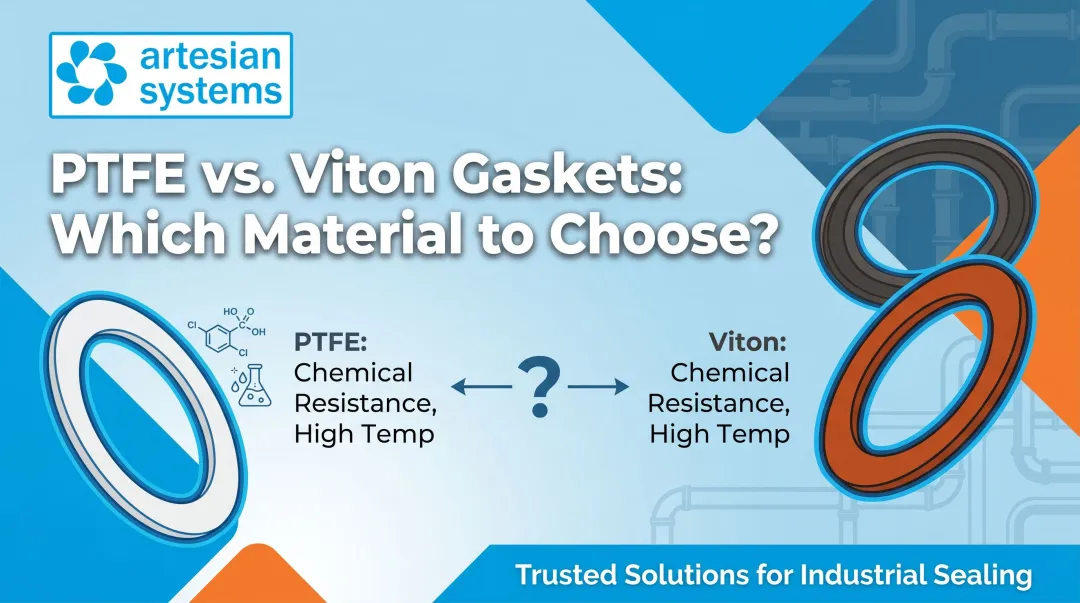
- EPDM suits water, steam, and sanitary lines—FDA/3A/USDA compliant, rated to 275°F
- Viton handles oils, fuels, and aggressive solvents in chemical, petroleum, and extraction systems up to 410°F
- At 8-10x the cost, Viton earns its price only where EPDM would fail—high heat or harsh chemical exposure
- The right choice depends on your fluid type, operating temperature, and compliance requirements
EPDM vs. Viton: Quick Comparison
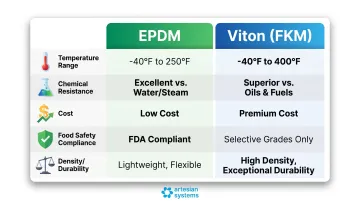
Here's how EPDM and Viton (FKM) stack up across the attributes that matter most for sanitary and industrial process applications.
| Attribute | EPDM | Viton (FKM) |
|---|---|---|
| Temperature Range | -55°F to 275°F (-45°C to 135°C); specialty compounds to 300°F | -40°F to 410°F (-40°C to 210°C); intermittent peaks to 500°F |
| Chemical Resistance | Excellent: water, steam, diluted acids/alkalis, ozone, alcohols / Poor: oils, fuels, petroleum products | Excellent: oils, fuels, aromatic hydrocarbons, mineral acids, hydraulic fluids / Poor: ketones, amines (except ETP grade), polar solvents |
| Cost | Baseline pricing; economical for high-volume applications | 8-10x more expensive than EPDM at material level |
| Food Safety Compliance | Widely available in FDA 21CFR177.2600, 3A Sanitary Standards, USDA-compliant grades | Available in FDA-compliant grades; primarily used in chemical/petroleum environments |
| Density & Durability | Lighter (0.86-1.2 specific gravity); flexible; available in solid and foam forms | Denser (1.7-1.9 specific gravity); superior compression resistance and chemical inertness |
What is EPDM?
EPDM (Ethylene Propylene Diene Monomer) is a synthetic rubber composed of ethylene, propylene, and diene monomers. Its saturated polymer backbone—meaning no carbon-carbon double bonds in the main chain—delivers strong resistance to oxidation, weathering, and polar solvents.
This molecular structure makes EPDM inherently suited for clean, water-based, and outdoor-exposed environments where other elastomers would degrade rapidly.
Performance Properties That Matter
Temperature performance: EPDM maintains flexibility at temperatures as low as -55°C (-67°F) and handles continuous service up to 135-150°C (275-300°F). Parker Hannifin documents specialty compounds tested at 288°C (550°F) in steam service for 70 hours with minimal property change. That covers the full CIP/SIP temperature envelope used in pharmaceutical and food processing.
Chemical resistance profile:
- Steam and hot water: 0% swell over 3 years at room temperature; approximately 2% swell at 70°C (158°F)
- Ozone and UV: Essentially immune to ozone degradation and surface cracking; maintains structural integrity outdoors without protective coatings
- Alkalis and diluted acids: Highly resistant to sodium/potassium alkalis and diluted cleaning chemicals commonly used in CIP systems
- Critical limitation: Poor performance with mineral oils, petroleum-based lubricants, fuels, and hydrocarbon solvents—contact causes swelling and structural breakdown
Regulatory Compliance Credentials
For food-contact applications, EPDM is the preferred choice when formulated to meet regulatory requirements. FDA 21 CFR 177.2600 governs rubber articles for repeated food contact, establishing extractives limits and a positive list of permitted compounds. 3-A Sanitary Standard 18-03 adds dairy and food-specific material serviceability testing across four classes, requiring compliance with FDA regulations as a prerequisite plus additional immersion testing for compatibility with food fats and cleaning chemicals.
Artesian Systems supplies EPDM gasket components in sizes from 1.5" to 12" meeting FDA 21CFR177.2600, 3A Sanitary Standards, and USDA requirements—covering pharmaceutical manufacturing, food and beverage processing, and nutraceutical extraction applications.
Primary Use Cases
Those compliance credentials translate directly into a defined set of applications where EPDM consistently outperforms other elastomers:
EPDM is the practical choice for:
- CIP (clean-in-place) and SIP (steam-in-place) systems
- Steam lines and hot water distribution
- Food and beverage processing equipment
- Pharmaceutical transfer lines
- Nutraceutical extraction systems
- Water treatment and distribution
What is Viton?
Viton—a registered trademark of Chemours for FKM (fluoroelastomer)—is a synthetic fluoropolymer rubber. Its fluorine content, ranging from 64% to 70% depending on grade, delivers exceptional resistance to chemicals, heat, and aggressive solvents.
That fluorine-rich backbone resists chemical attack from substances that would destroy conventional elastomers like EPDM, making it the default choice in high-risk sealing environments.
Performance Properties
Chemours documents Viton's maximum continuous service temperature at 204°C (400°F), with intermittent tolerance to 260°C (500°F). That range makes it essential when process temperatures exceed EPDM's 135–150°C ceiling.
Key performance characteristics:
- Rated to 204°C continuous / 260°C intermittent service
- Excellent resistance to mineral oils, fuels, aromatic hydrocarbons, and hydraulic fluids
- Compatible with most mineral acids and oxidizing agents
- Low gas permeability suits vacuum service applications
- High density (1.7–1.9 specific gravity) and strong compression resistance support long-term sealing integrity
Key limitations:
- Significantly higher cost than EPDM (8-10x at material level)
- Limited low-temperature flexibility compared to EPDM
- Incompatible with ketones, certain polar solvents, and some amines
- Higher density makes it unsuitable for vibration-isolation applications
Those limitations matter most when selecting a grade—because within Viton, grade choice is as consequential as choosing Viton over another elastomer entirely.
Viton Grades: Specificity Matters
Not all Viton is the same. Grade selection is as critical as choosing Viton over EPDM:
Common grades:
- Viton A (66% fluorine): General-purpose; automotive fuels, lubricants, mineral acids
- Viton B (68% fluorine): Better fluid resistance than A; chemical processing applications
- Viton F (70% fluorine): Best resistance to aggressive/oxygenated fuel blends; lowest toluene swell
- Viton ETP (67% fluorine): Only grade resistant to bases, amines, and steam—critical for caustic CIP environments
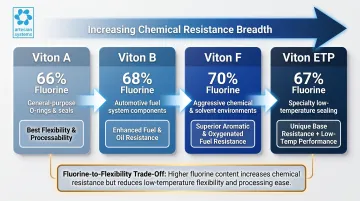
The core trade-off: higher fluorine content increases chemical resistance breadth but decreases low-temperature flexibility. Specifying "Viton" without a grade suffix risks compatibility failures as severe as selecting the wrong base material.
Market Adoption in High-Risk Environments
The global fluoroelastomer market reached $1.69 billion in 2024, with the FKM segment (including Viton) holding over 76% of market revenue. That concentration of revenue traces directly to industries where gasket failure isn't a maintenance event—it's a process shutdown or safety incident.
Primary applications include:
- Petroleum refining and offshore oil/gas operations
- Chemical processing and aggressive solvent handling
- Aerospace fuel and hydraulic systems
- Pharmaceutical manufacturing with organic solvents
- Hemp and cannabis hydrocarbon extraction systems
- Any environment where off-gassing or fuels cause rapid elastomer degradation
EPDM vs. Viton: Which Gasket Material Should You Choose?
Decision Framework
Evaluate six critical factors before specifying:
- Fluid/chemical type: Water-based vs. oil/solvent-based environments
- Operating temperature range: Peak and continuous exposure levels
- Regulatory compliance requirements: FDA, 3A, USDA mandates
- Pressure and sealing demands: Vacuum service, high-pressure systems
- Expected service life vs. total cost of ownership: Initial cost vs. replacement frequency
- Downtime tolerance: Cost per hour of unplanned outages
Clear Situational Recommendations
Choose EPDM when:
- Working with water, steam, diluted cleaning chemicals, or food-grade products
- Operating temperatures stay below 275°F (135°C)
- Requiring 3A/FDA/USDA compliance for food or pharmaceutical contact
- Cost-efficiency matters at scale for high-volume gasket applications
- Exposure to ozone, UV, or weathering is expected
Choose Viton when:
- Handling oils, fuels, aromatic solvents, or petroleum-based fluids
- Operating temperatures exceed 275°F or reach sustained levels above 150°C
- Processing hydrocarbon-based extraction operations
- Vacuum service requires low gas permeability
- Chemical exposure includes aggressive organic solvents or mineral acids
Total Cost of Ownership: The Real Equation
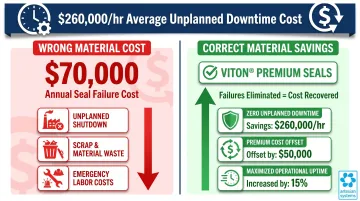
Material cost differences become irrelevant measured against downtime expenses. Unplanned downtime averages $260,000 per hour across manufacturing sectors. In food and beverage plants, Siemens quantifies costs at $36,000 per hour. Chemical processing facilities face approximately $500,000 per day.
A single gasket failure can exceed your entire annual gasket procurement budget. Detroit Sealing documented a facility incurring over $70,000 in annual seal failure costs from using EPDM in a hydrocarbon environment—switching to Viton eliminated failures despite the material's 8-10x cost premium. The same source also documents a facility that specified Viton for a hot water system where EPDM was sufficient, adding $12,000 annually with no performance benefit.
Real-World Application Scenarios
Dairy Processing: EPDM in Steam CIP Service
A dairy facility running steam-cleaned transfer lines at 280°F maintains 3A compliance through daily 90-minute CIP sequences with caustic and acidic cleaners. EPDM gaskets in 1.5" to 6" tri-clamp configurations showed zero degradation after 18 months. Replacement is scheduled per GMP protocols—not failure. Total gasket cost per line: approximately $800 annually.
Cannabis Extraction: EPDM Failure, Viton Fix
A CO₂ and butane extraction facility initially specified EPDM on solvent recovery lines. Within three weeks, operators found gasket swelling and solvent odors at clamp connections. Switching to Viton A-type gaskets rated for hydrocarbon service eliminated failures entirely. Gasket costs rose from $45 to $380 per connection point—but the facility avoided $15,000 per incident in emergency shutdowns and solvent loss.
Material Guidance From Artesian Systems
Artesian Systems manufactures FDA 21CFR, 3A, and USDA compliant tri-clamp gaskets in both EPDM and Viton for food, pharmaceutical, chemical, and extraction applications. The company's founder brings nearly two decades of hands-on experience in petroleum, chemical, and food industries, including development of a patented medical hydrocarbon extractor.
Contact Artesian Systems to discuss material selection for your process environment and get specifications for the right gasket configuration.
Conclusion
Neither EPDM nor Viton is universally superior. The right material depends entirely on the specific combination of fluid type, temperature, regulatory requirements, and cost constraints in your application. Operators who align gasket selection to these variables see fewer failures, lower maintenance costs, and stronger compliance outcomes.
The key decision factors come down to:
- Chemical exposure — solvents and hydrocarbons favor Viton; steam, water, and mild acids favor EPDM
- Temperature range — Viton handles sustained high heat; EPDM suits moderate-temperature sanitary service
- Regulatory requirements — both can meet FDA 21CFR and 3-A standards, but confirm compliance for your specific process
In regulated industries like food, pharmaceutical, and chemical processing, a gasket that performs reliably isn't just an engineering choice — a wrong material choice risks batch contamination, failed audits, and unplanned downtime. Evaluate both materials against your process specifications, or reach out to Artesian Systems' engineering team before finalizing your selection. The failure cost — in product loss, rework, and regulatory exposure — almost always exceeds the cost of specifying correctly from the start.
Frequently Asked Questions
Is EPDM or Viton cheaper?
EPDM is significantly less expensive than Viton—8-10x lower at the raw material level for typical industrial gasket applications. In chemically aggressive or high-temperature environments, Viton's premium pays for itself through longer service life and avoided seal failures.
How long does an EPDM gasket last?
In water, steam, and clean process environments, EPDM service life ranges from 20 to 50 years under optimal conditions. Sanitary gaskets in CIP/SIP service typically carry a 5-year shelf life, with actual replacement driven by cycle frequency, peak temperatures, and chemical exposure.
What is the difference between Viton and EPDM gaskets?
The key differences:
- Chemical resistance: Viton excels with oils and fuels; EPDM excels with water, steam, and diluted chemicals
- Temperature range: Viton tops out at 410°F; EPDM holds down to -55°F
- Density: Viton is significantly heavier (1.7–1.9 vs. 0.86–1.2 specific gravity)
- Cost: Viton runs 8–10x more expensive at the raw material level
Is EPDM better than Viton for water?
Yes. EPDM is the preferred choice for water, hot water, and steam—maintaining flexibility, sealing integrity, and food-grade compliance where Viton offers no performance advantage at a fraction of the cost. EPDM shows 0% swell over three years in room-temperature water service.
Can EPDM gaskets be used in food and pharmaceutical processing?
EPDM is widely used in food, dairy, beverage, and pharmaceutical processing when formulated to meet FDA 21CFR177.2600, 3A Sanitary Standards, and USDA requirements. Buyers should verify the specific gasket's compliance certification before use in regulated environments, as compliance is compound-specific rather than material-generic.
When should I choose Viton over EPDM for industrial gaskets?
Choose Viton when your application involves petroleum-based fluids, fuels, aggressive organic solvents, hydrocarbon extraction, or sustained temperatures above 275°F—conditions where EPDM would swell or degrade, making Viton's premium negligible against the cost of unplanned downtime.