Introduction
In sanitary process industries—food & beverage, pharmaceutical, chemical extraction—gasket material selection ranks among the most critical equipment decisions engineers and procurement teams make. According to the FDA's 2025 inspection enforcement data, deteriorated gasket seals remain a recurring violation in pharmaceutical manufacturing, highlighting the critical role proper material selection plays in regulatory compliance.
Choose the wrong material and you risk chemical degradation, seal failure, regulatory violations, and unplanned downtime. The cost of a $3 gasket failure can easily run into thousands in lost production.
Buna-N (NBR/Nitrile) and EPDM are the two most frequently specified elastomers in sanitary applications—yet they perform very differently depending on what's flowing through your system. This guide breaks down where each material excels, where it fails, and how to match the right gasket to your process conditions.
Key Takeaways
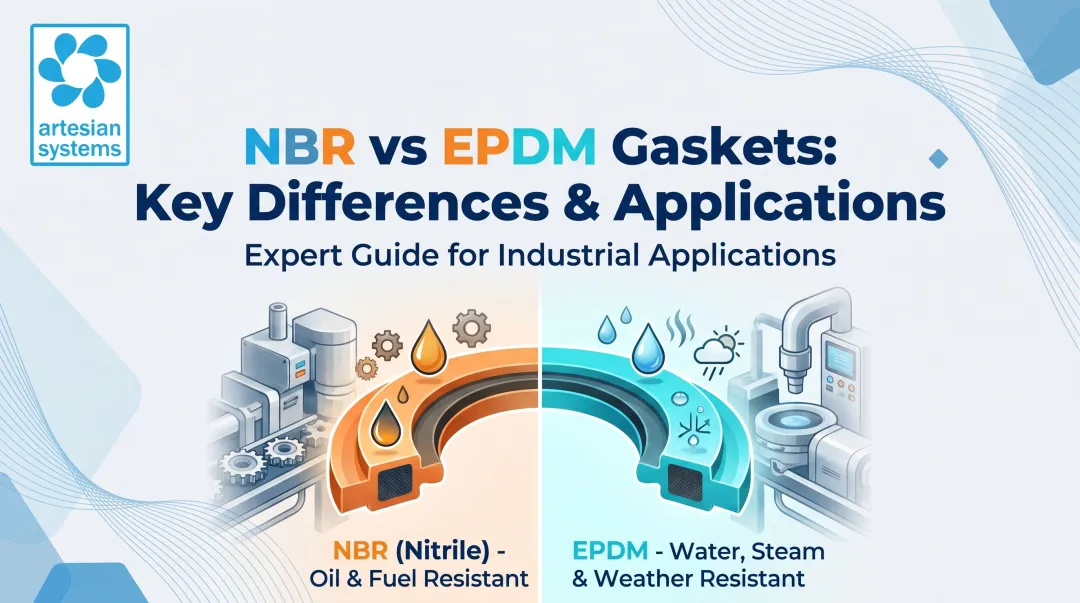
- Buna-N excels in petroleum oils, fuels, and hydrocarbon environments; EPDM dominates in water, steam, and cleaning agent applications
- EPDM handles temperatures from -55°F to 300°F versus Buna-N's -40°F to 225°F range—critical for steam and high-heat CIP protocols
- A 2025 Journal of Dairy Science study found Buna-N harbors significantly higher bacterial biofilm counts than EPDM
- EPDM's CIP sanitizer resistance makes it the practical default for sanitary processing—both materials meet FDA 21 CFR 177.2600, but EPDM holds up under cleaning
- Your process fluid chemistry, operating temperature, and cleaning protocols—not just cost—should drive material selection
Buna-N vs. EPDM: Quick Comparison
Chemical Composition
Buna-N is a copolymer of acrylonitrile and butadiene, with acrylonitrile (ACN) content typically ranging from 18% to 50%.
The ACN percentage directly governs oil resistance: high-ACN compounds (>45%) deliver maximum petroleum resistance but sacrifice low-temperature flexibility, while low-ACN formulations (<30%) maintain elasticity in cold environments but offer reduced oil resistance.
EPDM consists of ethylene, propylene, and a diene monomer. Its saturated polymer backbone—meaning the main ethylene-propylene chain contains no carbon-carbon double bonds—gives EPDM its outstanding resistance to ozone, UV radiation, and heat degradation. The diene monomer provides crosslinking sites while preserving this structural stability.
Temperature Range
| Material | Operating Range | Best For |
|---|---|---|
| Buna-N | -40°F to 225°F | Ambient to moderate-heat applications |
| EPDM (peroxide-cured) | -55°F to 300°F | Steam sterilization and high-temp CIP cycles |
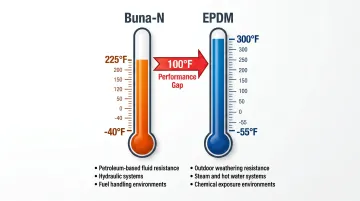
According to Rubber Fab's sanitary gasket temperature chart, EPDM carries a 100°F upper-limit advantage over Buna-N in sanitary service—enough margin to handle steam-in-place (SIP) protocols and elevated-temperature CIP cycles where Buna-N would degrade.
Chemical & Fluid Resistance
Buna-N handles:
- Petroleum oils and mineral oils
- Diesel, gasoline, and fuel oils
- Hydraulic fluids (HFA, HFB, HFC)
- Vegetable oils and animal fats
- Dilute acids and alkalis at low temperatures
Buna-N fails with:
- Ozone and UV exposure (confirmed poor resistance by Parker's elastomer handbook)
- Ketones (acetone, MEK) causing swelling
- Peroxide-based sanitizers (even <1% peracetic acid causes brittleness per Marco Rubber compatibility data)
- Steam (rated "0 - Do Not Use" by Rubber Fab's sanitary seal guidelines)
EPDM handles:
- Hot water and steam up to 300°F
- Ketones and polar solvents
- Strong acids and alkalis at cleaning concentrations
- CIP sanitizers (caustic, peroxide-based, nitric acid)
- Phosphate ester hydraulic fluids
EPDM fails with:
- Petroleum oils and mineral oils (causes rapid swelling)
- Gasoline, diesel, and aliphatic hydrocarbons
- Chlorinated solvents
- Non-polar process media
Regulatory & Compliance Standing
Both Buna-N and EPDM formulations can meet FDA 21 CFR 177.2600 compliance for food-contact rubber articles. Under 3-A Sanitary Standard 18-03, both occupy Class II status.
In practice, the distinction comes down to serviceability testing. EPDM's resistance to CIP chemicals and steam means it passes 3-A cycling tests more readily.
Buna-N can meet FDA ingredient requirements yet still fail 3-A cleaning agent compatibility testing when exposed to the peroxide-based sanitizers and caustic chemicals common in aggressive sanitation protocols.
Relative Cost
Buna-N represents the more cost-effective general-purpose option. EPDM carries a 10–15% cost premium due to its broader thermal and chemical resistance range, but facilities running frequent CIP cycles or SIP sterilization often recoup that premium through fewer seal replacements and less unplanned downtime.
What is Buna-N?
Buna-N—also called Nitrile or NBR (Nitrile Butadiene Rubber)—was developed as an oil-resistant alternative to natural rubber. The acrylonitrile content determines its performance profile: engineers can specify low-ACN compounds for cold flexibility or high-ACN grades for maximum hydrocarbon resistance—making compound selection as important as material selection itself.
Core Performance Strengths
Buna-N's strengths center on three properties:
- Oil and fuel resistance: Handles petroleum-based oils, mineral oils, fuels, hydraulic fluids, and animal/vegetable oils—the right choice for petroleum processing, fuel handling, and food manufacturing involving fats and oils
- Mechanical durability: Good abrasion resistance and tear strength hold up under installation stress and thermal cycling
- Temperature range: Rated -40°F to 225°F, covering most ambient and moderate-heat applications
Critical Limitations
Ozone and weathering vulnerability: Parker's elastomer handbook confirms NBR is "not resistant to weathering and ozone." Outdoor applications or processes with ozone exposure will experience surface cracking and seal degradation.
CIP sanitizer incompatibility: Peroxide-based sanitizers—even at concentrations below 1%—cause Buna-N to become brittle and crack. Facilities running peracetic acid or hydrogen peroxide cleaning protocols cannot use Buna-N.
Steam service prohibition: Rubber Fab rates Buna-N as "0 - Do Not Use" for both continuous and intermittent steam in sanitary applications. For SIP applications, Buna-N is an absolute no—not a marginal choice, but a disqualification.
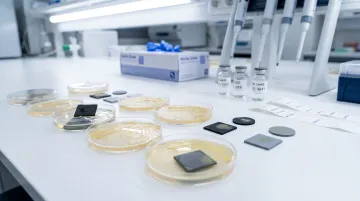
Biofilm risk: A 2025 peer-reviewed study found Buna-N surfaces harbored the highest Staphylococcus aureus biofilm counts of all tested materials—up to 4.54 log₁₀ cfu/mL—significantly exceeding EPDM, silicone, and stainless steel. At that contamination level, gasket material selection becomes a food safety decision, not just an engineering one.
Compliance Credentials
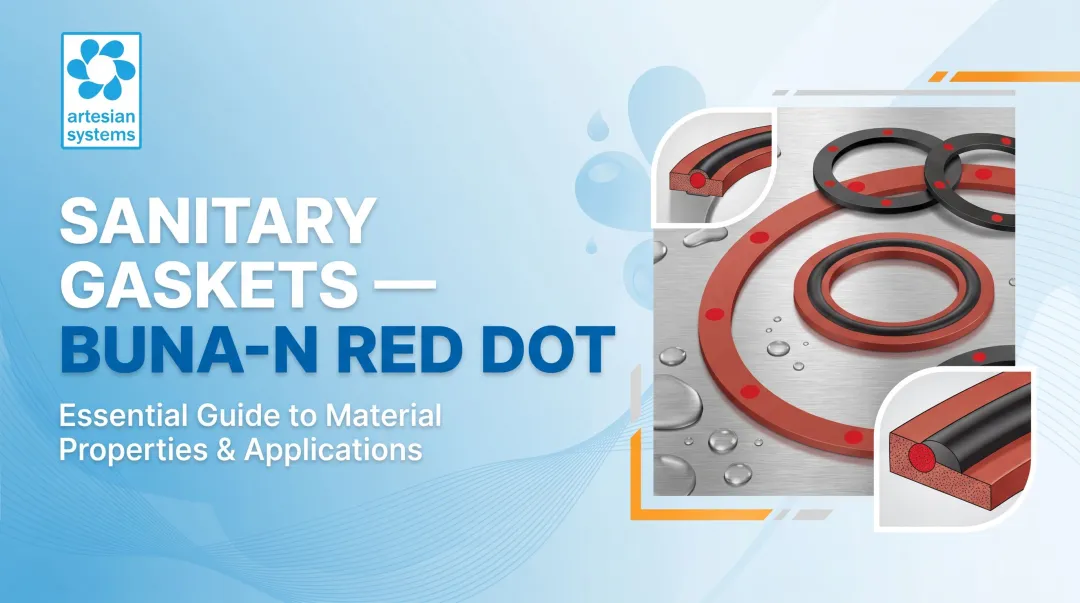
FDA 21 CFR 177.2600 compliant formulations exist, making food-grade Buna-N viable for specific food-contact applications. Engineers must verify compound-specific certifications—the regulation specifies permitted ingredients and extraction limits, not elastomer families by name. Artesian Systems' Buna-N tri-clamp gaskets carry FDA 21 CFR 177.2600/177.1550, 3-A, and USDA certifications—one example of how properly specified Buna-N can satisfy sanitary processing requirements when the compound is verified.
Use Cases of Buna-N
Buna-N performs best in environments where petroleum-based fluids and non-polar solvents are present. Its strongest applications include:
- Petroleum and chemical processing industries
- Oil and gas processing facilities
- Fuel handling and storage systems
- Hydraulic fluid systems
- Automotive sealing applications
It also has a foothold in select food processing environments — specifically those handling oil-based media:
- Meat processing operations involving animal fats
- Dairy fat handling systems
- Vegetable oil extraction and refining
- Oil-based media processing where CIP protocols use mild alkalis or detergents at ambient temperatures
That last point carries a hard limit. Buna-N holds up when cleaning involves mild alkalis or low-temperature detergents. Introduce peroxide sanitizers or steam sterilization, and EPDM becomes the required choice.
What is EPDM?
EPDM (Ethylene Propylene Diene Monomer) is a synthetic rubber built for long-term sanitary seal integrity in demanding process environments.
Its saturated polymer backbone — meaning no carbon-carbon double bonds in the main chain — blocks the oxidative attack that degrades other elastomers. That structural advantage translates directly into durability against heat, ozone, UV, steam, and cleaning chemicals.
Core Performance Strengths
- Temperature range: -55°F to 300°F — peroxide-cured grades handle continuous steam service, per Rubber Fab's sanitary seal guidelines. That's a 175°F advantage over Buna-N, making EPDM the default choice wherever steam or elevated CIP temperatures are involved.
- CIP and sanitizer resistance — survives caustic washes (sodium hydroxide at 176°F), acid rinses (nitric or peracetic acids), and peroxide-based sanitizers: the exact chemistry that destroys Buna-N gaskets.
- Environmental durability — resists ozone, UV, and weathering, so EPDM performs equally well in indoor process lines and outdoor installations.
- Chemical compatibility — compatible with hot water, de-ionized water, alkalis, acids at cleaning concentrations, ketones, and glycol-based fluids.
That range of strengths makes EPDM a natural fit for most sanitary process environments — with one hard exception.
Critical Limitation
EPDM swells and degrades rapidly when exposed to petroleum oils, mineral oils, and common fuels. This isn't a gradual wear issue — contact causes irreversible damage, making it an absolute disqualifier for any petroleum-handling application.
For food, pharmaceutical, and nutraceutical facilities, this limitation rarely comes into play. These processes primarily handle aqueous solutions, not petroleum-based media, so EPDM's incompatibility with oils is seldom a practical constraint.
Compliance and Sanitary Process Credentials
For regulated industries, material traceability matters as much as performance. EPDM is available in formulations compliant with:
- FDA 21 CFR 177.2600 for food-contact applications
- 3-A Dairy Standards for sanitary dairy processing
- USDA requirements for meat and poultry plants
- USP Class VI for pharmaceutical manufacturing
Critical procurement specification: All sanitary EPDM gaskets should be peroxide-cured, not sulfur-cured. According to Rubber Fab's technical guidance, sulfur-cured EPDM has been shown to reduce mammalian cell yields in biopharmaceutical applications. Procurement teams ordering "EPDM gaskets" without specifying cure chemistry risk receiving unsuitable material.
Artesian Systems' EPDM tri-clamp gaskets are verified compliant at the compound level — not just the finished component — covering FDA 21 CFR 177.2600, 3-A Dairy Standards, and USDA requirements.
Use Cases of EPDM
EPDM's resistance to heat, steam, and polar solvents makes it the default choice across sanitary and regulated process industries. If your facility runs CIP/SIP cycles or needs to meet FDA or 3-A standards, EPDM is typically the starting point.
Common applications include:
- Dairy processing and cheese manufacturing
- Food and beverage production lines
- Pharmaceutical manufacturing (tablet coating, API processing)
- Nutraceutical and biopharmaceutical fluid handling
- Drinking water and ultra-pure water systems
- Glycol-based heating and cooling loops in process facilities
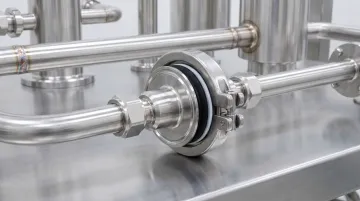
The through line: EPDM holds its own wherever hot water, steam sterilization, and regulatory compliance are the baseline — not the exception.
Buna-N vs. EPDM: Which Gasket Material is Better?
Neither material is universally superior—the right choice depends on four decision factors.
Decision Factor 1: Process Fluid Chemistry
Choose Buna-N when: Your process involves petroleum oils, mineral oils, fuels, hydraulic fluids, or animal/vegetable fats. EPDM will fail rapidly in these applications.
Choose EPDM when: Your process involves water-based solutions, cleaning agents, alkalis, ketones, or any aqueous media. EPDM's saturated backbone provides long-term chemical stability.
Decision Factor 2: Operating Temperature
Choose Buna-N when: Operating temperatures remain below 225°F and steam sterilization is not required.
Choose EPDM when: Your process includes steam cycles, elevated-temperature CIP (above 200°F), or requires thermal cycling between ambient and 300°F. That 100°F upper-limit advantage matters most for facilities running SIP protocols, where Buna-N simply cannot hold up.
Decision Factor 3: Cleaning and Sanitation Protocol
Choose Buna-N when: CIP protocols use mild detergents or dilute alkalis at ambient temperatures, avoiding peroxide-based sanitizers.
Choose EPDM when: Your facility uses:
- Peracetic acid or hydrogen peroxide sanitizers
- Caustic washes at elevated temperatures
- Acid rinses (nitric, phosphoric)
- Steam sterilization between production runs
According to Hennig Gasket's CIP technical guide, typical CIP protocols subject gaskets to caustic washes circulated at 176°F followed by acid rinses—conditions that eliminate Buna-N from consideration.
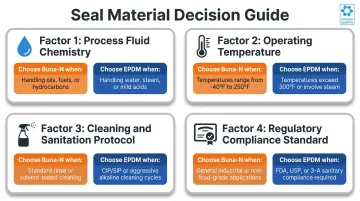
Decision Factor 4: Regulatory Compliance Standard
Both materials meet FDA 21 CFR 177.2600 when properly formulated. However, EPDM's resistance to CIP chemicals and steam means it passes 3-A serviceability testing more readily for dairy and pharmaceutical applications.
For pharmaceutical manufacturers requiring USP Class VI certification, EPDM is available in compliant formulations; Buna-N generally does not pass USP Class VI testing according to Rubber Fab's material guidelines.
Real-World Impact: Biofilm Control in Dairy Processing
The 2025 Journal of Dairy Science study provides quantitative evidence on contamination risk, not just performance ranking. S. aureus counts on Buna-N surfaces reached 4.54 log₁₀ cfu/mL—well above counts recorded on EPDM, silicone, and stainless steel—linking material selection directly to microbial control outcomes.
An earlier study (Czechowski, 1990) connected Buna-N gasket wear time to increased bacterial attachment risk in milk processing lines. Gasket replacement frequency, not just material choice, becomes a contamination control variable when Buna-N is in use.
For dairy processors, the practical takeaway is straightforward: EPDM reduces both cleaning chemical degradation and microbial accumulation risk, making it the lower-maintenance choice in CIP-intensive environments.
When to Consult a Specialist
When regulatory compliance and fluid compatibility must be validated together, material selection gets more complex—particularly in facilities where both oil-based and water-based media are present in different process zones.
Artesian Systems stocks FDA 21 CFR, 3-A, and USDA compliant gaskets in EPDM, Buna-N, PTFE, and Viton formulations. The company's founder spent nearly two decades as a mechanical engineer across petroleum, chemical, and food industries before building Artesian Systems around the component gaps he encountered firsthand—including material segmentation challenges in mixed-media facilities.
Conclusion
The right choice comes down to your process conditions:
- Buna-N fits oil and fuel service, temperatures below 225°F, and CIP systems using mild detergents
- EPDM is the standard for hot water, steam, aggressive CIP chemicals, and FDA/3-A regulated sanitary environments
In high-stakes industries like food, pharmaceutical, and chemical processing, an incorrectly specified gasket material risks not just equipment downtime but regulatory non-compliance, contamination events, and product recalls. The 2025 FDA warning letter to Apotex Inc.—which cited deteriorated gasket seals as a GMP violation—shows that material selection is an enforcement-level concern, not just an engineering preference.
Specify the right material upfront. Swapping a gasket after a contamination event or a regulatory audit costs far more than getting the spec right the first time.
Frequently Asked Questions
What is the difference between Buna-N and EPDM gaskets?
Buna-N is a nitrile-based synthetic rubber optimized for petroleum oils, fuels, and hydrocarbon resistance, while EPDM excels in water, steam, ozone, and cleaning agent environments. The choice depends on whether your process involves oil-based media (Buna-N) or aqueous solutions with CIP cleaning (EPDM).
Is EPDM the same as Viton?
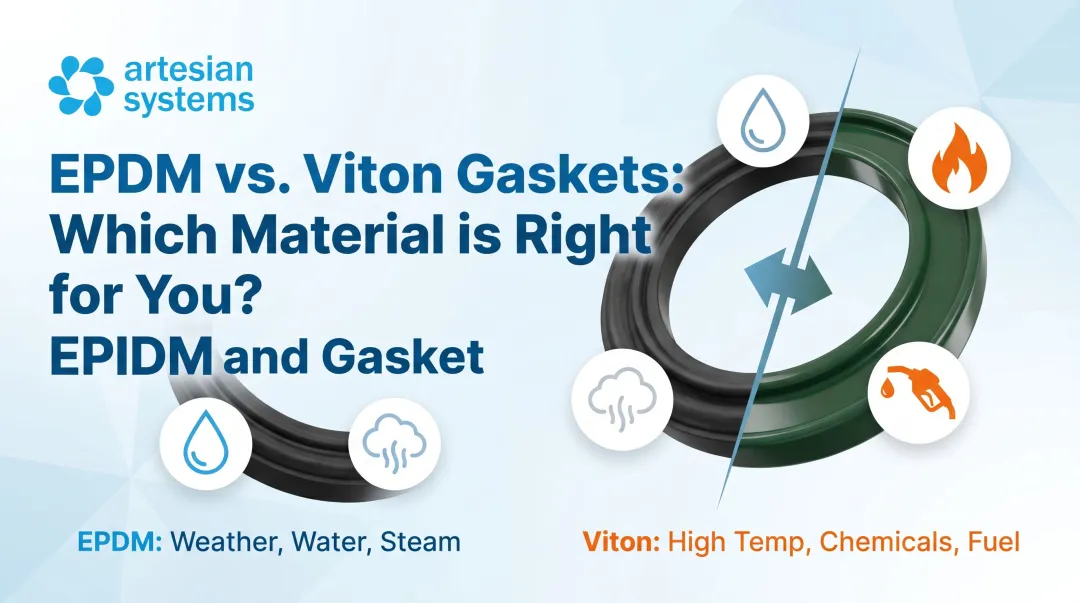
EPDM and Viton (FKM fluorocarbon rubber) are distinct elastomer families. EPDM is suited for water, steam, and cleaning agents with a -55°F to 300°F range. Viton handles petroleum oils and aggressive chemicals from -4°F to 410°F but at a significant cost premium and with poor ketone and steam resistance.
What are alternatives to EPDM gaskets?
Common alternatives include Buna-N for oil/fuel environments, Viton for extreme chemical and thermal resistance, platinum-cured silicone for ultra-pure pharmaceutical applications (-40°F to 450°F), and PTFE for universal chemical inertness. Each material fills a specific gap where EPDM falls short.
Can Buna-N gaskets be used in food-grade applications?
FDA 21 CFR 177.2600 compliant Buna-N formulations exist for food-contact use. Verify compound-specific certifications and confirm CIP sanitizers are free of peroxide-based chemicals, which degrade Buna-N rapidly. It's best suited to oil-based food processing with mild cleaning protocols.
Which gasket material is better for steam and hot water applications?
EPDM is the correct choice for steam and hot water service, handling temperatures up to 300°F and maintaining integrity through CIP/SIP cycles. Buna-N is rated "0 - Do Not Use" for steam applications and has a 225°F temperature ceiling.
Is Buna-N or EPDM better for oil and chemical resistance?
Buna-N excels for petroleum oils, mineral oils, fuels, and hydraulic fluids—EPDM degrades rapidly in these applications. Conversely, EPDM handles cleaning chemicals, alkalis, ketones, and peroxide-based sanitizers far better than Buna-N. When your system runs both oil-based and aqueous media, identify the dominant chemistry first—that single factor typically determines the right call.