Introduction
Picture this: A maintenance technician stands in a processing facility, holding two identical-looking black gaskets. One is nitrile, perfect for the oil-based product line being serviced. The other is EPDM, which will fail catastrophically in the same application. With no visible difference between them, how can the technician make the right choice?
The answer lies in a tiny marking on the gasket's edge: a single red dot.
BUNA-N (nitrile rubber) sanitary gaskets are among the most widely used elastomeric seals in process industries, from food and beverage to pharmaceutical manufacturing. The single red dot marking is the industry-standard identifier, letting maintenance teams and engineers confirm material compatibility at a glance. That small detail prevents seal failure, product contamination, and regulatory violations.
What follows covers BUNA-N material properties, how the color-dot system works, application fit, temperature and chemical limits, and side-by-side comparisons with EPDM, Silicone, and Viton.
TLDR:
- BUNA-N (nitrile) sanitary gaskets are identified by a single red dot on the gasket edge—a manufacturer-driven convention used industry-wide
- Operating range: -40°F to +250°F; excellent resistance to petroleum oils, fats, and hydrocarbon solvents
- NOT suitable for steam-in-place (SIP), hot caustic cleaners above 140°F, or strong acids/ketones
- Compliant formulations meet FDA 21CFR177.2600, 3-A, and USDA standards for food and pharma contact
- Artesian Systems stocks FDA-compliant BUNA-N tri-clamp gaskets with no minimum order quantity for food, beverage, and hydrocarbon extraction applications
What Is a BUNA-N Sanitary Gasket?
BUNA-N—also called nitrile rubber or NBR—is a synthetic copolymer of acrylonitrile (ACN) and butadiene. The acrylonitrile content ranges from 18% to 50%, with higher ACN content improving oil resistance while reducing low-temperature flexibility. Medium-ACN formulations (around 30-40%) strike the best balance for general sanitary service.
That ACN balance matters most when the gasket enters a regulated process line—which is exactly what the "sanitary" designation describes.
The "Sanitary" Designation
"Sanitary" means the gasket is manufactured for hygienic process piping systems—tri-clamp, I-line, bevel seat, and similar fittings designed for clean-in-place (CIP) environments. Sanitary gaskets must:
- Meet tight dimensional tolerances for leak-free seating
- Use FDA-compliant elastomer formulations
- Resist contamination from product, cleaning agents, and sanitizers
- Pass 3-A Sanitary Standards testing for milk fat absorption, aging, and chemical resistance
3-A requirements go well beyond basic FDA ingredient lists, making them the more demanding benchmark for dairy, food, and pharmaceutical service.
Visual Identification Challenge
BUNA-N sanitary gaskets are typically black in color with a smooth elastomeric surface. Here's the problem: EPDM sanitary gaskets also appear black. According to 3-A SSI, "the color of rubber materials will vary depending on the ingredients and formulation" and "color has no sanitary significance." You cannot reliably distinguish BUNA-N from EPDM by appearance alone—and using the wrong material can cause immediate seal failure.
The red dot marking system exists specifically to solve this problem—giving technicians a reliable visual cue that doesn't depend on color.
Artesian Systems manufactures BUNA-N tri-clamp gaskets in sizes from 1.5" to 6", compliant with FDA 21CFR177.2600 and 21CFR177.1550 and approved to 3-A Sanitary Standards and USDA requirements. They're suitable for food, beverage, pharmaceutical, and chemical processing applications.
Decoding the Red Dot: BUNA-N Color Code Identification
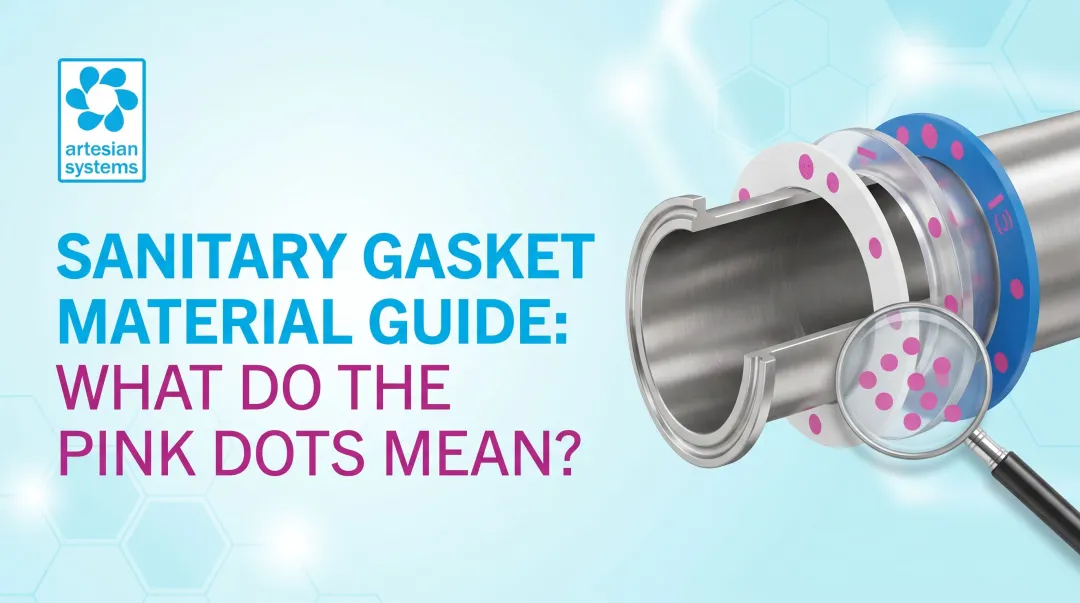
To prevent misidentification, sanitary gasket manufacturers apply small colored dots on the outer edge or side of gaskets to identify the elastomer material. No formal standard from 3-A SSI or ASME BPE governs this system, but manufacturers across the industry have adopted it consistently: one red dot = BUNA-N/nitrile material.
This holds true regardless of body color — both black and white BUNA-N gaskets carry the same red dot — and applies consistently across manufacturers.
Sanitary Gasket Color Code Reference
| Material | Dot Marking | Chemical Type |
|---|---|---|
| BUNA-N (Nitrile) | One red dot | Acrylonitrile-butadiene |
| EPDM (Sulfur-cured) | One green dot | Ethylene propylene diene |
| EPDM (Peroxide-cured) | Three green dots | Ethylene propylene diene |
| Viton (FKM) | One white + one yellow dot | Fluoroelastomer |
| Silicone (Peroxide-cured) | One pink dot | Polysiloxane |
| Silicone (Platinum-cured) | No dot | Polysiloxane |
| PTFE | No dot | Polytetrafluoroethylene |
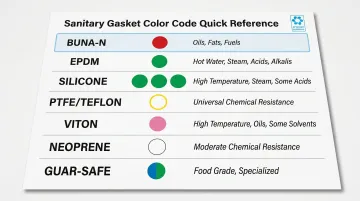
Source: Rubber Fab Technologies Group and SanitaryFittings.us
Why This Matters Operationally
Misidentifying a gasket material mid-process can trigger immediate and costly consequences. Installing the wrong elastomer exposes your line to:
- Seal failure from chemical incompatibility (for example, EPDM swells rapidly when exposed to petroleum oils)
- Product contamination from degraded elastomer particles entering the process stream
- Regulatory non-compliance during FDA or USDA inspections
With bulk gasket storage, it's easy to mix materials that look identical. A single glance at the dot color confirms the material before the clamp goes on.
BUNA-N Material Properties and Performance Range
Temperature Range
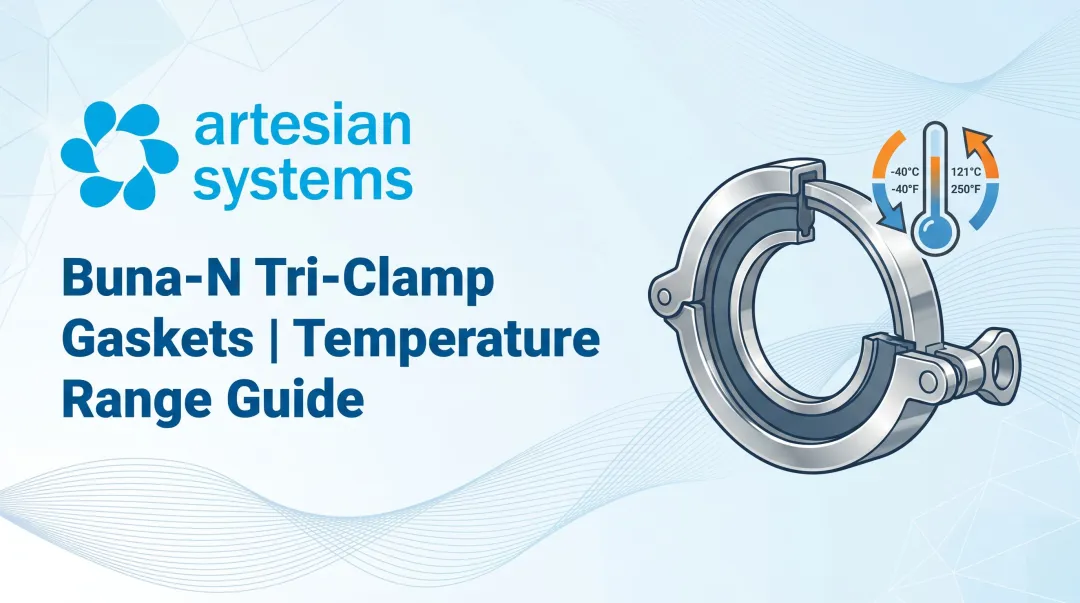
BUNA-N sanitary gaskets operate reliably from -40°F to +250°F (-40°C to +121°C) for continuous service. This range is confirmed across multiple sanitary gasket manufacturers, including GW Kent, BVV, and Artesian Systems.
Parker's O-Ring eHandbook cites a more conservative 212°F (100°C) for continuous exposure, with 250°F (121°C) for short-term service. The upper limit depends on the specific compound formulation and the presence of heat stabilizers.
Critical limitation: BUNA-N is not suitable for steam-in-place (SIP) systems or applications involving saturated steam above 212°F.
Mechanical Properties
- Hardness: Approximately 70 Shore A for sanitary gasket formulations (general NBR range: 20-95 Shore A)
- Tensile Strength: 200-3,500 PSI (formulation-dependent)
- Compression Set: Rated "Good to Excellent," meaning BUNA-N gaskets maintain their sealing force after repeated compression cycles
- Tear and Abrasion Resistance: Excellent, making BUNA-N durable in high-cycle applications
Chemical Resistance: What Works
BUNA-N offers excellent resistance to:
- Petroleum oils and fuels (diesel, mineral oils, aliphatic hydrocarbons)
- Vegetable and animal fats
- LP gases (propane, butane)
- Hydraulic fluids (HFA, HFB, HFC)
- Alcohols, ethers, glycols
- Water and mild salt solutions (at low to moderate temperatures)
This makes BUNA-N ideal for edible oil processing, dairy fat handling, cold-side brewing, CO₂ lines, and hydrocarbon-based extraction systems.
Chemical Resistance: What Fails
BUNA-N is incompatible with:
- Ketones (acetone, MEK)
- Esters (alkyl phosphate, aryl phosphate)
- Chlorinated/halogenated hydrocarbons (trichloroethylene)
- Aromatic hydrocarbons (benzene, toluene)
- Strong acids (concentrated sulfuric, nitric)
- Ozone, UV exposure, and outdoor weathering
- Hot caustic cleaners above 140°F
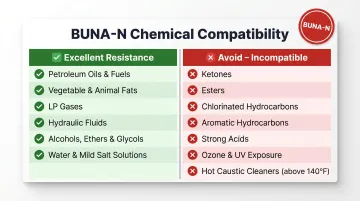
Any of these exposures will degrade BUNA-N quickly — switch to EPDM, Viton, or PTFE based on your specific chemistry. The ozone and UV limitations deserve particular attention for certain installations.
Ozone and UV Weakness
Parker states: "NBR is not resistant to weathering and ozone." EPDM, by comparison, handles outdoor applications well thanks to its UV and ozone resistance. For outdoor piping runs or ozone sterilization systems — common in water treatment and some pharmaceutical CIP setups — EPDM or Viton will hold up where BUNA-N won't.
Top Applications for BUNA-N Red Dot Sanitary Gaskets
Food and Beverage Processing
BUNA-N is widely used in:
- Cold-side brewing (fermenters, brite tanks)
- Dairy processing (handling milk fats, cheese whey)
- Edible oil processing (vegetable oils, animal fats)
- Glycol cooling systems
- CO₂ transfer lines
GW Kent confirms BUNA-N's suitability for water, oils, CO₂, and mild cleaning solutions at moderate temperatures. It's a cost-effective choice for cold-side systems where steam sterilization isn't required.
Chemical and Petroleum Transfer
BUNA-N's resistance to aliphatic hydrocarbons, petroleum oils, and mineral oils makes it well-suited for:
- Petroleum product transfer piping
- Hydraulic fluid systems
- Lubricant handling
- Chemical process lines (non-aromatic, non-oxidizing media)
Hemp and Cannabis Extraction
BVV (a botanical extraction equipment supplier) states: "BUNA-N Tri-Clamp gaskets are the preferred choice of material when using a closed loop, closed column, or open blast extraction when butane or propane are used as the extraction solvent."
BUNA-N rates "A – Excellent" for butane and propane compatibility. Artesian Systems supplies FDA 21CFR177.2600-compliant BUNA-N tri-clamp gaskets for these applications.
Important caveat: BUNA-N is not recommended for alcohol-based extraction (ethanol, isopropanol) or systems using ketone or ester solvents. Always verify solvent compatibility before specifying.
Where NOT to Use BUNA-N
Avoid BUNA-N in:
- Steam-in-place (SIP) systems — GW Kent explicitly states BUNA-N is "not suitable for steam or SIP" and "will degrade with repeated exposure to hot caustic cleaners above 140°F"
- High-temperature hot water lines above 212°F
- Ozone sterilization systems
- Lines with strong oxidizers or aromatic solvents
For steam service, EPDM is the standard elastomer replacement; for aggressive chemical environments, Viton or PTFE are the appropriate alternatives.
BUNA-N vs. Other Sanitary Gasket Materials: Quick Comparison
Sanitary gasket selection comes down to matching material properties — chemical compatibility, temperature range, and cost — to what the process actually demands. Here's how BUNA-N compares against the three other most common sanitary gasket materials.
| Property | BUNA-N (Red Dot) | EPDM (Green Dot) | Silicone (Pink Dot) | Viton/FKM (White + Yellow Dots) |
|---|---|---|---|---|
| Temp Range | -40°F to +250°F | -65°F to +300°F | -65°F to +450°F | -15°F to +400°F |
| FDA Standard | 21 CFR 177.2600 | 21 CFR 177.2600 | 21 CFR 177.2600 | 21 CFR 177.2600 |
| Relative Cost | $ (Economical) | $ (Economical) | $$ (Moderate) | $$$ (Expensive) |
| Steam/SIP | Not suitable | Excellent (specialist) | Poor | Not recommended |
| CIP Suitability | Degrades >140°F caustic | Excellent | Good (non-stick) | Excellent (hot caustic 160°F+) |
| Oil Resistance | Excellent | Fails (swells) | Poor (swells) | Good |
| Ozone/UV | Poor | Excellent | Good | Good |
| Primary Use | Cold-side, oils, CO₂, hydrocarbon extraction | Steam, hot water, CIP, caustic systems | Sample ports, sight glasses, low-cycle | High-temp chemical, aggressive cleaning |
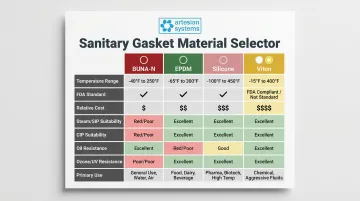
Data reflects general industry standards per FDA 21 CFR 177.2600 and elastomer compatibility references.
Decision Rule
- If the process involves oils, fats, or hydrocarbon media at moderate temperatures: choose BUNA-N — it's the cost-effective first choice
- If high temperatures, steam, or aggressive CIP chemicals are involved: EPDM or Viton are better fits
- For aggressive chemicals that compromise all four materials above: PTFE envelope gaskets are worth evaluating as a separate category
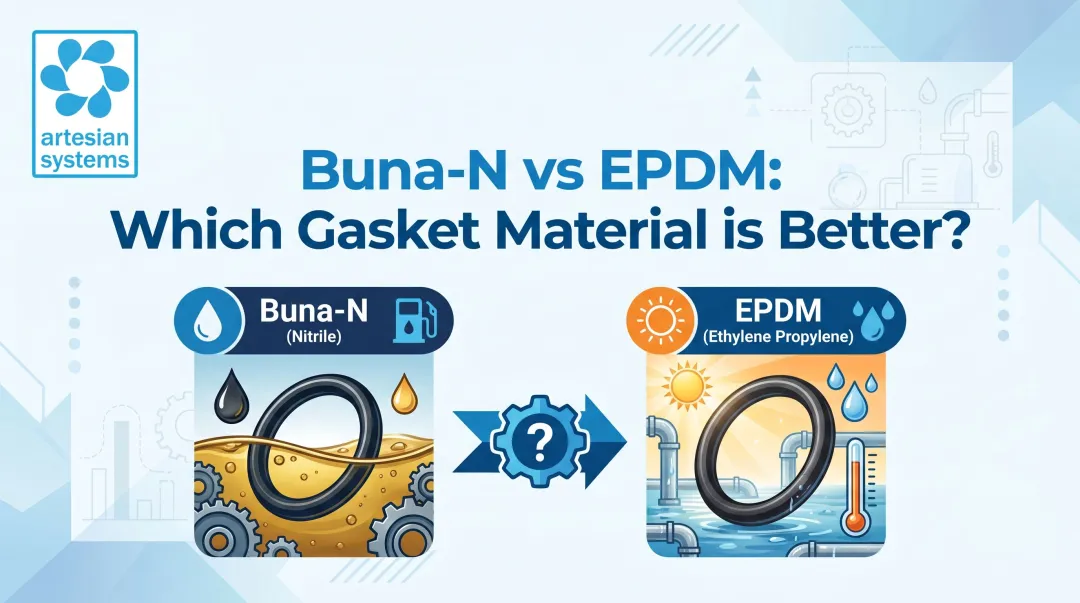
EPDM and BUNA-N are both economical, but they serve opposite chemical environments. EPDM resists caustics and steam but fails with oils; BUNA-N resists oils but fails with steam and hot caustics. Getting them mixed up in the field — easy to do without the color dot system — can cause swelling, leaks, or contamination in a matter of hours.
Compliance and Standards for BUNA-N Gaskets
FDA 21 CFR 177.2600 – Rubber Articles Intended for Repeated Use
This regulation covers rubber articles used in "producing, manufacturing, packing, processing, preparing, treating, packaging, transporting, or holding food." The regulation explicitly lists "acrylonitrile-butadiene" among approved elastomers.
Key requirements:
- Articles must be prepared only from substances listed in 177.2600(c)
- Extraction limits apply: aqueous food extractives ≤20 mg/sq in (first 7 hours), ≤1 mg/sq in (succeeding 2 hours)
- Fatty food extractives (n-hexane) ≤175 mg/sq in (first 7 hours), ≤4 mg/sq in (succeeding 2 hours)
Not all BUNA-N formulations are automatically compliant. Compliance depends on the specific ingredients used in the compound. Always request lot-specific compliance certificates from your gasket supplier.
3-A Sanitary Standard 18-03
3-A Standard 18-03 covers "Multiple-Use Rubber and Rubber-Like Materials Used as Product Contact Surfaces in Dairy Equipment." It goes beyond FDA ingredient requirements with additional performance testing:
- Milk fat absorption
- Aging resistance
- Resistance to cleaning and sanitizing solutions
BUNA-N is classified as Class II (along with EPDM). Class II materials are rated for service up to 250°F product exposure and 275°F cleaning solutions.
USDA Compliance
The USDA no longer approves rubber compounds or products (discontinued in 1997). WARCO confirmed directly with USDA that "rubber products in compliance with FDA can be used for meats and poultry without any further approval."
In practice, "USDA compliant" for rubber gaskets means the material meets FDA 21 CFR 177.2600 requirements and is suitable for use in USDA-inspected facilities under 9 CFR 416.3 (Equipment and Utensils Performance Standard).
Verification from Artesian Systems
Artesian Systems' BUNA-N sanitary gaskets are manufactured using 3-A approved, USDA compliant, and FDA 21CFR177.2600 and 21CFR177.1550 compliant materials. These gaskets have also passed U.S.P. Class VI Cytotoxicity testing, confirming biocompatibility for food, beverage, pharmaceutical, and medical device applications. Lot-specific compliance certificates and material documentation are available upon request.
Frequently Asked Questions
What color is a BUNA-N (nitrile) gasket?
BUNA-N gaskets are most commonly black in color, though white versions exist. The definitive identifier is the single red dot marked on the gasket's side edge—not the body color. Always check for the red dot to confirm BUNA-N material.
What is a red rubber gasket used for?
"Red rubber" typically refers to a red-colored SBR (styrene-butadiene rubber) gasket used in general plumbing and non-sanitary industrial applications. In the sanitary industry, "red dot" identifies BUNA-N nitrile — a different material entirely. SBR is unsuitable for oils and fuels; BUNA-N excels in those environments.
What color is an EPDM gasket?
EPDM sanitary gaskets are also commonly black (or white). They are identified by their dot code: one green dot for sulfur-cured EPDM and three green dots for peroxide-cured EPDM. Do not rely on body color alone to distinguish EPDM from BUNA-N.
What are the three types of gaskets?
Gaskets are broadly categorized as elastomeric/soft (rubber-based like BUNA-N, EPDM, Silicone), semi-metallic (spiral wound, jacketed), and metallic (ring joint). Sanitary process applications primarily use elastomeric types due to their cleanability, compliance, and low cost.
Is BUNA-N safe for food and beverage applications?
FDA 21CFR177.2600-compliant BUNA-N formulations are acceptable for food and beverage contact, particularly in oil-based or low-temperature applications. Always confirm compliance documentation with your supplier — not all BUNA-N compounds meet this standard automatically.
What temperature range can BUNA-N sanitary gaskets handle?
BUNA-N sanitary gaskets operate reliably from -40°F to +250°F (-40°C to +121°C). BUNA-N is not suitable for steam sterilization or SIP processes, where EPDM (rated to 300°F) or Viton (rated to 400°F) would be the appropriate choice.
Conclusion
The single red dot on a BUNA-N sanitary gasket is more than a marking—it's a system of accountability that prevents costly material mix-ups in high-stakes process environments. BUNA-N's excellent resistance to petroleum oils, fats, and hydrocarbon solvents makes it the economical choice for cold-side food processing, chemical transfer, and botanical extraction systems—but only when used within its documented temperature range and confirmed against your fluid's chemical compatibility profile.
When sourcing BUNA-N red dot sanitary gaskets, verify compliance documentation from your supplier. Artesian Systems manufactures and stocks FDA-compliant BUNA-N tri-clamp gaskets (1.5"–6") with 3-A and USDA approval. The company draws on almost two decades of field experience across petroleum, chemical, food, and extraction industries.
For technical support or to request compliance documentation, contact Artesian Systems at +1 801-318-4079 or artesiansystems@gmail.com.