Introduction
Choosing the wrong sight glass specification can result in catastrophic component failure, process contamination, unplanned downtime, or serious safety hazards. Many engineers treat sight glass selection as a simple procurement task—matching a pipe size and ordering a component. In reality, it's a critical engineering decision that balances mechanical integrity, chemical compatibility, regulatory compliance, and operational visibility.
This guide covers what sight glasses are, the main types available, and the six specifications engineers must evaluate to match a sight glass to its process environment:
This guide covers what sight glasses are, the main types available, and the six specifications engineers must evaluate to match a sight glass to its process environment:
- Pressure rating
- Temperature and thermal shock resistance
- Glass material selection
- Chemical compatibility
- Connection type and dimensions
- Regulatory and sanitary compliance
Miss any one of these, and you've built a failure point into your system before the process ever starts.
Key Takeaways
- Sight glasses provide visual monitoring of process fluids in closed systems—no power or calibration required
- Six specifications must align: pressure rating, temperature, glass material, chemical compatibility, connection standard, and regulatory compliance
- Borosilicate 3.3 covers most industrial applications; quartz handles high heat; sapphire is reserved for extreme pressure and abrasive service
- Mismatched specifications—particularly pressure, corrosion resistance, or compliance—drive most sight glass failures
- Sanitary industries require 3-A, FDA 21CFR, and USDA compliance on top of all mechanical specifications
What Is a Sight Glass?
A sight glass is a transparent window or tube component installed on tanks, pipes, reactors, or vessels that provides direct visual observation of process fluid behavior, level, color, flow, or phase state without opening or disrupting the system. Unlike instruments that measure and transmit data, sight glasses require no power, calibration, or signal processing.
Their value is passive, real-time confirmation of what's happening inside a closed process system: detecting foam-out in a fermenter, confirming complete drainage during CIP, or identifying phase separation in an extraction vessel.
Types of Sight Glasses
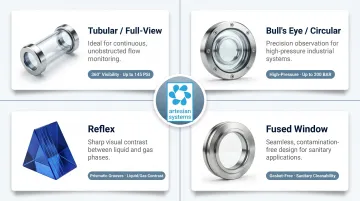
Four main types serve distinct applications:
Tubular/full-view sight glasses consist of a clear glass tube held between two flanges, providing 360-degree visibility of flow. These are best suited for low-to-moderate pressure applications where continuous flow observation is required. Operating limits typically reach 145 PSI (10 bar) due to tensile stress constraints in cylindrical glass.
Bull's eye/circular sight windows use a thick glass disc mounted on a flange or weld pad, allowing inspection through vessel walls. These designs achieve significantly higher pressure ratings, up to 200 bar for small-diameter discs, because flat geometry handles compressive loads more effectively than tubular shapes.
Reflex sight glasses feature prismatic grooves carved into one glass surface. Light passing through the gas phase reflects back to the observer, while liquid phase appears dark due to different refractive indices. This design improves liquid/gas level contrast without requiring backlighting or external power.
Fused sight glass windows eliminate gaskets by bonding glass directly to a metal ring under controlled heat. The metal ring compresses the glass, reducing failure modes and improving cleanability for sanitary applications.
Type selection should be locked in before evaluating materials or dimensions — the wrong geometry creates constraints that no material upgrade can fix.
Why Industries Rely on Sight Glasses
Sight glasses deliver five operational benefits:
- Real-time process verification without system interruption or sampling delays
- Early detection of contamination, phase separation, or foam-out conditions
- Quality control confirmation of color, clarity, emulsion stability, or particulate levels
- Reduced risk of hazardous over- or under-fill conditions in batch operations
- Support for CIP/SIP cycle verification in pharmaceutical and food processing systems
Each industry brings distinct requirement profiles. Food and beverage operations prioritize cleanability and sanitary compliance. Pharmaceutical and bio-pharma environments demand materials that pass USP and FDA validation. Chemical and petrochemical applications focus on chemical resistance and pressure rating. Hemp and cannabis extraction, nutraceutical manufacturing, and drinking water treatment each carry their own regulatory and process constraints.
Key Sight Glass Specifications: What to Evaluate Before Selecting
Sight glass selection failures almost always trace back to one or more mismatched specifications, not to product defects. The following six specification parameters allow engineers to systematically connect process conditions to the correct component. Each factor independently narrows the field of acceptable products, and the final selection must satisfy all six simultaneously. Neglecting even one creates a failure risk that negates the value of getting the others right.
Pressure Rating
Every sight glass must be rated for working pressure, design pressure, test pressure, and burst pressure. The rating must meet or exceed the maximum system operating pressure including any pressure surges, water hammer, or cyclic loading. A safety factor—typically 4:1 for general industrial equipment per ASME Section VIII, or 1.5-2.0x per DIN 7080 guidelines—should always be applied.
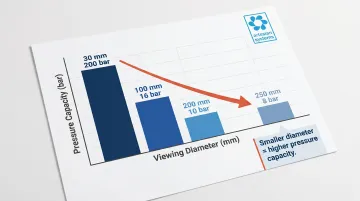
The diameter-pressure inverse relationship is a design constraint engineers cannot ignore: DIN 7080 data shows that a 30 mm borosilicate disc at 15 mm thickness achieves 200 bar, while a 250 mm disc at 25 mm thickness is limited to 8 bar. Unsupported span increases bending stress proportionally to the square of diameter. Specify the smallest viewing diameter that meets observation needs to maximize pressure capacity.
Tubular sight glasses operate at inherently lower pressures due to glass tensile strength constraints. Typical ratings reach 145 PSI (10 bar) with heavy-wall borosilicate construction. Circular bull's eye designs with thicker planar glass achieve substantially higher ratings—making design type inseparable from pressure specification.
Pressure rating example:
| Diameter (mm) | Thickness (mm) | Pressure Rating (bar) |
|---|---|---|
| 30 | 15 | 200 |
| 100 | 15 | 16 |
| 200 | 25 | 10 |
| 250 | 25 | 8 |
Larger viewing area trades directly against pressure capacity. Quantify the minimum acceptable viewing diameter through task analysis rather than defaulting to "as large as possible."
Temperature Range and Thermal Shock Resistance
Operating temperature determines which glass materials remain viable. Soda lime glass is limited to approximately 150°C, borosilicate 3.3 handles continuous service to 280°C, fused quartz extends to 540°C, and sapphire operates to 815°C. The maximum continuous temperature must account for both process temperature and any heat introduced during CIP/SIP cleaning cycles.
Thermal shock—the risk of rapid temperature differentials causing glass fracture—depends on the thermal shock parameter, a function of thermal conductivity, coefficient of thermal expansion (CTE), Young's modulus, and tensile strength. Materials with high CTE combined with low conductivity are poorly suited for applications involving rapid temperature swings such as steam-in-place cycles or sudden coolant introduction.
CTE comparison reveals the magnitude of difference:
| Glass Type | CTE (× 10⁻⁶/K) | Thermal Shock Resistance |
|---|---|---|
| Soda lime | ~9.0 | Poor |
| Borosilicate 3.3 | 3.3 | ≥230°C ΔT (tempered) |
| Fused quartz | ~0.55 | Excellent |
Fused quartz's CTE is approximately 6x lower than borosilicate and 16x lower than soda lime, directly explaining its superior thermal shock resistance.
Pharmaceutical SIP processes operate at 121-134°C under 1-2 bar overpressure with saturated steam maintained for at least 20 minutes. Standard DIN 7080 tempered borosilicate sight glasses rated to 280°C accommodate SIP cycles with substantial margin. Quartz or sapphire is required only when continuous process temperatures exceed borosilicate's upper limit.
Glass Material Selection
Four primary materials dominate industrial sight glass applications, each occupying a distinct performance-cost position:
Borosilicate 3.3 is the most widely used material, offering good chemical resistance (HGB 1, Acid Class 1 per ISO ratings), thermal shock resistance up to approximately 260°C continuous service (280°C per DIN 7080), and cost-effectiveness. It covers food, beverage, pharmaceutical, and general industrial processes — strong across most specifications without the cost premium of quartz or sapphire.
Fused silica/quartz suits high-temperature applications up to approximately 540°C continuous with near-zero thermal expansion (CTE ~0.55 × 10⁻⁶/K) and UV transparency. Used in pharmaceutical, semiconductor, and high-temperature chemical processes where borosilicate's 280°C limit is insufficient. It lacks sapphire's mechanical strength but closes the temperature gap between borosilicate and extreme-service applications.
Sapphire provides the highest mechanical strength and scratch resistance. Flexural strength of 900 MPa—36x greater than borosilicate's 25 MPa—and Knoop hardness of 2000 versus borosilicate's 480. Rated for extreme pressures up to 20,000 PSI and temperatures to 815°C continuous. Used in abrasive slurry service, high-pressure reactor monitoring, and erosive environments. The cost premium is justified only where borosilicate or quartz cannot survive the service conditions.
Soda lime is low cost but offers poor thermal resistance (maximum ~150°C) and limited chemical durability. Suitable only for mild, low-temperature, non-corrosive applications. DIN 7080 explicitly prohibits soda lime for pressure-rated sight glass discs.
Material comparison summary:
| Material | Max Temp (°C) | Thermal Shock Resistance | Chemical Resistance | Relative Cost |
|---|---|---|---|---|
| Soda lime | ~150 | Poor | Poor | Lowest |
| Borosilicate 3.3 | 280 | Good (≥230°C ΔT) | Good (HGB 1) | Moderate |
| Fused quartz | 540 | Excellent | Excellent | High |
| Sapphire | 815 | Excellent | Excellent | Highest |
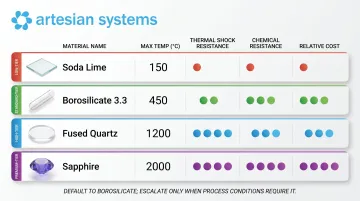
Default to borosilicate for general service. Specify quartz only when temperatures exceed 280°C. Reserve sapphire for extreme pressure, abrasive media, or applications where borosilicate's 25 MPa bending strength is insufficient.
Chemical and Corrosion Compatibility
Corrosive or caustic process fluids can cloud or etch the glass surface over time, permanently impairing visibility and weakening structural integrity. Both the glass material and the housing/seal materials must be independently verified for compatibility with the process fluid and all CIP/SIP chemicals.
Borosilicate glass resists most industrial chemicals but is vulnerable to three agent classes that cause corrosion through leaching, dissolution, etching, or spalling mechanisms:
- Hydrofluoric acid
- Concentrated phosphoric acid
- Strong caustic solutions at elevated temperatures
Screen all process fluids and cleaning agents against these categories before specifying borosilicate. (Reference: corrosion mechanisms)
Temperature accelerates corrosion rates. Hot caustic alkalis pose the greatest hazard to borosilicate glass, with dissolution rates increasing exponentially above 60°C. What might be acceptable exposure at ambient temperature can become destructive at CIP temperatures.
Abrasive media present a distinct risk: surface erosion reduces wall thickness and optical clarity over time. Slurries, particulate-laden flows, and crystallizing solutions require thicker glass, harder materials (sapphire), and more frequent inspection intervals. Sapphire's Mohs 9 hardness—second only to diamond—makes it the material of choice when abrasion is the limiting factor.
Housing material must be specified independently. Stainless steel 316L suits most applications, but corrosive service may require Hastelloy C276, Alloy C, or PFA-lined housings. Hydrofluoric acid service specifically requires fluoropolymer-lined housings regardless of glass material choice.
Connection Type and Dimensional Standards
Dimensional and connection specifications must match the process system's existing piping to ensure proper sealing and pressure integrity. Mismatch in connection type is a common installation error that creates leak risk regardless of how well the glass material is specified.
DIN 7080 is the primary international standard governing dimensions, tempering, and mechanical strength for borosilicate circular sight glasses. Key requirements include:
- Borosilicate Glass 3.3 per ISO 3585
- Bending strength greater than 160 N/mm² for tempered glass
- EN 10204-3.1 material certification per batch
- Standard diameters from 24 mm to 265 mm with pressure ratings from 6 to 200 bar
Sanitary tri-clamp connections follow ISO 2852, DIN 32676, and BS 4825 standards, with couplings and hardware in stainless steel ASTM 316. Artesian Systems offers tri-clamp sight glasses in 1.5", 2", 3", 4", and 6" sizes with 316 stainless steel housings and borosilicate glass rated to 150 PSI and 400°F.
Flanged connections per ANSI/ASME B16.5 or DIN flange standards apply to sight glass installation in process piping. Face-to-face dimensions must comply with EN558-1 or equivalent standards to ensure proper fit within piping runs.
Glass diameter directly affects pressure capacity in circular sight windows: smaller diameter discs of equivalent thickness withstand higher pressures due to reduced unsupported span. This relationship means connection size selection involves a trade-off between visibility and pressure rating. Specify the smallest tri-clamp or flange size that provides adequate viewing area for the monitoring task.
Regulatory and Sanitary Compliance
Applications in food processing, pharmaceutical manufacturing, nutraceutical production, and hemp/cannabis extraction are subject to compliance standards that extend beyond mechanical specifications.
3-A Sanitary Standard 65-01 establishes criteria for windows installed in equipment used to view dairy and food products during processing. This standard governs design, materials, and surface finish requirements for product-contact surfaces.
FDA 21 CFR 177.2600 regulates rubber articles intended for repeated food contact—covering elastomeric gaskets and seals used in sight glass assemblies. It specifies extraction limits (total extractives not exceeding 20 mg/sq in during first 7 hours of water extraction) and approved polymer lists.
FDA 21 CFR 177.1550 governs perfluorocarbon resins (PTFE) used in food-contact gaskets and seals, establishing requirements for material purity and extractables testing.
ASME BPE defines seven surface finish designations for bioprocessing equipment, ranging from SF1 (Ra 0.51 μm, mechanically polished) to SF4 (Ra 0.38 μm, mechanically polished + electropolished). SF4 represents the tightest finish for critical pharmaceutical product-contact surfaces. Surface finish affects cleanability, bacterial harboring potential, and validation of CIP/SIP effectiveness.
Compliance is a system property, not a component property. A DIN 7080 borosilicate disc installed with a non-FDA-compliant gasket in a 3-A certified system invalidates the entire assembly. Verify compliance at the assembly level across every component:
- Glass material (DIN 7080 borosilicate or approved equivalent)
- Housing material (316L SS per ASTM)
- Gasket material (FDA 21 CFR 177.2600 or 177.1550)
- Surface finish (ASME BPE SF designation)
- Connection type (3-A 65-01)
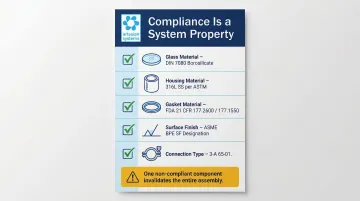
Non-compliance consequences are severe: invalidated product batches, FDA warning letters, consent decrees, product seizure, or import alerts. Using non-compliant components can trigger audit findings that shut down production lines until corrective action is completed and verified.
How Artesian Systems Can Help
Artesian Systems is a specialized provider of high-quality sanitary process components built on nearly two decades of mechanical engineering experience in petroleum, chemical, food, and pharmaceutical industries. Component selection is guided by both engineering rigor and deep familiarity with regulated process environments—the combination required to navigate the six-factor specification framework outlined above.
Compliance-Ready Components
Artesian's borosilicate tri-clamp sight glasses satisfy the compliance-critical requirements that many general-purpose suppliers cannot address:
- Built to 3A approved, USDA compliant, and FDA 21CFR177.2600/177.1550 compliant materials
- Available in 1.5", 2", 3", 4", and 6" sizes with 316 stainless steel housings
- Rated to 150 PSI and 400°F for pharmaceutical-grade and food-safe environments
- ISO9001 certified, confirming quality system discipline across design and manufacturing
Integrated Engineering Services
Artesian serves as a single resource for both specification guidance and component supply. Engineers can work with one provider to specify, design, fabricate, and integrate sight glasses within broader process systems. Services include:
- P&ID development and complete process pipe engineering
- CNC machining for specialty alloys (Hastelloy, Inconel) and composite materials
- Custom solutions built around specific process requirements
- Full system design and fabrication incorporating sanitary inline components
Application-Specific Experience
Artesian has developed precision filtration screens for detecting microplastics in drinking water systems and methods for processing high-grade hemp oil—both applications where visibility of microparticulates or phase separation is critical. The founder's background includes Section VIII Division 1 vessel building and pharmaceutical passivation services, providing direct insight into the pressure vessel and sanitary compliance requirements that govern sight glass installation in regulated industries.
Conclusion
Sight glass selection is an engineering decision with direct consequences for process safety, product quality, and regulatory compliance. The six specification factors—pressure rating, temperature resistance, glass material, chemical compatibility, connection standards, and regulatory compliance—form the full specification checklist before any component is ordered. A single miscalculation means premature failure, compromised product integrity, or a compliance violation.
Process conditions evolve: throughput increases, cleaning regimes change, new media are introduced, or regulatory requirements tighten. Sight glass specifications should be reviewed any time significant process changes occur. A component correctly specified for last year's process envelope may not hold up under this year's operating conditions — reviewing specs proactively is far cheaper than an unplanned failure mid-production.
Frequently Asked Questions
What is glass specification?
A glass specification defines the material, dimensional, and performance requirements a glass component must meet for a given application—covering thermal resistance (CTE, max temperature), pressure rating, chemical resistance class, surface quality, and dimensional tolerances per standards like DIN 7080 or ISO 3585.
What does Boro 3.3 mean?
"Boro 3.3" refers to borosilicate glass with a coefficient of thermal expansion of 3.3 × 10⁻⁶/K, measured over 20-300°C per ISO 3585. This low thermal expansion rate gives borosilicate superior thermal shock resistance compared to soda lime glass (CTE ~9 × 10⁻⁶/K), making it the most common material for industrial sight glasses exposed to temperature cycling or CIP/SIP processes.
What is the difference between a sight glass window and a sight flow indicator?
A sight glass window mounts on a tank or vessel wall to allow inspection of the interior—observing level, phase state, or contamination. A sight flow indicator installs inline within a pipe, using two opposed sight glasses in a housing to observe fluid as it passes through. Each type has distinct mounting configurations and pressure design requirements.
What is the most common sight glass material for food and beverage processing?
Borosilicate glass (Boro 3.3) is the standard choice due to its combination of thermal shock resistance (≥230°C ΔT when tempered), chemical inertness (HGB 1, Acid Class 1), optical clarity, and compatibility with CIP/SIP cleaning cycles up to 134°C. Housing and seal materials must also meet 3A Sanitary Standards or FDA 21CFR177 compliance requirements—compliance must be verified at the system level, not for the glass alone.
How do I determine the correct pressure rating for a sight glass?
Start with the system's maximum operating pressure, including surge or water hammer, then apply the required safety factor—typically a 4:1 burst-to-working ratio for general industrial use or 1.5-2.0x MAWP per DIN 7080. Glass type, diameter, and thickness must be evaluated together, as larger viewing diameters reduce pressure capacity for equivalent thickness.
What compliance standards should sight glasses meet in pharmaceutical or sanitary applications?
Sight glasses in these environments should comply with 3A Sanitary Standard 65-01, ASME BPE (SF4 surface finish at Ra 0.38 μm for product-contact surfaces), and FDA 21CFR177.2600/177.1550 for gasket and seal materials. Surface finish, material traceability, and cleanability carry equal weight to mechanical ratings—CIP/SIP validation depends on surface quality, not pressure or temperature alone.