
Introduction
Choosing the wrong sanitary sight glass supplier can trigger failed audits, product recalls, and compromised process safety. In industries where contamination control is non-negotiable—pharmaceutical manufacturing, dairy processing, cannabis extraction, and beverage production—the sight glass is not just a viewing window. It's a regulatory checkpoint and a potential contamination vector if designed or sourced improperly.
Not all sight glass suppliers operate to the same sanitary standards. Industrial sight glasses prioritize pressure containment — sanitary sight glasses must clear a different bar entirely:
- 3-A Standard 65-01 for hygienic design
- FDA 21 CFR compliance for food-contact materials
- ASME BPE surface finish specifications for pharmaceutical applications
- USDA acceptance for dairy facilities
A supplier who delivers "sight glasses" without documenting these certifications creates audit exposure you won't discover until inspection day.
This guide profiles the top US-based sanitary sight glass suppliers, clarifies what distinguishes them in terms of compliance and capability, and gives you the criteria — certifications, materials, and documentation standards — to evaluate each one before you commit.
Key Takeaways
- Sanitary sight glasses meet 3-A, FDA, and USDA hygienic design standards that standard industrial sight glasses don't
- Top US suppliers differ in specialization: fused-glass safety, custom engineering, broad catalogs, or pharma-grade documentation
- Evaluate suppliers on 3-A 65-01 compliance, FDA 21 CFR material certs, connection type, and surface finish specs
- Artesian Systems, L.J. Star, ARCHON Industries, Steel & O'Brien (formerly Top Line), and Ernst Instruments represent the leading US suppliers worth evaluating for sanitary applications
What Is a Sanitary Sight Glass and Why Does It Matter?
A sanitary sight glass is a transparent inline viewing device designed specifically for hygienic process piping. It allows operators to visually monitor fluid flow, color, clarity, level, and phase changes without breaking system containment—critical for maintaining sterility and preventing contamination in regulated environments.
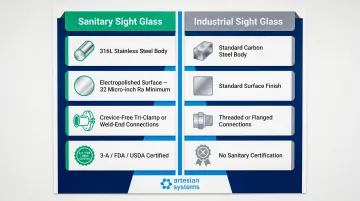
What separates sanitary sight glasses from standard industrial models:
- Body made from 316L stainless steel with borosilicate glass windows—not the 304 or soda-lime materials found in standard industrial units
- Internal surfaces polished to at least 32 micro-inch Ra per 3-A Sanitary Standards, or 15 micro-inch Ra (SF4) for pharmaceutical use per ASME BPE
- Crevice-free throughout—no dead legs, threads, or gaps where bacteria can colonize; connections are tri-clamp, I-line, or weld-end only
- Compliant with 3-A Standard 65-01, FDA 21 CFR 177.2600 for elastomer seals, and USDA acceptance for dairy equipment
These distinctions matter because regulated facilities face unannounced audits. A sight glass missing material certificates or using non-compliant gaskets will trigger corrective action requests and potential production holds.
Those risks apply across a broad range of industries where sanitary sight glasses aren't optional—they're a baseline requirement:
Industries where sanitary sight glasses are mandatory:
- Food and beverage processing (dairy, juice, sauces)
- Pharmaceutical and biotech manufacturing
- Nutraceutical and dietary supplement production
- Hemp and cannabis extraction operations
- Cosmetics and personal care manufacturing
- Drinking water and municipal water systems
Top Sanitary Sight Glass Suppliers in the US
These suppliers were selected based on documented compliance credentials (3-A, FDA, USDA), material quality standards, product range, engineering support, and proven performance in regulated process environments. Verification was based on official supplier documentation, industry standards, and regulatory databases.
Artesian Systems
Artesian Systems is a Wyoming-based engineering-driven supplier founded by a mechanical engineer with nearly two decades of experience across petroleum, chemical, and food industries. The company manufactures inline sanitary sight glasses alongside a full suite of solid-state sanitary components and offers complete custom process system design services.
Key differentiators:
- ISO 9001 certified with documented compliance to 3-A approved materials, USDA acceptance, and FDA 21 CFR 177.2600/1550 for all wetted components
- Custom engineering capability: CNC machining of specialty alloys (Inconel, Hastelloy, all grades of stainless steel), complete passivation services, and full process pipe design with P&ID development
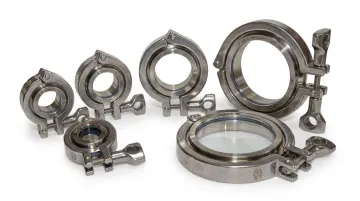
- Product range: Manufactures tri-clamp sight glasses in 1.5″, 2″, 3″, 4″, and 6″ sizes with both borosilicate glass (rated to 500°C, 150 PSI) and polycarbonate options for lighter-duty applications
- No minimum order quantity: Single-unit purchases available, making Artesian accessible for both pilot systems and full production lines
Artesian's strength lies in serving buyers who need more than catalog components: those requiring custom configurations, specialty alloy fabrication, or integrated process system design for pharmaceutical, hemp/cannabis, nutraceutical, and food processing applications.
| Attribute | Details |
|---|---|
| Key Industries Served | Food & beverage, pharmaceutical, hemp/cannabis extraction, nutraceutical, chemical, drinking water systems |
| Certifications & Compliance | ISO 9001, 3-A approved materials, USDA compliant, FDA 21 CFR 177.2600 and 1550 |
| Standout Capability | Custom process system design, CNC machining of specialty alloys, full component passivation |
L.J. Star
L.J. Star, based in Twinsburg, Ohio, developed Metaglas® fused glass technology, which addresses a known failure mode in conventional sight glass design: catastrophic glass fracture under mechanical overload or thermal shock. The company serves pharmaceutical, biotech, chemical, and food processing markets with a compliance portfolio that spans ASME BPE, USP, FDA, FM, TUV, and EHEDG standards.
Key differentiators:
- Metaglas® fused borosilicate construction: glass melted and fused inside a metal ring creates uniform compressive stress, eliminating the shattering risk of conventional gasket-clamped designs under overload or thermal shock
- TUV-approved to 64 bar with operating temperatures from -30°C to +300°C; reusable after cleaning, unlike conventional designs that are often damaged during removal
- Compliance coverage: ASME BPE, USP Class VI gaskets, USP Type I glass (borosilicate per USP 29-661), FDA-compliant seals, FM (Factory Mutual) Approved, DIN 7079/7080, TUV Approved, EHEDG Approved
- Product line includes METACLAMP sanitary clamp sight glass, MetaPlex glass-free sight windows, sterile visual flow indicators (SVFI), and integrated light/window combinations
Where pressure ratings, thermal cycling, or pharmaceutical safety margins drive the specification, L.J. Star's fused-glass construction is a different category of product than standard clamped sight glasses.
| Attribute | Details |
|---|---|
| Key Industries Served | Pharmaceutical, biotech, food processing, chemical, oil and gas |
| Certifications & Compliance | ASME BPE, 3-A Sanitary Standards, USP Class VI materials, USP Type I glass, FDA compliant, FM Approved |
| Standout Capability | Metaglas® fused glass technology for blow-out resistant, gasket-free sight glass assemblies rated to 64 bar |
ARCHON Industries
ARCHON Industries is a Suffern, New York-based manufacturer offering a broad catalog of sight glasses, sight flow indicators, and level gauges covering sanitary, industrial, and specialized applications. With 24 years serving pharmaceutical, chemical, food, and dairy sectors, the company has a documented track record in US process equipment supply.
Key differentiators:
- Product range covers Model SS (pharmaceutical, food, beverage, dairy, distillation columns) and Model SSTC (clamp-on end connections with 316L stainless steel ASME weld ferrules)
- New York-based domestic manufacturing with reliable lead times and material certificates available for code vessels
- Application engineering support for selecting the right configuration based on process conditions
Note on certifications: ARCHON's website references ASME code compliance and material certification availability but does not explicitly claim 3-A Standard 65-01 or FDA material compliance on product pages. Buyers should request specific sanitary certifications and material test reports directly from ARCHON to verify compliance for regulated applications.
| Attribute | Details |
|---|---|
| Key Industries Served | Food processing, chemical, pharmaceutical, dairy, general industrial, water treatment |
| Certifications & Compliance | ASME code (confirmed); request verification of 3-A and FDA compliance directly |
| Standout Capability | Wide product catalog, domestic US manufacturing, reliable lead times for industrial and sanitary applications |
Steel & O'Brien (formerly Top Line Process Equipment)
Top Line Process Equipment, founded in the 1950s and headquartered in Bradford, Pennsylvania, was acquired by Flow Control Holdings' Steel & O'Brien division. The toplineonline.com domain now redirects to steelobrien.com. The company specializes in tri-clamp sanitary fittings, valves, and sight glasses designed for dairy, food and beverage, and pharmaceutical applications.
Key differentiators:
- Sanitary sight glass formats include bolt style, cross style, and flange cap style, all featuring borosilicate glass sealed with Buna gaskets
- Connection options: clamp, bevel seat, I-line, Q-line, and John Perry end configurations
- 316L stainless steel is standard for all sanitary product-contact surfaces
- Broad compatible ecosystem: sanitary fittings, BPE fittings, valves, pumps (TOP-FLO brand), gaskets, strainers, and spools support system-level sourcing from a single supplier
Note on certifications: Specific 3-A or FDA compliance documentation for sight glass products was not confirmed on the Steel & O'Brien website. Buyers should contact Steel & O'Brien directly at (585) 492-5800 to verify current certifications and confirm product continuity post-acquisition.
| Attribute | Details |
|---|---|
| Key Industries Served | Dairy, food and beverage, brewery, pharmaceutical, bioprocessing, cosmetics |
| Certifications & Compliance | Confirm current 3-A sanitary and FDA material compliance directly with Steel & O'Brien |
| Standout Capability | Purpose-built tri-clamp sanitary sight glasses, broad compatible accessory ecosystem, 316L standard construction |
Ernst Instruments (formerly John C. Ernst & Co.)
Ernst Instruments, based in Sparta, New Jersey, offers one of the broadest US catalogs of sight glasses, gauge glasses, and level indicators for sanitary and industrial applications. The company has merged with EFI and now operates under the Ernst Instruments brand, covering a wider specification range than most single-category suppliers.
Key differentiators:
- Configuration breadth: male/female NPT threaded, weld neck, weld pad (ASME and non-ASME), bolt-on, and tri-clamp sanitary products
- Pressure class options: commercial 150 PSIG, 150 PSIG ASME Grade, 300 PSIG ASME Grade, and 600 PSIG ASME Grade
- Catalog spans sight flow indicators, sight windows, liquid level gauges, flow meters, gauge valves, flow/level switches, and replacement glass/gaskets
- Sanitary tri-clamp products are specifically listed as part of the product line for hygienic applications
Note on certifications: The Ernst Instruments website references ASME grade pressure ratings but does not explicitly claim 3-A Standard 65-01 or FDA material compliance. Buyers should verify sanitary certifications directly with Ernst Instruments for regulated applications.
| Attribute | Details |
|---|---|
| Key Industries Served | Chemical, food processing, pharmaceutical, industrial, utilities |
| Certifications & Compliance | ASME code (confirmed); request verification of 3-A and FDA compliance directly |
| Standout Capability | Broadest US catalog range; suitable as a multi-specification source for facilities sourcing across multiple process types |
What to Look for When Choosing a Sanitary Sight Glass Supplier
Regulatory Certifications Are Non-Negotiable
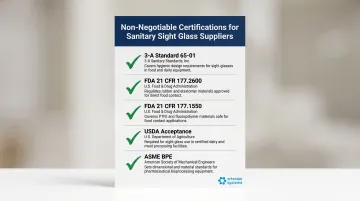
Verify these certifications before committing to a supplier:
- 3-A Standard 65-01: Specific standard for sight and light windows in contact with dairy product; baseline for hygienic design
- FDA 21 CFR 177.2600: Governs rubber articles for repeated food contact (EPDM, silicone gaskets)
- FDA 21 CFR 177.1550: Covers perfluorocarbon resins (PTFE, FEP, PFA gaskets)
- USDA acceptance: Voluntary equipment review programs for dairy and meat/poultry facilities
- ASME BPE: Required for pharmaceutical/bioprocessing applications; mandates absence of crevices at glass-metal interface
Critical: Request certificates of compliance and material test reports (MTRs) for every component—body, glass, gaskets. Don't rely on generic claims.
Material and Finish Specifications Matter
Body material:
- 316L stainless steel is the industry standard (confirmed by L.J. Star, ARCHON, and all major suppliers)
- Material traceability reports (MTRs) should be available on request for ASME code vessels
Surface finish:
- Minimum requirement: 32 micro-inch Ra (0.8 micrometer) per 3-A Sanitary Standards
- Pharmaceutical default: ASME BPE SF4 (15 micro-inch Ra / 0.38 micrometer), mechanically polished then electropolished to resist biofilm attachment
- Electropolished finishes (SF4-SF6) raise the chromium-to-iron ratio above 2:1, actively preventing bacterial colonization
Glass type:
- Borosilicate glass (not soda-lime): Minimum 80% SiO2, 13% B2O3; thermal expansion coefficient 3.3 x 10^-6; rated to 932°F short-term
- Superior thermal shock resistance and chemical resistance (ISO Class S1 acid resistance)
- Specify USP Type I glass for pharmaceutical applications
Gasket materials:
- EPDM or silicone (21 CFR 177.2600)
- PTFE, FEP, or PFA (21 CFR 177.1550)
- All gaskets must carry USP Class VI certification for biocompatibility in pharmaceutical applications
Connection Type Compatibility
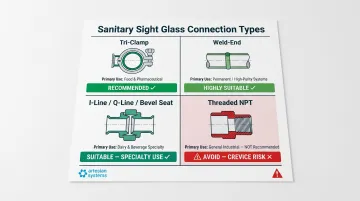
Match the sight glass connection to your existing piping system:
- Tri-clamp (Tri-Clover): Most common in food, beverage, and pharmaceutical applications; sizes 1.5″–6″
- Weld-end: Permanent installation for high-pressure or high-purity applications
- I-line, Q-line, bevel seat, John Perry: Specialty dairy and beverage connection standards
- Threaded NPT: Avoided in sanitary applications — crevices trap bacteria and block effective CIP cleaning
Confirm dimensional consistency with your installed fittings before ordering. Not all "tri-clamp" connections are manufactured to identical tolerances, and mismatches mean costly retrofits.
Pressure and Temperature Ratings Must Align With Process Conditions
Request detailed datasheets covering:
- Maximum working pressure (typical: 150 PSI for standard sanitary; up to 1,000 bar for fused-glass designs)
- Operating temperature range (borosilicate: -40°C to 500°C; polycarbonate: up to 150°F)
- Glass type and thickness (borosilicate vs. soda-lime; tempered vs. annealed)
- Thermal shock resistance (critical for CIP/SIP cycles and steam sterilization)
Undersizing pressure/temperature ratings creates safety hazards; oversizing increases cost without benefit.
Engineering and Customization Support Add Value
Catalog-only vendors work for standard installations. When your process involves non-standard pressures, specialty alloys, or integrated system design, look for suppliers who offer:
- Inconel, Hastelloy, and duplex stainless fabrication for corrosive or high-temperature environments (such as Artesian Systems)
- In-house electropolishing and passivation to meet SF4 surface finish requirements
- P&ID development, CIP system integration, and control cabinet design as part of complete process pipe engineering
- Material certificates, pressure testing reports, and compliance documentation ready for regulatory audits
When specifications are still evolving, a supplier with in-house engineering can adapt — a catalog vendor cannot.
How We Selected These Suppliers
Suppliers were evaluated based on:
- Sanitary compliance credentials: Documented 3-A Standard 65-01 compliance, FDA 21 CFR material conformance, USDA acceptance, and ASME BPE compliance for bioprocessing applications
- Material quality standards: Verified use of 316L stainless steel, borosilicate glass, and FDA-compliant elastomers with material traceability
- Engineering capability: Availability of custom configurations, technical documentation, and responsive application support
- Industry track record: Proven performance in regulated sectors (pharmaceutical, food, dairy, biotech) with verifiable references
- Transparency: Public disclosure of certifications, technical specifications, and compliance documentation
These same criteria should guide your own supplier evaluation. Before committing to a relationship, request certificates of compliance, material test reports, and application-specific references. A supplier's name recognition tells you nothing about whether their components will pass your facility's audit.
Conclusion
Selecting a sanitary sight glass supplier is a compliance and engineering decision first. The right supplier should match your regulatory environment (3-A, FDA, USDA, ASME BPE), process conditions (pressure, temperature, fluid compatibility), and technical requirements (connection type, surface finish, material traceability)—not simply offer the lowest unit price.
Beyond the product catalog, assess supplier depth across four areas:
- Documented certifications — 3-A, FDA, ISO 9001, and material traceability records
- Engineering support — available before and after purchase, not just at the point of sale
- Custom fabrication capability — non-standard sizes, specialty alloys, passivation services
- Quality management systems — ISO 9001 or equivalent, with verifiable documentation
Suppliers who cover all four can adapt as your process evolves. Catalog-only vendors typically can't.
For food, pharmaceutical, chemical, or extraction applications, Artesian Systems manufactures FDA 21CFR and 3-A compliant sight glasses from 1.5" to 6" in borosilicate and polycarbonate, with engineering support for custom configurations and passivation. Contact Artesian Systems at (801) 318-4079 or artesiansystems@gmail.com to discuss your requirements.
Frequently Asked Questions
What is a sanitary sight glass used for?
Sanitary sight glasses install inline in hygienic process piping so operators can visually monitor fluid flow, color, clarity, level, or phase transitions without breaking containment. They're essential in food, pharmaceutical, and bioprocessing applications where sterility and contamination prevention are non-negotiable.
How do you choose the right sight glass?
Key selection factors include:
- Operating pressure and temperature range
- Process fluid compatibility and chemical resistance
- Required certifications (3-A Standard 65-01, FDA 21 CFR)
- Connection type for your piping system (tri-clamp, weld-end)
- Whether standard or custom-engineered configurations suit your application
What is the highest quality of glass used in sanitary sight glasses?
Borosilicate glass is the industry standard due to its thermal shock resistance (thermal expansion coefficient 3.3 x 10^-6) and chemical inertness (ISO Class S1 acid resistance). Fused borosilicate assemblies with glass-to-metal bonding offer the highest safety level by eliminating gasket failure risk entirely.
What certifications should a sanitary sight glass supplier have?
Look for suppliers holding:
- 3-A Standard 65-01 — confirms hygienic design compliance
- FDA 21 CFR 177.2600/1550 — material compliance for food-contact elastomers
- USDA acceptance — required for dairy equipment
- ISO 9001 — supports material traceability and audit readiness
What is the difference between a sanitary sight glass and an industrial sight glass?
Sanitary sight glasses use higher-grade materials (316L stainless steel), electropolished crevice-free surfaces (32 micro-inch Ra minimum), hygienic connection styles (tri-clamp, weld-end), and are certified to sanitary standards (3-A, FDA, USDA). Industrial sight glasses prioritize pressure and temperature performance without the same hygiene, surface finish, or contamination-prevention requirements.
What materials are sanitary sight glasses made from?
The three main components:
- Body: 316L stainless steel (304 SS for lower-grade applications)
- Viewing window: Borosilicate glass (USP Type I for pharmaceutical use)
- Seals: FDA-compliant elastomers — EPDM, silicone, or PTFE/FEP/PFA depending on process fluid and temperature