Introduction
A single failed gasket in a cannabis extraction system can compromise an entire batch, create a serious safety hazard, or trigger a costly compliance violation. Yet gasket selection often becomes an afterthought during equipment procurement, overshadowed by concerns about vessel capacity, automation controls, or solvent recovery rates.
Cannabis extraction environments put elastomers through serious chemical stress. Ethanol, butane, and propane attack molecular structures directly. Supercritical CO2 dissolves into rubber compounds and expands during depressurization. Cryogenic temperatures push materials past their glass transition points into brittleness.
Add the pressure cycling of closed-loop systems, the thermal swings of distillation, and the sanitary requirements of pharmaceutical-grade production — and the gasket becomes the most technically demanding compliance-critical component in the entire system.
Material compatibility, sizing precision, elastomeric recovery under sustained load, and regulatory compliance all determine whether a gasket holds up or becomes a point of failure. This guide covers:
- Best gasket materials for cannabis extraction and why they differ
- How to size gaskets correctly for sanitary tri-clamp fittings
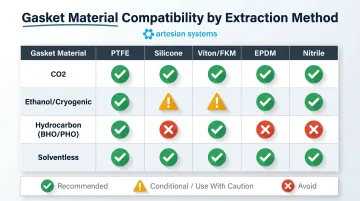
- Material-to-method matching for ethanol, hydrocarbon, and CO2 systems
- Compliance documentation required during facility audits
Key Takeaways
- Match gasket material to your extraction method: PTFE for solvents, Viton/FKM for hydrocarbons, EPDM for CO2, Silicone for heat-intensive food-grade setups — Nitrile should be phased out.
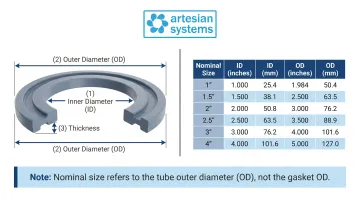
- Most leaks trace back to sizing mistakes; nominal tri-clamp size refers to tube OD, not gasket OD — confirm ID, OD, and cross-section thickness before ordering.
- Compliance isn't optional: gaskets must meet FDA 21CFR, 3A sanitary, or USDA standards, with material certifications on file for audits.
- Inspect gaskets before every run for swelling, cracking, or compression set — solvent and heat exposure degrade elastomers well before visible damage appears.
Best Gasket Materials for Cannabis Extraction Equipment
The five materials below are the most widely used options in cannabis extraction. Each is evaluated against five criteria:
- Chemical resistance to your specific solvent(s)
- Temperature tolerance across your operating range
- Pressure performance and sealing integrity
- Elastomeric recovery for repeated use
- Regulatory compliance (FDA, 3A, USDA)
Material Type 1: PTFE (Polytetrafluoroethylene)
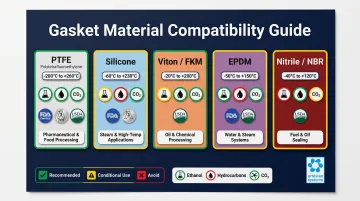
PTFE is a non-elastomeric, chemically inert fluoropolymer that resists virtually all solvents used in cannabis extraction, including ethanol, butane, propane, and CO2. It does not swell or leach, making it the top choice for multi-solvent or high-purity applications where product contamination is unacceptable.
Key differentiator: PTFE offers near-universal chemical resistance and FDA compliance, making it the default choice when product purity is paramount. Its lower elastomeric recovery compared to rubber materials means it requires adequate clamping force and well-machined seating surfaces. PTFE exhibits cold-flow (creep) under sustained pressure, meaning virgin PTFE gaskets should not be reused after removal. Filled PTFE variants (glass, carbon, or bronze) reduce creep, while expanded PTFE (ePTFE) offers better recovery and reduced cold-flow.
| Property | Specification |
|---|---|
| Temperature Range | -100°F to 450°F (-74°C to 232°C) |
| Chemical Resistance | Virtually all solvents (ethanol, butane, propane, CO2, acids, bases); non-reactive |
| Compliance / Best Use | FDA 21CFR 177.1550 compliant; best for static, high-purity, multi-solvent extraction joints |
Material Type 2: Silicone (VMQ)
Silicone is a flexible, thermally stable elastomer with excellent recovery properties and broad temperature tolerance. It is commonly used in food-grade and pharmaceutical extraction systems where repeated disassembly and high-temperature steps (such as wiped film distillation) are involved.
Silicone's glass transition temperature of -115°C to -120°C allows it to remain flexible at cryogenic temperatures, making it the preferred material for cryogenic ethanol extraction. Its superior compression set recovery also makes it ideal for joints that are frequently opened during cleaning or maintenance.
That said, silicone has limited resistance to hydrocarbon solvents (butane, propane) and should not be used in those systems. It can also absorb CO2 and swell up to 30% under pressure cycling, ruling it out for supercritical CO2 extraction.
| Property | Specification |
|---|---|
| Temperature Range | -65°F to 450°F (-53°C to 232°C) |
| Chemical Resistance | Good with ethanol and CO2; poor with hydrocarbons (butane, propane); moderate with glycols |
| Compliance / Best Use | FDA 21CFR 177.2600 compliant; best for ethanol, CO2, and solventless extraction with frequent maintenance cycles |
Material Type 3: Viton / FKM (Fluorocarbon Elastomer)
Viton/FKM is a premium fluorocarbon elastomer with exceptional resistance to hydrocarbons, glycols, fuels, and aggressive solvents. It is the recommended material for hydrocarbon extraction systems (butane/propane closed-loop) and systems that use glycol-based heat exchangers or jacketed vessels.
Among all elastomeric gasket materials, FKM offers the best combination of chemical resistance and elastomeric recovery in the presence of gas-phase and liquid-phase hydrocarbons and glycols, making it the direct answer for operations running BHO, PHO, or glycol-cooled systems.
One critical limitation: FKM fails catastrophically in supercritical CO2 service via explosive decompression (ED). CO2 dissolves into the FKM molecular structure under pressure, then expands rapidly during depressurization — tearing the elastomer from the inside.
| Property | Specification |
|---|---|
| Temperature Range | -20°C to 205°C (-4°F to 401°F) continuous; short-term to 230°C |
| Chemical Resistance | Excellent with hydrocarbons (butane, propane), glycols, fuels, and most organic solvents; poor with ketones and esters |
| Compliance / Best Use | Available in FDA-grade; best for hydrocarbon closed-loop extraction and glycol-jacketed equipment |
Material Type 4: EPDM (Ethylene Propylene Diene Monomer)
EPDM is a cost-effective, durable elastomer with strong resistance to water, steam, CO2, and mild polar solvents. It is widely used in CO2 extraction systems and solventless water-based extraction (ice water hash) due to its low permeability to CO2 and good mechanical toughness.
EPDM's nonpolar molecular structure gives it "pronounced inertness toward carbon dioxide", making it the preferred rubber for supercritical CO2 systems. It also handles clamping stress from frequent valve and fitting assembly better than softer silicone — a practical advantage for parts that see repeated mechanical stress. The trade-off: EPDM is incompatible with hydrocarbon solvents (butane and propane are rated D-Severe).
| Property | Specification |
|---|---|
| Temperature Range | -65°F to 300°F (-54°C to 149°C) |
| Chemical Resistance | Excellent with CO2, water, steam, mild polar solvents; poor with oils, fuels, and hydrocarbons |
| Compliance / Best Use | 3A and FDA-grade options available; best for CO2 extraction, ice water hash systems, and mechanically stressed joints |
Material Type 5: Nitrile / Buna-N (NBR)
Nitrile (NBR) is an oil-resistant rubber commonly used in petroleum and chemical processing, with good resistance to fats, oils, and mild hydrocarbons. It is less common in cannabis extraction but may appear in legacy or repurposed petroleum-grade equipment.
Limitation in cannabis applications: Nitrile is not FDA 21CFR food-grade compliant in standard formulations and has limited resistance to ketones, esters, and aromatic solvents, making it a poor choice for ethanol or supercritical CO2 systems. While FDA-grade NBR formulations exist, standard industrial NBR should not be assumed compliant. Include it as a cautionary reference: operators should replace legacy Nitrile gaskets when upgrading extraction equipment.
| Property | Specification |
|---|---|
| Temperature Range | -30°F to 220°F (-34°C to 104°C) |
| Chemical Resistance | Good with oils and mild hydrocarbons; poor with ketones, esters, oxygenated solvents, and polar solvents like ethanol |
| Compliance / Best Use | Not recommended for food/pharma-grade cannabis extraction; legacy use only—replace with PTFE, FKM, or EPDM |
Gasket Sizing Guide for Cannabis Extraction Equipment
Most cannabis extraction equipment uses tri-clamp (sanitary) fittings, and gasket sizing in this standard is defined by tube outer diameter (OD), not by the gasket OD itself. A "1.5-inch tri-clamp gasket" corresponds to a specific tubing OD and ferrule bore, and mixing standards (ISO vs. ASME BPE vs. 3A) leads to improper sealing even with the correct nominal size.
Key Dimensions to Confirm
Operators must verify three dimensions:
- Inner Diameter (ID): Must match the tubing bore — undersized IDs restrict flow and create turbulence
- Outer Diameter (OD): Must seat flush in the ferrule recess — oversized ODs create dead zones that trap product
- Cross-Section Thickness: Determines compressibility and pressure rating under clamp torque
Under-sized gaskets blow out under pressure, while over-sized gaskets harbor contamination.
Common Tri-Clamp Gasket Sizes
| Nominal Size | Gasket ID (inch) | Gasket OD (inch) | OD (mm) |
|---|---|---|---|
| 1" | 0.88 (7/8) | 2.00 | 50.5 |
| 1.5" | 1.38 (1-3/8) | 2.00 | 50.5 |
| 2" | 1.88 (1-7/8) | 2.50 | 63.5 |
| 2.5" | 2.38 (2-3/8) | 3.00 | 76.2 |
| 3" | 2.88 (2-7/8) | 3.50 | 89.0 |
| 4" | 3.88 (3-7/8) | 4.50 | 114.3 |
Pressure Rating and Material Interaction
Gasket material and cross-section thickness together determine the maximum allowable working pressure (MAWP). Standard stainless steel sanitary clamps at 70°F are rated at 500 PSI for 1–1.5 inch sizes — far below supercritical CO2 operating pressures of 1,500–5,000 PSI.
Supercritical CO2 systems require high-pressure bolted clamps or non-clamp closures. Standard tri-clamps are suitable only for ethanol and solventless systems operating within these pressure limits.
PTFE gaskets carry a specific caveat operators often overlook: the 150 PSI service rating does not apply to connections 1 inch and larger due to cold-flow under normal operating conditions. In practice, PTFE gaskets are likely to leak well below published service ratings for these sizes.
Two Common Sizing Mistakes
- Using gaskets from non-sanitary plumbing stock: These may have incorrect dimensions or lack FDA/3A compliance
- Reusing compressed or deformed gaskets: A gasket that has taken a compression set no longer seals to specification, even if it looks intact
Matching Gaskets to Your Extraction Method
The same extraction facility may run multiple methods or use hybrid systems. The guidance below pairs each major extraction type with the recommended primary and backup gasket material, and flags incompatible materials that should never be used in those systems.
CO2 (Supercritical and Subcritical) Extraction
Supercritical CO2 runs at high pressure (typically above 1,000 PSI) and moderate temperatures, requiring gaskets with low CO2 permeability, high pressure tolerance, and minimal cold-flow under sustained clamping. EPDM and PTFE are the recommended materials. Silicone absorbs CO2 and can swell under pressure cycling, making it unsuitable. FKM/Viton fails catastrophically in scCO2 service via explosive decompression.
Recommended: PTFE (filled or ePTFE for high pressure), EPDM
Avoid: FKM/Viton, Silicone
Ethanol Extraction (Warm and Cryogenic)
Cryogenic ethanol extraction pushes gaskets into low-temperature brittleness risk, making material selection critical. Silicone's glass transition temperature of -115°C to -120°C allows it to remain flexible at cryogenic temperatures, making it the preferred choice. PTFE is acceptable for static joints. EPDM may become too stiff at cryogenic temperatures. Nitrile and standard Neoprene are incompatible with ethanol.
Recommended: Silicone (low-temperature grade), PTFE
Avoid: Nitrile, NBR, EPDM (at cryogenic temperatures)
Hydrocarbon Extraction (Butane / Propane Closed-Loop)
Hydrocarbon solvents are aggressive toward most rubber formulations. Viton/FKM is the industry-recommended gasket material for all solvent-contact joints in BHO/PHO closed-loop systems. PTFE is acceptable for non-dynamic seals. Silicone and EPDM must not be used in hydrocarbon-contact positions due to rapid swelling and seal failure.
Recommended: Viton/FKM, PTFE (with creep monitoring)
Avoid: EPDM, Silicone, NBR
Solventless Extraction (Ice Water Hash / Rosin)
Unlike hydrocarbon or CO2 systems, solventless extraction deals with cold water, ice, and heat-and-pressure (rosin presses) rather than chemical solvents, making gasket selection more straightforward. Silicone and EPDM handle both the thermal cycling of ice water hash and the sustained heat of rosin pressing without degradation.
Non-FDA-grade materials pose a contamination risk in product-contact positions — particularly relevant when solventless concentrates go directly into consumable or pharmaceutical applications without further solvent purging.
Recommended: Silicone, EPDM
Avoid: Non-FDA-grade materials
How to Select, Source, and Maintain Compliant Gaskets
Compliance Criteria
Operators should require the following compliance documentation when sourcing gaskets for cannabis extraction:
- FDA 21 CFR 177.2600 (rubber gaskets in food/drug contact applications)
- FDA 21 CFR 177.1550 (PTFE and perfluorocarbon resins)
- 3A Sanitary Standards (sanitary dairy and pharma-grade fittings)
- USDA compliance (facilities handling organic or federally regulated products)
Gaskets without documented material certification create liability during state inspections and GMP audits. The FOCUS Cannabis Manufacturing Standard (FS-2001-1:2016) requires extraction systems to be constructed of materials meeting "ASME, ASTM, or equivalent standards" and mandates food-grade contact surfaces.
Artesian Systems manufactures tri-clamp gaskets in PTFE and EPDM materials that carry FDA 21 CFR 177.2600/1550 and USDA compliance documentation — the same traceability records auditors look for.
Maintenance Protocol
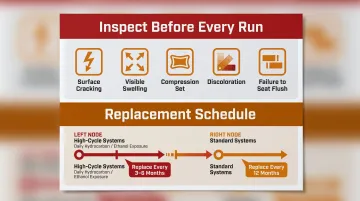
Run-to-failure is not a compliant approach. Establish a documented inspection and replacement schedule, and pull gaskets showing any of these indicators:
- Surface cracking
- Visible swelling
- Compression set (permanent deformation)
- Discoloration
- Failure to seat flush
Heat and solvent exposure accelerate degradation. High-cycle systems — such as those running daily hydrocarbon or ethanol extraction — typically require replacement every 3–6 months rather than annually.
Sourcing Mistake to Avoid
Do not purchase generic industrial gaskets from non-sanitary suppliers. Food/drug-grade sanitary gaskets must carry traceability documentation — lot numbers, material certs, and compliance data sheets — that non-sanitary industrial stock typically does not provide. This documentation gap is a common compliance failure point in cannabis facility audits.
Conclusion
Gasket selection in cannabis extraction comes down to four variables: solvent compatibility, sizing accuracy to your fitting standard, elastomeric recovery under operating pressure, and regulatory compliance. Get any one of these wrong and the system becomes a source of product loss, safety risk, or failed audits.
When those variables intersect with extraction-specific demands, the right component choice isn't always obvious.
Operators building or upgrading extraction systems can reach out to Artesian Systems for application-specific guidance. The team supplies FDA 21CFR-compliant, 3A-approved sanitary gaskets and components, with engineering experience spanning pharmaceutical, chemical, and cannabis processing environments.
Frequently Asked Questions
What gasket material is best for gas and glycol resistance in cannabis extraction equipment?
Viton/FKM is the top choice for both gas-phase hydrocarbon and glycol resistance. Its fluorocarbon chemistry resists swelling in butane, propane, ethylene glycol, and propylene glycol environments. For static sealing positions, PTFE is a reliable alternative.
Which elastomeric gasket materials have excellent recovery properties for cannabis extraction equipment?
Silicone and Viton/FKM are the top performers for elastomeric recovery, with EPDM as a strong secondary option for mechanically stressed joints like valves.
What gasket material is best for CO2 extraction equipment?
EPDM is recommended for its low CO2 permeability and pressure tolerance, while PTFE is suitable for static high-pressure joints. Silicone should be avoided due to CO2 absorption and swelling under pressure cycling.
How often should gaskets be replaced in cannabis extraction systems?
There is no universal interval — replacement frequency depends on solvent exposure, temperature cycling, and disassembly frequency. Establish a documented inspection schedule and replace gaskets when you see compression set, cracking, or visible deformation.
Are PTFE gaskets suitable for high-pressure cannabis extraction?
PTFE handles high-pressure applications including supercritical CO2, but its limited elastomeric recovery (cold-flow risk) requires proper clamping torque and a well-machined seating surface. Filled or expanded PTFE variants improve performance under sustained pressure.
What compliance standards should gaskets meet for cannabis extraction equipment?
Gaskets used in cannabis extraction should meet the following standards:
- FDA 21CFR 177.2600 and 177.1550 — food and drug contact material requirements
- 3A Sanitary Standards — for tri-clamp and sanitary fittings
- USDA compliance — where applicable to your process
All three require documented material certifications from your supplier.