Introduction
Teflon PTFE gaskets are fluoropolymer sealing components engineered to maintain leak-tight seals in process systems handling aggressive chemicals. Chemical resistance is their most critical performance advantage in food processing, pharmaceutical production, nutraceutical manufacturing, and chemical handling — but not every chemical is compatible with PTFE, and the wrong gasket material can trigger serious operational consequences.
Incompatible material selection leads to chemical degradation, premature seal failure, product contamination, worker safety hazards, and costly unplanned shutdowns. One in five gasket failures stems from improper material selection, making upfront verification essential.
This guide covers what PTFE can and cannot resist, how temperature affects chemical compatibility, and how to choose the right gasket type for your specific process conditions.
Key Takeaways
- PTFE gaskets offer excellent chemical resistance against most acids, alcohols, solvents, and bases
- Incompatible chemicals include elemental fluorine, molten alkali metals, and specific fluorinating agents
- Temperature and pressure directly alter chemical resistance — ratings at 22°C do not apply at elevated conditions
- Virgin PTFE has the broadest chemical resistance; filled variants (glass, carbon) add mechanical strength with minor compatibility trade-offs
- Always verify compatibility using current chemical resistance charts and physical testing under process conditions
Why Chemical Resistance Matters When Selecting PTFE Gaskets
Gasket material selection directly determines seal integrity in process systems. A chemically incompatible gasket will swell, soften, or degrade when exposed to process media, causing leaks, contamination, or complete seal failure. According to industry failure analysis, approximately 14% of gasket failures result from using the wrong material for the application.
Impact on regulated industries:
In pharmaceutical, food processing, and chemical manufacturing environments, gasket degradation compromises product purity, triggers regulatory violations, and leads to costly batch losses. FDA 21CFR177.1550 governs PTFE materials for food-contact applications, while 3-A Sanitary Standards and USDA approvals address dairy and food processing compliance.
A gasket that leaches contaminants into a pharmaceutical batch can require complete product disposal — losses that can reach millions of dollars per incident.
Safety and process integrity:
A degrading gasket in high-pressure or corrosive service poses direct worker safety risks, environmental hazards, and unplanned production shutdowns. The downstream costs extend well beyond the gasket itself, including machinery damage, production downtime, OSHA citations, non-compliance penalties, potential litigation, and reputational harm. Any cost savings from installing an inadequate gasket disappear after a single failure event.
Cost comparison:
Those failure costs make upfront material verification the logical choice. A PTFE gasket matched to your chemical environment consistently outperforms mismatched alternatives:
- Maintains integrity in organic solvents and strong acids where rubber gaskets degrade rapidly
- Reduces emergency maintenance calls and unplanned replacement cycles
- Minimizes process downtime tied to seal failure in corrosive or high-temperature service
- Lowers total cost of ownership compared to frequent replacement of cheaper materials
The upfront verification step prevents significantly higher costs downstream.
PTFE Gasket Chemical Compatibility: What It Can Handle
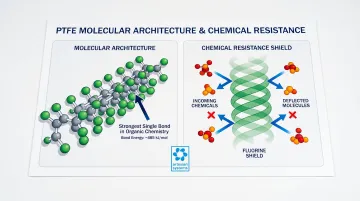
PTFE's broad chemical inertness stems from its molecular structure. The carbon-fluorine (C-F) bond is the strongest single bond in organic chemistry, creating a nearly impervious barrier to chemical attack. Fluorine's extreme electronegativity locks carbon atoms into exceptionally stable bonds. The fluorine atoms then wrap around the carbon backbone in a tight helical structure, physically blocking chemical penetration. This architecture enables PTFE to handle most industrial chemicals at standard operating temperatures.
Acids and Corrosive Chemicals
PTFE gaskets receive excellent (A) ratings for most inorganic and organic acids, including:
- Sulfuric acid (all concentrations: 1-6%, 20%, 60%, 98%)
- Hydrochloric acid (up to 100% concentration, plus dry gas form)
- Nitric acid (including concentrated formulations up to 70%)
- Hydrofluoric acid (4% and 48% concentrations)
- Chromic acid (10% and 50% concentrations)
- Aqua regia (80% HCl, 20% HNO₃ mixture)
This makes PTFE a reliable choice for chemical processing, metal plating, and laboratory environments — with documented resistance across the full pH range encountered in industrial acid service.
Solvents and Organic Compounds
PTFE gaskets perform excellently with most organic solvents used in pharmaceutical manufacturing and extraction processes:
- Acetone and other common ketones
- Ethanol, methanol, and glycerin
- Aromatic solvents including toluene and xylene
- Halogenated solvents: chloroform, carbon tetrachloride, methylene chloride
- Ethylene glycol
This broad solvent resistance makes PTFE the material of choice for pharmaceutical production lines, chemical synthesis operations, and hemp/cannabis extraction systems using ethanol or hydrocarbon-based processes.
Food, Beverage, and Biological Fluids
PTFE receives excellent ratings for food-contact media including:
- Fruit and vegetable juices
- Dairy products
- Vegetable oils
- Sugar solutions
- Alcoholic beverages
- Vinegar and organic food acids
For food and pharmaceutical applications, PTFE gaskets must carry relevant compliance certifications. Materials meeting FDA 21CFR177.1550 (perfluorocarbon resins) are approved for repeated food contact. Additional certifications include 3-A Sanitary Standards for dairy processing and USDA approvals for inspected food processing plants.
Artesian Systems produces sanitary PTFE gasket components built to these compliance standards, offered in envelope and unitized configurations for tri-clamp connections from 1.5" to 12".
Bases, Salts, and Oxidizers
PTFE handles strong alkalis and oxidizing agents effectively:
- Strong bases: Sodium hydroxide, potassium hydroxide, calcium hydroxide (all concentrations)
- Oxidizers: Hydrogen peroxide (3%, 30%, 90%), sodium hypochlorite (15%), ozone, potassium permanganate
PTFE holds up across the full cleaning cycle — caustic washes, peroxide sanitizers, and ozone treatments — without degradation. That durability makes it a practical fit for cleaning-in-place (CIP) and sterilization-in-place (SIP) systems in sanitary processing operations.
Chemicals That PTFE Gaskets Cannot Withstand
PTFE is not universally compatible. Specific chemicals attack the carbon-fluorine backbone and must not contact PTFE components.
Primary incompatible chemicals (D-Severe Effect rating):
- Elemental fluorine (F₂) attacks the C-F bonds directly in PTFE's molecular structure
- Fluorinating agents — including xenon difluoride (XeF₂), cobalt(III) fluoride, and cesium fluoride — degrade the polymer matrix
- Gold monocyanide is chemically incompatible with PTFE
- Diethylamine carries a D (severe effect) rating across tested concentrations
These materials chemically degrade PTFE and require alternative sealing materials such as metal gaskets or specialized elastomers.
Condition-dependent limitations:
Some chemicals receive B (Good) or C (Fair) ratings, indicating limited compatibility:
- Chlorobenzene (B/Good): minor effect, slight discoloration possible under prolonged contact
- Fuel oils and high-aromatic gasoline (B/Good): suitable with monitoring
- Iodoform (C/Fair): moderate effect, not recommended for continuous use
- Petrolatum (C/Fair): can cause softening or dimensional swelling over time
Understanding the Rating Scale
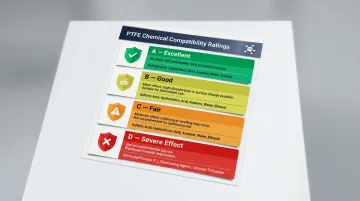
- A (Excellent): No effect — full compatibility
- B (Good): Minor effect — slight corrosion or discoloration possible
- C (Fair): Moderate effect — softening, strength loss, or swelling may occur; not recommended for continuous use
- D (Severe Effect): Not recommended for any use
Critical caution: Chemical resistance data is typically based on 48-hour exposure at controlled conditions. Elevated temperature, pressure, concentration changes, or extended exposure can cause equipment to fail even when initial tests pass. Before full-scale deployment, test under your actual process conditions — including peak operating temperature, maximum concentration, and expected cycle duration — not just standard lab benchmarks.
How Temperature and Pressure Affect PTFE Gasket Chemical Resistance
PTFE's rated operating range spans from cryogenic temperatures (maintaining strength as low as -268°C / -450°F) up to approximately 260°C / 500°F for continuous service. The FSA Gasket Handbook specifies the full temperature range as -210°C to 260°C (-346°F to 500°F) before risk of toxic hydrogen fluoride gas release.
Chemical resistance ratings are typically reported at 22°C and 48°C. Resistance for some chemicals drops from excellent to satisfactory as temperature rises. For example, perchloric acid drops from Good at 20°C to Fair at 50°C — a documented example of temperature-dependent compatibility degradation.
Specifying Gaskets for Actual Process Conditions
Engineers must verify compatibility at the actual process temperature, not just ambient conditions. Elevated temperature service often requires selecting a more robust PTFE grade or reducing chemical concentration to maintain seal integrity. A gasket rated excellent for 98% sulfuric acid at 22°C may soften or degrade at 100°C under the same chemical exposure.
How Heat Weakens PTFE Mechanically
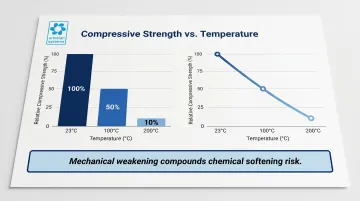
PTFE compressive strength at 100°C is approximately half its value at 23°C; at 200°C it drops to roughly one-tenth. This mechanical weakening, combined with chemical softening, compounds the risk of seal failure.
| Temperature | Compressive Strength (Relative to 23°C) |
|---|---|
| 23°C / 73°F | 100% (baseline) |
| 100°C / 212°F | ~50% |
| 200°C / 392°F | ~10% |
Pressure adds mechanical stress to a gasket already weakened by heat and chemical exposure. The relationship is straightforward: as temperature rises, pressure-holding capability drops.
Creep is significant in the first 4 to 24 hours after installation and accelerates with temperature.
For any elevated-temperature application, cross-reference the manufacturer's combined temperature-pressure-chemical compatibility data. A single-axis compatibility chart listing only chemical names and ratings won't capture how these variables interact in service.
Virgin PTFE vs. Modified PTFE Gaskets: Choosing the Right Type
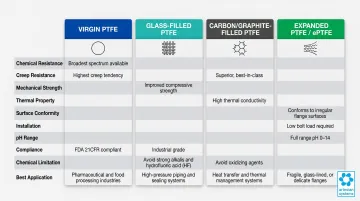
Not all PTFE gaskets perform the same way under pressure, heat, or aggressive chemistry. Each variant trades some mechanical or chemical property to solve a specific problem. Here's how to match the right type to your application.
Virgin PTFE
Virgin PTFE offers the broadest chemical compatibility of any gasket material — inert to nearly all industrial chemicals, with only molten alkali metals and elemental fluorine causing attack. That near-universal resistance makes it the default choice for aggressive chemical environments.
The tradeoff is mechanical: virgin PTFE has the highest creep (cold flow) of all PTFE types. Under sustained load, it deforms continuously, which limits its usefulness in high-pressure applications. Where bolt loads stay moderate, however, it performs reliably.
It's covered under FDA 21CFR177.1550, making it the standard choice for pharmaceutical and food-grade piping where regulatory compliance is non-negotiable.
Glass-Filled PTFE
Glass fiber filler (5–40% by weight) significantly improves dimensional stability and wear resistance over virgin PTFE, making it viable in high-pressure mechanical applications where creep is a concern.
The chemical compatibility caveat matters here: glass degrades in strong alkalis and hydrofluoric acid (HF), even though the surrounding PTFE matrix stays intact. Verify your process chemistry excludes both before specifying glass-filled grades.
Carbon-Filled and Graphite-Filled PTFE
Carbon and graphite fillers (10–35% by weight) deliver the best creep resistance and thermal conductivity of any PTFE variant. Wear resistance and deformation strength also improve markedly — useful in high-load conditions and heat transfer applications where virgin PTFE would deform.
One limitation: carbon can oxidize at elevated temperatures in air, and strong oxidizing agents degrade performance. Keep this type away from concentrated nitric acid, peroxides, or high-temperature oxidizing atmospheres.
Expanded PTFE (ePTFE)
Gore pioneered ePTFE in 1969 by mechanically expanding PTFE into an interconnected node-and-fibril microstructure. The result retains full pH 0–14 chemical compatibility while solving two problems virgin PTFE cannot: poor conformability and high creep under low bolt loads.
The interlocking fibril structure resists cold flow once densified, and the material conforms readily to rough, damaged, or irregular sealing surfaces. This makes ePTFE the preferred choice for fragile flanges — glass-lined steel, FRP, plastic — where high bolt stress would crack the flange before achieving a seal.
For sanitary tri-clamp systems in pharmaceutical and food-grade piping, ePTFE's combination of FDA compliance, low required bolt load, and full chemical resistance makes it a reliable fit. Artesian Systems' tri-clamp envelope gaskets use FDA 21CFR-compliant materials in sizes from 1.5" to 12", with no minimum order quantity for regulated production environments.
Application selection guide:
| Application | Recommended PTFE Type |
|---|---|
| Pharmaceutical/food-grade with aggressive chemicals | Virgin PTFE |
| High-pressure systems with moderate chemicals | Glass-filled PTFE |
| High-temperature heat transfer applications | Carbon or graphite-filled PTFE |
| Irregular or damaged flanges in sanitary systems | ePTFE |
Frequently Asked Questions
Which chemicals are compatible with Teflon (PTFE) gaskets?
PTFE gaskets are rated excellent for most acids (sulfuric, hydrochloric, nitric, hydrofluoric), alcohols, ketones, solvents, bases, and oxidizers. That breadth of compatibility — combined with FDA 21CFR and 3A approvals — is why PTFE is the default gasket choice in sanitary process systems.
Is Teflon (PTFE) chemically resistant?
PTFE is one of the most chemically inert plastics available due to its strong carbon-fluorine molecular bonds. It resists all industrial chemicals except elemental fluorine, certain fluorinating agents (xenon difluoride, cobalt fluoride), and a handful of specialized compounds like gold monocyanide.
What gasket materials have the best chemical resistance?
PTFE/Teflon consistently ranks as the top choice for chemical resistance among gasket materials. Other strong options include PVDF, FEP, and PFA fluoropolymers, though PTFE offers the broadest range of compatibility and the most recognized regulatory approvals — including FDA 21CFR177.2600, 3A, and USDA — for food, pharmaceutical, and sanitary process applications.
What is the difference between PTFE and glass-filled PTFE?
Virgin PTFE offers maximum chemical resistance and FDA compliance for food and pharmaceutical applications. Glass-filled PTFE incorporates glass fiber to improve compressive strength and dimensional stability, at a slight cost to chemical inertness in aggressive environments like strong bases and hydrofluoric acid.
Can Teflon (PTFE) gaskets withstand hydrochloric acid (HCl)?
PTFE gaskets are rated excellent (A) for hydrochloric acid at all concentrations — 20%, 37%, and 100% — and in dry gas form. They maintain that rating continuously up to 212°F (100°C), covering most HCl service conditions in chemical processing, metal plating, and laboratory environments.