Introduction
Industrial processes demand materials that handle extreme temperatures, aggressive chemicals, and strict hygiene standards at the same time — a combination that eliminates most standard materials outright.
Pharmaceutical reactors cycle between cryogenic solvents and high-temperature sterilization. Food processing lines require optical clarity alongside zero extractables risk. Chemical plants expose components to corrosive media that degrades both metals and polymers. Engineers across these industries share the same core problem: finding components that hold up across multiple failure modes simultaneously.
Borosilicate glass addresses that problem directly. Its coefficient of thermal expansion is roughly one-third that of soda-lime glass (3.3 x 10⁻⁶ K⁻¹ versus 9.1 x 10⁻⁶ K⁻¹), and it resists both acids and alkalis while remaining fully transparent for real-time process monitoring.
The catch: off-the-shelf lab glassware rarely meets the pressure ratings, connection specifications, or dimensional tolerances industrial systems require. Forcing standard parts into custom applications creates compliance risks, process bottlenecks, and costly failures.
What follows covers the properties, applications, fabrication requirements, and sourcing criteria engineers need to specify custom borosilicate components with confidence.
TLDR:
- Borosilicate glass offers thermal shock resistance 4x better than standard glass and withstands continuous use to 500°C
- Custom components must be engineered for pressure ratings, seal compatibility, and regulatory compliance as a complete assembly
- Applications span pharmaceutical reactors, food sight glasses, cannabis extraction, and chemical process monitoring
- Fabrication requires CNC machining, DIN 7080 pressure testing, and certified material documentation for all seals and fittings
- Sourcing partners should provide design-through-validation support, not just supply raw glass
What Is Borosilicate Glass and Why Does It Matter for Industrial Use?
Borosilicate glass contains 12-13% boron trioxide (B₂O₃), which alters its structural and thermal behavior compared to standard soda-lime glass. That boron content drops the coefficient of thermal expansion to 3.3 x 10⁻⁶ K⁻¹ — roughly one-third of soda-lime glass — giving it the lowest thermal expansion rate among mass-produced technical glasses at this price point.
Core Material Properties:
| Property | Borosilicate 3.3 | Soda-Lime Glass |
|---|---|---|
| CTE (20-300°C) | 3.3 x 10⁻⁶ K⁻¹ | 9.1 x 10⁻⁶ K⁻¹ |
| Max Operating Temp | 500°C continuous | ~480°C |
| Thermal Shock Resistance | 166°C (ΔT) | 40-50°C (ΔT) |
| Hydrolytic Resistance | Class 1 (ISO 719) | Class 3-4 |
| Acid Resistance | Class 1 (DIN 12116) | Poor |
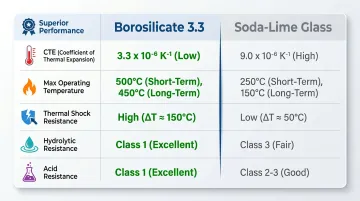
This resistance to thermal shock allows borosilicate components to transition directly from liquid nitrogen cooling to high-temperature steaming without fracturing — a capability essential for pharmaceutical CIP (clean-in-place) systems where components undergo repeated heating and cooling cycles.
Chemical Resistance Across Process Media:
Borosilicate glass achieves Class 1 hydrolytic resistance under ISO 719, with weight loss under 0.1 mg per 100 cm² after boiling in water for one hour. Acid resistance per DIN 12116 limits weight loss to 0.4 mg/dm² after six hours in boiling 20% hydrochloric acid. Alkali resistance reaches Class 2 under ISO 695, handling sodium hydroxide solutions where metals corrode and standard glass dissolves.
Why Custom Matters:
Standard borosilicate labware — beakers, flasks, tubing — is manufactured for general laboratory use, not engineered to process-specific pressure ratings, dimensional tolerances, or sanitary connection standards. Research into industrial sight glass failures documents how off-specification components create leak points, compliance violations, and process contamination risks. Custom fabrication addresses three critical gaps:
- Validated burst pressures with 7:1 to 10:1 safety factors per DIN 7080, documented for each component
- Tri-clamp ferrule tolerances held to ±0.5mm to prevent gasket compression failures at sanitary connections
- Full assembly compliance — seals, gaskets, and fittings independently certified to FDA 21CFR, 3-A, or USP standards alongside the glass
Borosilicate vs. Alternatives:
| Material | Max Temp | Optical Clarity | Cost Multiplier |
|---|---|---|---|
| Borosilicate | 500°C | Excellent | 1x (baseline) |
| Quartz Glass | 1,100°C | Excellent | 5-10x |
| PTFE | 260°C | Opaque | 0.5-0.8x |
| Stainless Steel | 800°C+ | Opaque | 0.8-1.5x |
Quartz glass components offer higher temperature tolerance but cost five to ten times more than equivalent borosilicate parts. PTFE provides flexibility and impact resistance but eliminates visual process monitoring. Stainless steel handles mechanical stress but corrodes in halogenated solvents and strong acids where borosilicate remains inert.
For most sanitary process environments — pharmaceutical, food and beverage, nutraceutical — that range puts borosilicate in a practical middle ground: chemical inertness and visual monitoring at a fraction of quartz's cost, without the opacity trade-off of metal or PTFE alternatives.
Key Industrial Applications of Custom Borosilicate Glass Components
Pharmaceutical and Biopharma Manufacturing
Pharmaceutical processes require USP Type I borosilicate glass, classified as neutral glass with hydrolytic resistance limits of 0.1 mL of 0.02M HCl per gram. Custom borosilicate components serve:
- Reactors and vessels — jacketed glass reactors for API synthesis where product contact surfaces must produce zero extractables
- Sight glasses and flow indicators — allow real-time visual monitoring of batch progression without breaking containment
- Chromatography columns — transparent housings for resin beds requiring optical inspection during purification runs
- Sanitary connections — tri-clamp sight glasses engineered to specific pressure ratings integrate into existing stainless steel piping networks
Custom geometries become necessary when standard catalog parts cannot accommodate process-specific pressure differentials, temperature cycling protocols, or connection standards like DIN flanges or ASME sanitary fittings.
Food, Beverage, and Nutraceutical Processing
3-A Sanitary Standard 65-01 governs sight and light windows in contact with food products. Borosilicate glass applications include:
- Inspection windows in process vessels — pasteurizers, fermentation tanks, and mixing vessels where operators monitor product consistency
- Inline sight glasses — flow observation points in CIP-validated piping systems
- Bottle inspection stations — quality control checkpoints using borosilicate components for fill-level verification
USDA and 3-A compliance extends beyond the glass disc to the complete assembly. Key material limits include:
- EPDM gaskets — FDA 21CFR 177.2600 limits extractables to 20 mg/sq. in. maximum in the first seven hours for aqueous foods
- PTFE seals — FDA 21CFR 177.1550 requires total extractives not exceeding 0.2 mg/sq. in.
Hemp, Cannabis, and Hydrocarbon Extraction
The global cannabis extraction equipment market reached $11.06 billion in 2024, with borosilicate sight glasses playing critical roles in:
- Solvent extraction vessels — ethanol and hydrocarbon extraction systems operating under pressure require sight glasses rated to 150 PSI
- Visual process monitoring — operators track color changes and solvent clarity during extraction runs
- Temperature cycling — components must withstand rapid transitions between room temperature solvent loading and heated purging cycles
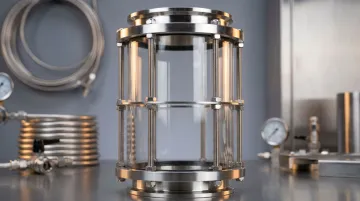
Artesian Systems' patented medical hydrocarbon extractor required custom borosilicate sight glasses built specifically for solvent exposure, sustained pressure cycling, and operator-visible process monitoring. No catalog part met all three requirements simultaneously — a common situation in specialized extraction equipment.
Chemical and Petroleum Processing
Glass-lined reactors and borosilicate sight glasses handle corrosive media that rapidly degrade stainless steel:
- Acid concentration systems — sulfuric acid, hydrochloric acid, and nitric acid applications where metals corrode
- Distillation columns — sight glasses at critical separation stages monitor reflux ratio and vapor-liquid interfaces
- Flow indicators — confirm product transfer in caustic solutions, halogenated solvents, and oxidizing acids
In these environments, borosilicate outperforms glass-lined steel on cost and lead time for smaller-diameter sight glass fittings — particularly in custom sizes where glass lining a standard fitting isn't practical.
Water Treatment and Filtration
Borosilicate glass serves water systems requiring NSF/ANSI 61 compliance for drinking water contact:
- Inline observation windows — confirm filter bed integrity and detect breakthrough in granular activated carbon systems
- Microplastics detection systems — Artesian Systems developed filtration screens capable of detecting microplastic contamination, where borosilicate's near-zero extractables prevent interference with sensitive detection equipment
- Flow verification points — sight glasses in ultrapure water systems for semiconductor or pharmaceutical manufacturing
Material extractables must remain undetectable to avoid false positives in analytical equipment measuring contaminants at parts-per-billion levels.
Designing and Fabricating Custom Borosilicate Glass Components
Step 1: Define Process Requirements
Custom component design begins with complete process specification:
Critical Parameters:
- Operating temperature range (continuous and peak excursions)
- Maximum and minimum operating pressure
- Process media chemistry (acids, bases, solvents, concentrations)
- Required dimensional tolerances
- Connection type (tri-clamp size, flange standard, threaded fitting)
- Regulatory framework (USP, FDA 21CFR, 3-A, USDA, NSF/ANSI 61)
Engineers must specify complete assembly requirements beyond the glass itself: gasket material compatibility, seal compression specifications, and pressure testing standards. DIN 7080 sight glass standards provide baseline pressure ratings by diameter and thickness, with safety factors of 7:1 to 10:1 against rated pressure.
Step 2: Engineering and Prototyping
Mechanical engineering translates process specifications into precise component geometries:
- Model components in SOLIDWORKS or AutoCAD, integrating glass geometry with mounting hardware and seal interfaces
- Run finite element analysis to validate wall thickness against pressure ratings and thermal cycling loads
- Machine custom flanges, mounting brackets, and seal retention features from 316L stainless steel or Hastelloy
Artesian Systems' CNC machining capabilities cover specialty alloys including Inconel, Hastelloy, and A200 alongside borosilicate glass. This enables single-source fabrication of complete assemblies where tolerances between glass and metal components must align within ±0.5mm.
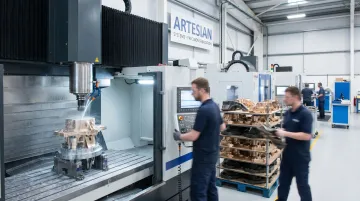
With close to two decades of process engineering experience across petroleum, chemical, and pharmaceutical industries, Artesian Systems engineers identify integration challenges during initial design. Thermal expansion mismatches, gasket compression requirements, and mounting stress concentrations get resolved on paper — not during field installation.
Step 3: Material and Seal Selection
A borosilicate glass component is only one element of a complete assembly. Seal selection determines whether that assembly holds up under real process conditions:
Seal Material Options:
| Material | FDA 21CFR | Max Temp | Chemical Compatibility |
|---|---|---|---|
| EPDM | 177.2600 | 150°C | Acids, bases, steam |
| PTFE | 177.1550 | 260°C | Universal (except molten alkali metals) |
| Silicone | 177.2600 | 200°C | Aqueous solutions, steam |
| Viton | 177.2600 | 200°C | Hydrocarbons, solvents |
Artesian Systems uses 3-A approved, USDA compliant, and FDA 21CFR177.2600 and 1550 compliant materials across all component assemblies. Seal selection is driven by process media and operating temperature.
PTFE-faced EPDM gaskets are a common choice where chemical resistance and elastomeric sealing memory both matter — particularly for applications with ferrule misalignment or repeated thermal cycling.
Material Certification Documentation:
- Certificates of conformance to FDA regulations
- Extractables test reports per 21CFR methods
- USP Class VI biological reactivity certification (for pharmaceutical elastomers)
- 3-A certification for complete assemblies, not just individual components
Step 4: Testing and Validation
Components undergo validation before process deployment:
- Pressure testing — hydrostatic proof testing to 1.5x rated pressure per DIN 7080, with safety factors validated by destructive burst testing
- Thermal cycling — repeated heating and cooling cycles simulate CIP protocols and verify seal integrity across temperature excursions
- Chemical compatibility — immersion testing in process media at operating concentrations confirms no extractables, swelling, or degradation
ISO9001-aligned quality management ensures documentation traceability: batch numbers linking glass discs to melt certifications, seal material lot tracking, and pressure test reports archived for audit trails in GMP-regulated environments.
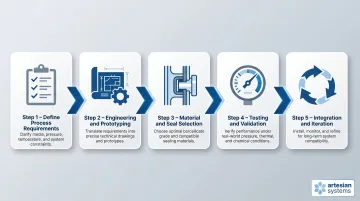
Step 5: Integration and Iteration
Custom components often require refinement when integrated into full process systems:
- First-article inspection — dimensional verification against design specifications before production runs
- Field testing — installation in actual process conditions may reveal vibration, mounting stress, or thermal expansion issues not apparent in isolated testing
- Design iteration — engineering partners compress iteration cycles by maintaining design files and tooling for rapid modification
Sourcing from an engineering partner like Artesian Systems, rather than a raw glass supplier, reduces costly process downtime. Rapid prototype-to-production cycles with single-source accountability for design, fabrication, testing, and documentation keep projects moving.
Compliance and Certification Requirements for Industrial Glass Components
Regulatory Landscape by Sector
Different industries mandate specific material and testing standards:
Pharmaceutical:
- USP Type I glass — neutral borosilicate glass suitable for all parenteral preparations
- USP Class VI — biological reactivity testing for elastomers and seals (systemic injection, intracutaneous, implantation tests)
- FDA 21CFR — food contact regulations apply to seals and gaskets in drug manufacturing equipment
Food and Beverage:
- 3-A Sanitary Standard 65-01 — sight and light windows in product contact (excludes non-contact external sight glasses)
- USDA approval — materials used in federally inspected meat and poultry plants
- FDA 21CFR 177.2600 — rubber gaskets with extractables limits for aqueous and fatty foods
Water Treatment:
- NSF/ANSI 61 — drinking water system components (49 states mandate compliance)
The FDA's 2011 glass delamination advisory was issued after drug recalls traced to glass lamellae in injectable products. For procurement teams, this is a direct reminder that substandard glass quality leads to batch rejection, audit failures, and product liability exposure — not just technical non-conformance.
Complete Assembly Certification
Material certifications must cover entire assemblies, not just glass discs:
- Type I borosilicate glass certified per ASTM E438 or ISO 3585
- Seals and gaskets with separate compliance to 21CFR 177.2600 (rubber) or 177.1550 (PTFE)
- 316L stainless steel hardware supplied with passivation certificates
A compliant supplier should be able to document every layer of an assembly — not just the glass. Artesian Systems covers this across the board:
- 3-A approved, USDA compliant, FDA 21CFR177.2600 and 1550 compliant materials across full assemblies
- ISO9001-certified design and build processes
- Material certificates, test reports, and batch traceability records available on request
Documentation Requirements for GMP Environments
Regulated industries require:
- Material certificates of conformance per FDA regulation, issued by component and batch
- Extractables test reports confirming seals meet 21CFR limits for aqueous and fatty food simulants
- Hydrostatic pressure test reports with serial number traceability
- Batch traceability records linking installed components to raw material lot numbers for recall management
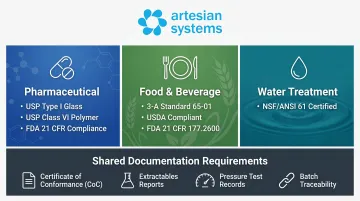
ISO9001 quality systems ensure these documents are generated, archived, and retrievable during regulatory audits or quality investigations.
Borosilicate Glass vs. Alternative Industrial Materials
Performance Comparison
| Material | Max Temp | CTE | Optical | Chemical Resistance | Relative Cost |
|---|---|---|---|---|---|
| Borosilicate | 500°C | 3.3 x 10⁻⁶ K⁻¹ | Excellent | Class 1 (acids, water) | 1x |
| Quartz | 1,100°C | 0.55 x 10⁻⁶ K⁻¹ | Excellent | Superior | 5-10x |
| PTFE | 260°C | 110 x 10⁻⁶ K⁻¹ | Opaque | Universal | 0.5-0.8x |
| Stainless Steel | 800°C+ | 17 x 10⁻⁶ K⁻¹ | Opaque | Limited (corrodes in acids) | 0.8-1.5x |
When Borosilicate Is Optimal
Borosilicate is the right call when:
- Operating temperatures remain below 500°C
- Visual process monitoring provides operational value
- Chemical resistance to acids, bases, or solvents is required
- Extractables must remain near-zero for product purity
- Cost considerations prohibit quartz glass
Addressing Mechanical Fragility
The primary objection to borosilicate components centers on brittleness compared to metal alternatives. Industrial sight glass service life typically ranges from 1-3 years depending on operating conditions, with proper engineering addressing fragility through:
- Metal guards around the glass prevent impact damage during operation and maintenance
- DIN 7080-rated components (160 N/mm² minimum bending strength, 7:1 safety factors) perform reliably within specified pressure envelopes
- Stress-free installation procedures eliminate torque-induced cracking at connection points
Components sized for the actual process — correct wall thickness, compatible gasket material, and impact shielding — routinely outlast stock glass in demanding process environments.
Total Cost of Ownership
Borosilicate components carry a higher upfront cost than polymer alternatives, but that gap closes quickly in acid service, high-temperature lines, or any application where contamination triggers a batch loss:
- Resists chemical attack, eliminating the premature replacements that polymer sight glasses require in solvent or acid service
- Releases no extractables into the product stream, preventing the batch losses and regulatory holds that dwarf component costs
- Extends maintenance intervals in acid service where stainless steel corrodes and requires frequent inspection or replacement
A complete cost picture covers replacement frequency, contamination risk, regulatory compliance burden, and process downtime alongside the purchase price.
How to Source Custom Borosilicate Glass Components for Your Process
Define Partner Requirements
Look for fabrication partners offering engineering expertise, not just catalog sales:
Essential Capabilities:
- Mechanical engineering team capable of translating process specs into component designs
- CNC machining for precision fabrication of glass and complementary materials
- Demonstrated compliance certifications (ISO9001, 3-A, FDA material approvals)
- Prototype development support before committing to production volumes
- Documentation packages for regulated environments (certificates of conformance, test reports, batch traceability)
Prepare Specification Information
Accelerate quoting and design phases by compiling:
- Process media: chemical identity, concentration, and pH
- Operating conditions: temperature range (continuous and peak), plus maximum pressure and vacuum
- Connection standards: tri-clamp size, flange type (DIN, ASME), pipe thread
- Regulatory framework: applicable FDA regulations, 3-A standards, USP requirements
- Volume estimates: annual quantities for pricing and lead time planning
Engage Engineering-Led Suppliers
Work with partners offering end-to-end support from design through testing and documentation:
Artesian Systems provides custom process component design and build services backed by:
- ISO9001 certification for quality management and traceability
- Compliant materials (3-A approved, USDA compliant, FDA 21CFR177.2600 and 1550)
- Almost two decades of engineering experience across food, pharmaceutical, chemical, and extraction industries
- CNC machining capabilities for specialty alloys and composite materials
- Section VIII Division 1 vessel and reactor building capabilities
This integrated approach shortens design-to-delivery timelines and provides single-source accountability when components require iteration or field modification. Having one partner coordinate glass fabrication, machining, and seal compatibility means faster resolution when assemblies need adjustment before validation.
Frequently Asked Questions
What makes borosilicate glass better than regular glass for industrial applications?
Borosilicate glass has a thermal expansion coefficient roughly one-third of soda-lime glass (3.3 x 10⁻⁶ K⁻¹ vs. 9.1 x 10⁻⁶ K⁻¹), handling 166°C temperature differentials without fracturing. It also achieves Class 1 chemical resistance per DIN 12116 and ISO 719, with near-zero extractables essential for pharmaceutical and food contact use.
Which industries most commonly use custom borosilicate glass components?
The most common sectors are pharmaceutical/biopharma, food and beverage, chemical manufacturing, hemp and cannabis extraction, and water treatment. Custom fabrication serves each by meeting pressure ratings, connection standards, and compliance requirements that standard catalog parts cannot.
Is borosilicate glass FDA and USDA compliant for food and pharmaceutical contact applications?
Borosilicate glass is USP Type I and considered inert for food contact, but full assembly compliance requires seals and fittings that independently meet FDA 21CFR 177.2600 (rubber gaskets), 21CFR 177.1550 (PTFE components), and 3-A or USDA standards where applicable. Material certifications must cover the complete assembly — not just the glass.
What are the main limitations of borosilicate glass in industrial settings?
Borosilicate glass is mechanically brittle compared to metals, with lower impact resistance requiring protective housings. Maximum continuous operating temperature reaches 500°C (below quartz glass at 1,100°C). Proper mounting design prevents stress concentration at connection points. Engineering-grade custom fabrication with validated wall thickness, pressure ratings, and protective measures addresses these limitations.
How are custom borosilicate glass components manufactured to precise tolerances?
Custom components combine precision glass forming with CNC machining of glass and complementary materials such as specialty alloys and composite seals. DIN 7080 sight glass discs hold diameter tolerances of ±0.5mm (up to 135mm) and thickness tolerances of +0.50/-0.25mm, with finished assemblies verified through dimensional inspection, pressure testing to 1.5x rated pressure, and thermal cycling validation.
How do I get started with sourcing custom borosilicate glass components for my process?
Start by compiling your process specs: media chemistry, operating temperature and pressure, connection standards (tri-clamp, flange, threaded), regulatory requirements (FDA, 3-A, USP, USDA), and annual volume. Then engage a fabrication partner with engineering capabilities to translate those specs into compliant, tested designs with full documentation support.