
Buna (nitrile) gaskets are widely used throughout food processing operations for their excellent resistance to fats and oils. Yet many maintenance teams still rely on reactive replacement strategies—waiting for visible failure rather than monitoring condition indicators. This guide explains exactly when to replace Buna gaskets based on physical condition, chemical exposure history, operating temperature, and operational cycles. You'll learn to identify the warning signs that demand immediate action, understand how process conditions accelerate degradation, and implement condition-based replacement intervals that protect both product safety and your bottom line.
Key Takeaways
- Replace Buna gaskets based on physical condition and exposure history, not arbitrary calendar schedules
- Key replacement triggers: visible cracking, compression set, elasticity loss, leakage, swelling, and CIP validation failures
- Buna excels with fats and oils but degrades rapidly under ozone, alkaline/acidic CIP cleaners, and sustained high temperatures
- Delayed replacement risks contamination, regulatory non-compliance, and unplanned downtime — costs can reach $30,000 per hour
- Align replacement timing with scheduled maintenance windows and inspection logs
Why Replacement Timing Matters for Buna Gaskets in Food Processing
Replacement timing directly determines sealing performance and food safety outcomes. A gasket replaced too late allows contamination pathways to open at the microscopic level—permitting microbial ingress, product loss, and cross-contamination long before visible leakage appears. Replace too early, and you waste resources while increasing the risk of improper reinstallation during unnecessary maintenance events.
The compliance stakes are particularly high in food processing. Three regulatory frameworks define the performance floor for gaskets in active service:
- FDA 21 CFR 177.2600 governs rubber articles intended for repeated food contact, requiring extraction limits no higher than 20 mg/in² for aqueous foods and 175 mg/in² for fatty foods
- USDA 9 CFR 416.3 requires all equipment to be "thoroughly cleanable" and not "adulterate" food products
- 3-A Sanitary Standard 18-03 mandates that multiple-use rubber materials maintain sanitary integrity throughout their full service life
A degraded gasket that has undergone chemical breakdown may exceed FDA extraction limits even when no visible leak has occurred. A Buna gasket showing compression set, surface cracking, or chemical swelling no longer meets any of these standards.
Buna's material properties make condition tracking especially important. Nitrile offers good resistance to oils and fats—making it suitable for meat processing, dairy fat handling, and cooking oil lines—but shows real vulnerability to ozone, certain CIP chemicals, and sustained high temperatures.
Buna's material properties make condition tracking especially important. Nitrile offers good resistance to oils and fats—making it suitable for meat processing, dairy fat handling, and cooking oil lines—but shows real vulnerability to ozone, certain CIP chemicals, and sustained high temperatures.
Research published in Molecules documented 11.5% weight gain in Buna samples exposed to 3% acetic acid for just 10 days, along with zinc migration of 291,942 micrograms/L into the food simulant. Those numbers mean a gasket can be chemically compromised—and actively migrating contaminants—well before any operator notices a problem.
When to Replace Buna Gaskets: Condition and Performance Indicators
Observable and measurable signals indicate when a Buna gasket has reached or is approaching the end of its serviceable life. Any one of these indicators is sufficient to warrant replacement—do not wait for multiple failure modes to appear simultaneously.
Physical Signs of Degradation
Inspect gaskets for these visual and tactile warning signs during routine maintenance:
Surface cracking or crazing indicates that the elastomer matrix has begun to break down. Ozone exposure causes particularly aggressive degradation, attacking the carbon-carbon double bonds in butadiene segments and producing cracks perpendicular to the strain axis. Trace amounts as low as 1 ppm can initiate this process in Buna compounds.
Hardening or loss of pliability signals that the polymer has undergone excessive cross-linking or chain scission due to thermal aging or chemical exposure. A healthy Buna gasket should feel firm but resilient when pressed. If it feels rigid, like a hard plastic, the material has lost the elasticity needed to maintain sealing force.
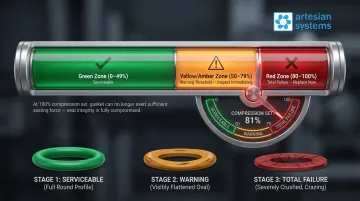
Permanent deformation (compression set) occurs when the gasket no longer returns to its original shape after being compressed. Parker Hannifin identifies compression set as the primary seal failure mode, with temperature as the most critical accelerating factor.
Industry guidelines typically consider 50% compression set a warning threshold and 80% or higher as total failure. At that point, the gasket can no longer exert sufficient sealing force against mating surfaces.
Swelling indicates chemical attack. The same study cited earlier found 15.3% weight gain when Buna samples were exposed to 50% ethanol, demonstrating how certain food media change gasket dimensions and compromise seal geometry.
Discoloration often accompanies chemical or thermal degradation, particularly when the gasket transitions from black to brown or develops uneven color across its face.
Functional Signs of Seal Failure
Operational indicators reveal that seal failure is underway or imminent:
- Visible leakage at fittings or joints (a late-stage indicator—contamination may have already occurred)
- Unexplained pressure drops in process lines
- Increased product loss or residue at connection points
- Failed CIP validation checks where contamination is detected post-cleaning
Of these, visible leakage is the most dangerous indicator to wait for. By the time product appears at the joint, the seal has likely permitted microbial ingress or cross-contamination for days or weeks. Proactive replacement based on physical inspection—not visible failure—is the only defensible food safety posture.
When sourcing replacements, specify FDA 21 CFR 177.2600 compliant materials. Artesian Systems manufactures tri-clamp gaskets in sizes from 1.5" to 12" with 3-A Sanitary Standards approval and USDA compliance, built for sanitary process applications in food, beverage, and pharmaceutical settings.
When to Replace Based on Operational and Environmental Scenarios
The "right time" to replace a Buna gasket depends heavily on exposure conditions. The same material will wear at dramatically different rates depending on application, process media, cleaning regime, and operating temperature.
Based on Process Temperature and Chemical Exposure
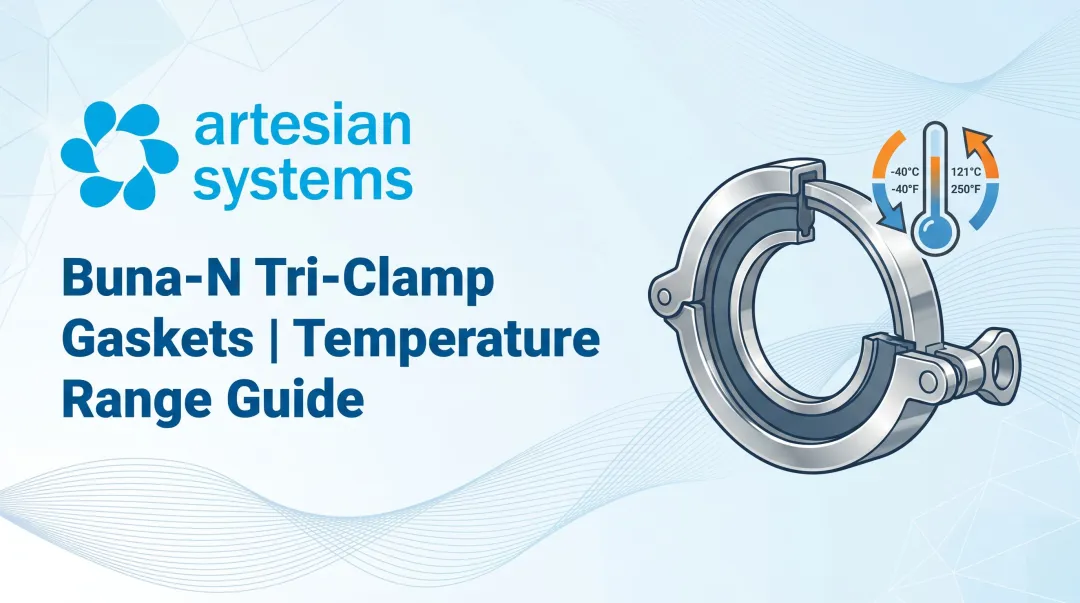
Temperature range considerations: Standard Buna operates reliably from -40°F to +250°F (-40°C to +121°C), though some manufacturers rate continuous service at the more conservative limit of 200°F. Gaskets used near pasteurizers or in high-temperature CIP cycles should be inspected more frequently than those in ambient-temperature lines.
Research on thermal degradation shows accelerated aging at temperatures above 120°C, with compression set increasing exponentially as temperature rises. Gaskets in steam-adjacent applications or hot-fill lines may require replacement at half the interval of ambient-temperature installations.
CIP chemical exposure: Typical CIP protocols involve hot water pre-rinse followed by caustic soda (NaOH) at 80°C (176°F), acid rinses, and sanitizer steps. While Buna handles moderate CIP temperatures, it struggles with aggressive CIP chemicals—particularly strong chlorine-based sanitizers, high-concentration caustic solutions, and ozone-based sanitizers.
Ozone represents the most severe threat. Buna's butadiene content makes it highly vulnerable—only trace amounts initiate surface cracking under mechanical stress. Facilities using ozone sanitization should either select alternative elastomers (EPDM) or shorten Buna gasket inspection intervals to weekly or even per-shift basis.
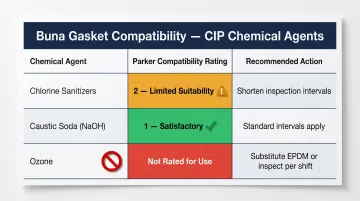
Parker's chemical compatibility data assigns these ratings for common CIP agents:
- Chlorine sanitizers: "2" (limited suitability/minor effect) — shorten inspection intervals
- Caustic soda (NaOH): "1" (satisfactory) — standard intervals apply
- Ozone: Not rated for use — substitute EPDM or inspect per shift
Facilities running aggressive CIP protocols with multiple daily cycles at elevated temperatures should reduce inspection intervals accordingly.
Based on Product Type and Processing Intensity
Buna performs exceptionally well with fats, oils, and neutral pH products, making it the preferred choice for:
- Meat processing operations
- Dairy applications involving milk fat
- Cooking oil and edible fat handling
- Neutral pH beverage lines
However, Buna is poorly suited for high-acid environments. The 11.5% swelling documented in acetic acid exposure demonstrates why gaskets in citrus processing, vinegar handling, or fermentation operations degrade faster and require earlier replacement—or material substitution to EPDM or fluoroelastomers.
High-throughput lines where gaskets undergo frequent assembly and disassembly—plate heat exchangers, tri-clamp fittings on portable equipment, frequently cleaned sight glasses—accumulate mechanical wear faster than chemical degradation. In these applications, replacement intervals should reflect assembly frequency rather than contact time alone. A gasket assembled and disassembled daily may require replacement after 90-120 cycles regardless of chemical exposure.
Based on Maintenance and Production Cycles
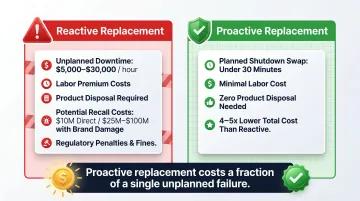
Replace gaskets during planned maintenance shutdowns or scheduled production breaks. The cost difference is significant: reactive repairs run 4-5 times more than proactive replacements on the same equipment.
Build replacement intervals into your preventive maintenance calendar based on:
- Operating hours since installation
- Cumulative CIP cycle count
- Documented inspection findings
- Process condition changes (new cleaning chemicals, increased throughput, product line modifications)
These intervals aren't static. Any process change — especially a switch from chlorine-based to ozone-based sanitization — requires an immediate revision to inspection and replacement schedules. Buna gaskets left on original intervals after such a change will fail unpredictably.
When You Cannot Afford to Delay Buna Gasket Replacement
Certain conditions transform delayed replacement from a maintenance inconvenience into a food safety crisis. Immediate replacement is required when:
- Visible cracking or compression set appears in a product-contact zone
- Leakage is detected at a critical control point
- A contamination event has occurred and gasket integrity is questioned
- CIP validation fails and gasket condition cannot be confirmed
These situations demand same-shift or next-shift response, not "next scheduled window" planning.
The downstream consequences of replacing too late include microbial contamination pathways at gasket joints, failed regulatory audits, and potential product recalls. Equipment maintenance failures account for 31% of food product recalls, with cited causes including "leaky pipes, metal shavings from worn components, and contamination from poorly maintained seals."
The average recall costs $10 million in direct expenses—and $25–100 million or more once brand damage and lost sales are factored in.
Those recall costs make the economics of proactive replacement straightforward. Unplanned downtime in food processing runs $5,000–$30,000 per hour when you factor in labor, materials, disposal, and lost production. A planned gasket swap during a scheduled shutdown, by contrast, typically takes under 30 minutes with minimal labor cost.
Degraded Buna also carries a direct compliance risk. Unlike more chemically resistant materials, Buna breaking down under process conditions can leach compounds directly into food products.
The zinc levels (291,942 micrograms/L) documented in the acid exposure study far exceed acceptable food-contact limits—a clear violation under FDA 21 CFR 177.2600 extraction restrictions.
Best Practices for Timing Buna Gasket Replacement
Build a Structured Replacement Schedule
Track these data points for every gasket:
- Installation date
- Operating hours
- Cumulative CIP cycle count
- Process media type
- Operating temperature range
- Chemical exposure history
Use this log to establish condition-based replacement intervals rather than defaulting to arbitrary timelines. Document replacement events with part numbers, inspection findings, and reason for replacement to support regulatory traceability.
Implement Routine Inspection
Establish a cadence based on operating conditions:
- High-frequency lines: Weekly visual inspection
- Moderate-frequency lines: Inspection at each planned disassembly or monthly
- Low-frequency service: Quarterly or after a defined number of CIP cycles
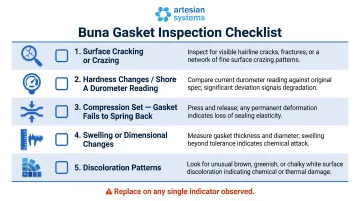
Train maintenance personnel to identify:
- Surface cracking or crazing
- Hardness changes (use Shore A durometer for objective measurement)
- Compression set (gasket no longer springs back when removed)
- Swelling or dimensional changes
- Discoloration patterns
Make replacement decisions based on observed condition, not assumptions about remaining life.
Specify Compliant Replacement Materials
When sourcing Buna gaskets for food processing, verify FDA 21 CFR 177.2600 and USDA compliance. Artesian Systems provides sanitary-grade Buna gaskets, including material certifications and 3-A Sanitary Standards approval. This ensures replacement gaskets are food-safe from the moment of installation.
Store Spare Gaskets Properly
Sourcing compliant gaskets is only half the equation — proper storage preserves their material properties until installation. Maintain spare inventory under controlled conditions:
- Store in original packaging in a clean, dry environment
- Keep away from UV light and ozone sources (electric motors, welding equipment)
- Maintain storage temperature between 65°F and 85°F
- Rotate stock—first in, first out—to use gaskets within their shelf life
- Check manufacturer shelf life data; most Buna gaskets degrade after 3–5 years in storage even under ideal conditions.
Frequently Asked Questions
How long do gaskets last?
Buna gaskets in food processing last anywhere from several months to a few years depending on CIP frequency, temperature, and contact media. Research on plate heat exchangers at 140°C puts service life around 300 days, with longer service at typical food processing temperatures. Condition-based inspection is more reliable than fixed replacement schedules.
How to tell if a rubber gasket is bad?
Check for visible cracking, hardening, compression set (gasket no longer springs back when pressed), swelling, discoloration, or leakage at the joint. Any of these signs warrants replacement before the next production run.
Are Buna gaskets FDA-approved for food contact?
Buna (nitrile) is listed under FDA 21 CFR 177.2600 as a permitted elastomer, but not all Buna gaskets are automatically food-grade—the compound must also satisfy extraction limits and adjuvant substance restrictions. Always verify material certification before using Buna gaskets in food-contact applications.
Can Buna gaskets handle CIP cleaning chemicals used in food processing?
Buna has moderate CIP chemical resistance but degrades faster under ozone-based sanitizers, high-concentration chlorine, or strong caustic solutions at elevated temperatures. Facilities with aggressive CIP protocols should inspect Buna gaskets more frequently or evaluate EPDM as an alternative for those lines.
What food processing applications are Buna gaskets best suited for?
Buna excels in oil- and fat-contact applications such as meat processing, dairy lines handling milk fat, and cooking oil handling. It offers superior resistance to petroleum derivatives, fats, oils, and greases. However, it is not ideal for high-acid food environments, steam-intensive processes, or applications requiring broad CIP chemical compatibility—EPDM performs better in those scenarios.
What is the difference between Buna and EPDM gaskets for food processing?
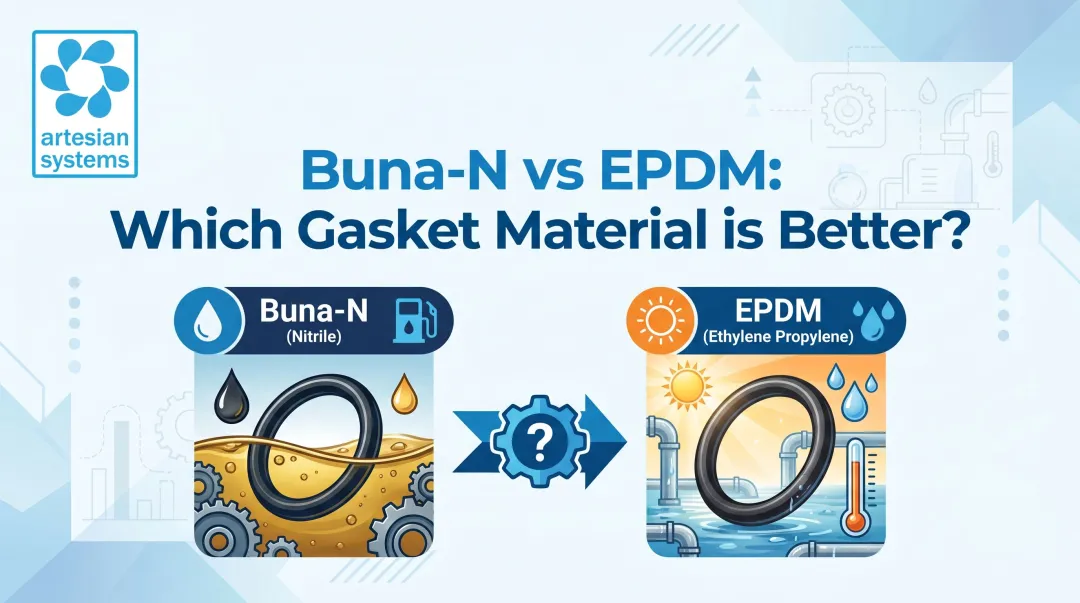
Buna handles fats and oils better; EPDM outperforms it with acidic and alkaline CIP chemicals, water-based media, steam, and hot caustic. Temperature ratings also differ: Buna tops out at +250°F while EPDM extends to +300°F. Select based on your process media and cleaning regime—if your lines run aggressive CIP or steam sanitization, EPDM is the stronger choice.